
TL;DR
The most effective way to reduce noise isn’t fancy foam — it’s distance. Placing your rig in a closet with proper ventilation, sealing cracks, and strategic absorption makes a huge difference. Treatment alone isn’t enough; placement and airflow matter most.
Imagine your perfect recording space. Small, quiet, and tucked away. Now, forget expensive gear or elaborate studios. The secret lies in where you put your rig—and how you treat that tiny space around it. You don’t need a dedicated room; a closet can be a hero.
This guide reveals how to dampen sound, position your equipment, and keep your closet setup cool and quiet. You might also find tips on acoustic treatment useful. Whether you’re a streamer, voiceover artist, or podcaster, the right choices turn a cramped closet into a powerhouse of clarity.
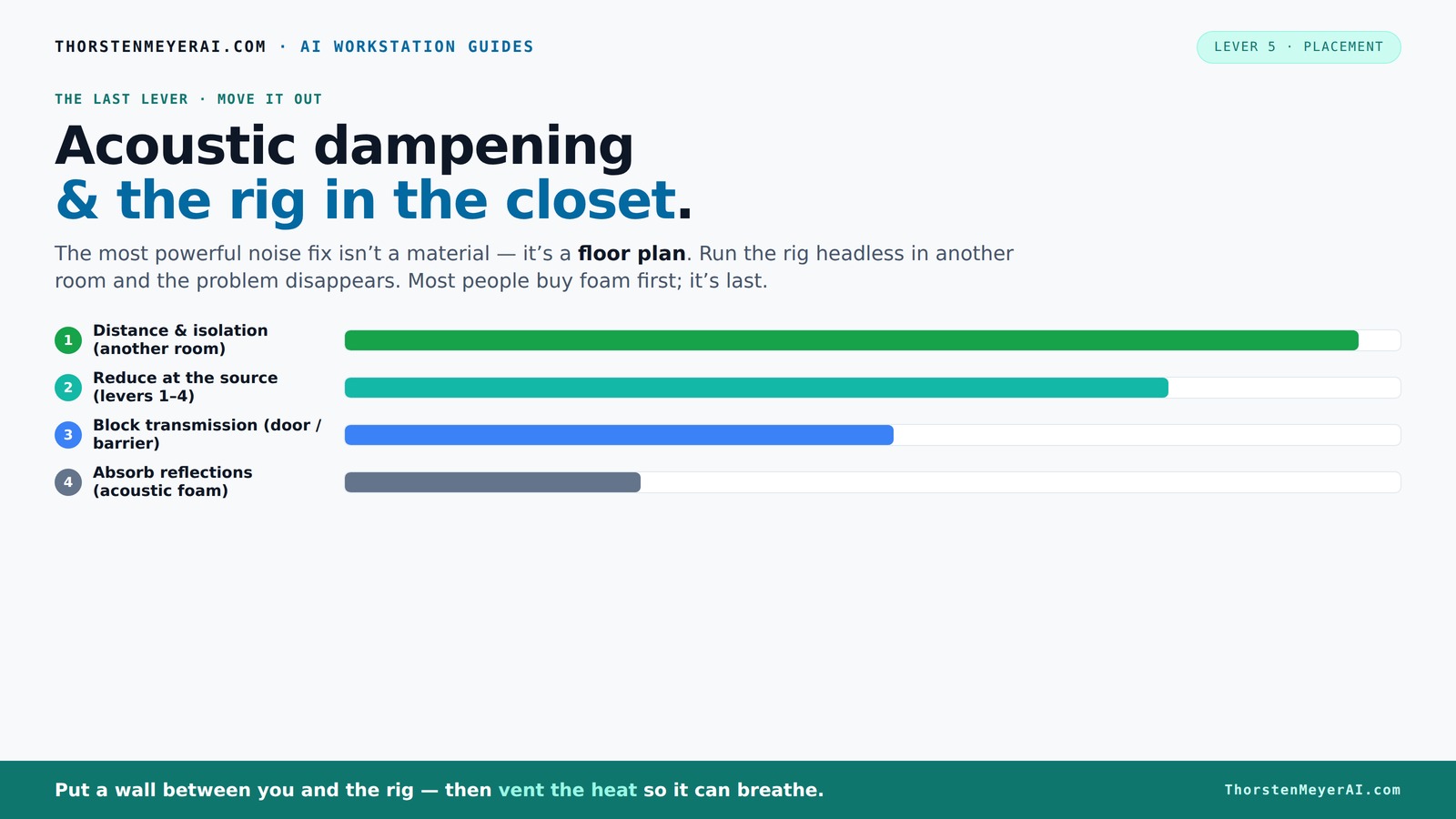
Acoustic dampening
& the rig in the closet.
The most powerful noise fix isn’t a material — it’s a floor plan. A rig you can’t hear because it’s in another room beats any amount of foam. Tap the approaches in Part 1 to see what actually works.
(another room)
(levers 1–4)
(door / barrier)
(acoustic foam)
Contain the noise, not the heat
Key Takeaways
- Moving your rig to a different room or closet is the most effective noise reduction technique.
- Proper ventilation is essential when placing high-power machines in enclosed spaces to prevent overheating.
- Treat reflection points, corners, and the door with absorptive materials and sealing to boost noise isolation.
- Bass traps in corners drastically improve low-frequency clarity in small rooms.
- DIY solutions with blankets and foam can be effective, cheap, and renter-friendly—just cover all major reflection and leak points.
soundproof closet panels for recording
As an affiliate, we earn on qualifying purchases.
As an affiliate, we earn on qualifying purchases.
Why Moving Your Rig Is the Top Noise Solution
The most effective method for reducing noise in your recording environment is to physically move the source away from your microphone and listening area. When equipment like GPUs, fans, or high-power computers operate farther from your recording space, their noise footprint diminishes significantly. This is because sound intensity diminishes with distance, following the inverse square law, which means that doubling the distance reduces the perceived noise level by about 75%. This reduction can often make additional soundproofing measures unnecessary.
For instance, relocating a noisy inference machine to a separate room or closet drastically reduces ambient sound. This approach not only minimizes the need for complex absorption or sealing but also simplifies your setup. The implication is that prioritizing the physical placement of equipment can save time, money, and effort compared to elaborate damping solutions. However, this tradeoff involves ensuring that the new location has adequate ventilation and connectivity, which are essential to maintain performance without overheating or connectivity issues.
In essence, understanding the acoustic impact of distance underscores the importance of strategic placement. It’s a fundamental principle that often yields the most noticeable improvements with minimal investment, emphasizing that sometimes, the best solution is simply moving your gear to a quieter, more isolated spot.
The ‘Rig in the Closet’ Setup: How to Keep It Cool Without Cooking
Placing a high-power, heat-generating machine in a closet might seem like a clever way to contain noise, but it introduces significant challenges related to heat management. Without proper airflow, the equipment can quickly overheat, leading to thermal throttling, reduced performance, and even hardware failure. Overheated components tend to increase fan speeds, which in turn produce more noise, defeating the purpose of quiet operation.
The key to a successful closet setup is effective ventilation and acoustic dampening. Passive vents can allow natural convection, but they often aren’t enough for high-performance machines. Incorporating active cooling solutions such as ducted exhaust fans or inline fans becomes essential. These devices actively move hot air out of the enclosure, maintaining safe operating temperatures while keeping noise levels low. For example, installing a thermostatically controlled inline fan connected to a duct that vents outside can ensure the system remains cool during intensive workloads without creating additional noise pollution inside the room.
Additionally, purpose-built soundproof cabinets with integrated active ventilation can provide an optimal balance between noise isolation and cooling. Materials like acoustic foam inside the enclosure absorb internal noise, while the ventilation system ensures heat dissipation. Evaluating options like these involves understanding the tradeoff: better insulation can trap heat if ventilation isn't adequate. Therefore, designing a closet or cabinet with both soundproofing and airflow considerations in mind is crucial for sustained performance and quiet operation.
How to Position Your Microphone & Gear for Best Sound
Proper microphone and gear placement is critical in small rooms because it directly influences the quality of your recordings through control of reflections and ambient noise. For more on optimizing your setup, see microphone placement tips. Positioning your microphone away from reflective surfaces like walls, windows, or metal furniture reduces early reflections that can cause comb filtering and muddiness in your recordings. Ideally, situate the microphone in the room's center or facing a treated, absorption-heavy wall to minimize unwanted reflections.
Strategic placement of absorptive materials is equally important. Placing acoustic panels or foam directly behind the microphone and at reflection points on the side walls can significantly reduce sound bouncing into the mic. Using a mirror trick—placing a mirror along the wall and adjusting it until you see the reflection of your microphone—helps identify reflective surfaces that should be treated. Covering these spots with foam or blankets enhances clarity and reduces echo.
The implications of proper placement are profound: it can improve vocal clarity, reduce editing time, and produce a more natural sound. Combining this with absorption behind the mic and at reflection points ensures a controlled acoustic environment, maximizing the quality of your recordings without the need for costly equipment upgrades.
Frequently Asked Questions
Can a closet really serve as a good vocal booth?
Yes. Closets are naturally good at reducing reflections and echoes because of their small size and soft materials. With proper treatment—sealing cracks, adding bass traps, and covering reflective surfaces—they can produce clean, focused vocals and voiceovers.How much treatment do I need for a closet studio?
Cover the main reflection points behind and around your mic, treat corners with bass traps, and cover the door with blankets or seal it. For detailed acoustic treatment advice, visit acoustic treatment guides. You don't need perfection—broad coverage of key reflection zones makes a big difference.Will foam alone keep sound from leaking out?
No. Foam mainly absorbs reflections within the space. To prevent sound leakage, you need to seal gaps and use dense barriers or mass-loaded vinyl on doors and walls. Foam alone won’t stop sound from escaping or entering.Should I treat the door or the walls first?
Start with the door, sealing cracks and adding heavy blankets or seals. You can learn more about effective soundproofing at soundproofing strategies. Next, focus on reflection points and corners. Prioritizing leaks and reflection zones gives you the biggest improvement for your effort.How thick should panels or blankets be?
Aim for at least 2-4 inches of dense material for bass traps and absorption panels. Thicker materials absorb lower frequencies better, which is crucial in small spaces to prevent muddiness.Conclusion
Sometimes, the smartest move isn’t more gear or expensive soundproofing. It’s simply putting your rig in a closet, sealing it tight, and treating the right spots. This approach makes a surprisingly quiet, focused space for high-quality recordings and streams.
Imagine a tiny corner of your home transformed into a professional-sounding booth—quiet, cool, and efficient. The secret is in the placement, ventilation, and a bit of strategic absorption. Your closet can be your best studio yet—if you treat it right.