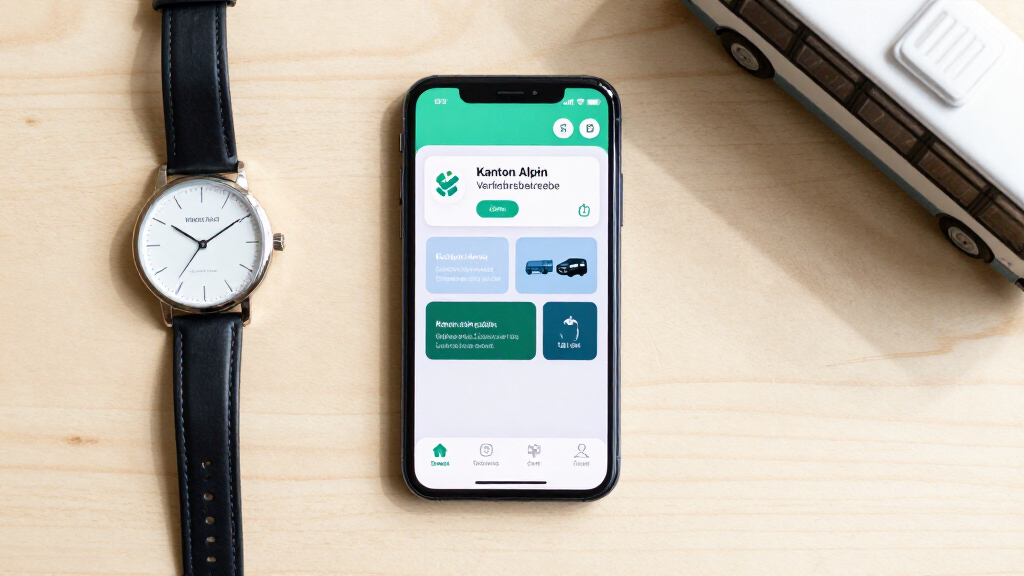

📊 Full opportunity report: Inside Room 23: The AI-Driven Creation Of 'Kanton Alpin Verkehrsbetriebe' on ThorstenMeyerAI.com — validation score, market gap, and execution plan.
TL;DR
Room 23 of 175 showcases an AI-driven digital replica of a Swiss alpine railway station, emphasizing Swiss International Style and real-time precision. This project highlights AI’s role in creating highly detailed, code-based virtual environments, as detailed in the original analysis.
AI has developed a meticulously crafted digital replica of a Swiss alpine railway station in Room 23 of FABLE/175, featuring real-time synchronization, code-driven visuals, and a strict Swiss International Style aesthetic. This project demonstrates AI’s capacity to produce highly precise, interactive virtual environments that adhere to rigorous design standards, making it a significant showcase of AI’s creative and technical potential.
The exhibit is a fully code-based, single-page website that replicates a Swiss transit station with exceptional precision. Learn more about the project in the original coverage. It features a real-time SVG Mondaine-style clock, a split-flap departure board, and a visual language rooted in monochrome colors—white, near-black, and signal red—emphasizing Swiss design principles. All elements, including pictograms, maps, and schematics, are generated via code, relying on CSS grid, SVG, and JavaScript without external assets or frameworks.
This project is part of a larger collection of 175 AI-crafted websites, each built end-to-end by artificial intelligence, with the aim of exploring the boundaries of AI-driven design and coding. The process involved multiple phases, including initial construction, rigorous critique, and final artistic refinement, guided by a strict design manual to ensure adherence to the Swiss style. For more on the design process, see this detailed report. The result is a highly disciplined, visually cohesive digital environment that embodies precision and clarity.
Inside Room 23: The AI-Driven Creation of Kanton Alpin Verkehrsbetriebe
A meticulously coded replica of a Swiss alpine railway station—combining real-time synchronization, transit-grade information design and the disciplined geometry of Swiss International Style.
A station built entirely from code
Room 23 is a single-page virtual environment, not a photographic mock-up. Every clock hand, departure row, pictogram, map and schematic is generated programmatically under a strict visual manual.
Mondaine-style clock
A live SVG timepiece synchronizes the station’s visual identity with the current moment, turning a familiar Swiss object into functional interface infrastructure.
Split-flap departures
A code-driven board recreates the rhythm and hierarchy of railway information: destination, platform, departure time and operational status.
Swiss precision
Grid alignment, typographic hierarchy, monochrome structure and signal accents produce clarity without decorative noise.
Generated pictograms
Transit symbols and directional cues are constructed as reusable code elements, maintaining consistent weight, scale and spacing.
Maps and schematics
SVG routes and modular diagrams give the fictional station a believable operational geography without relying on external artwork.
Framework-free build
CSS Grid, SVG and JavaScript form the entire environment, demonstrating how a restrained technical stack can support a rich experience.

Mondaine A997.MCAL.16SBB.1 Mini Wall Clock and Alarm Clock with Aluminium Case – Ticking Seconds Hand – Silver/Grey Glass Mineral Glass
- Dual Functionality: Table and wall clock use
- Elegant Design: Aluminium case with tone-on-tone hands
- Swiss Alps Inspiration: White dial with alpine aesthetic
As an affiliate, we earn on qualifying purchases.
As an affiliate, we earn on qualifying purchases.
From machine construction to art-directed refinement
The exhibit emerged through successive passes rather than a single prompt. Each phase narrowed the gap between functional simulation and coherent visual authorship.
Design manual
Rules establish grid, typography, timing, color discipline and transit behavior.
AI construction
The station, interfaces and visual systems are generated end-to-end in code.
Rigorous critique
Visual inconsistencies, timing errors and weak hierarchy are identified and revised.
Final refinement
Art direction resolves the experience into a disciplined, cohesive environment.
AI environment versus conventional web production
Room 23 compresses design, illustration, interaction and implementation into one code-centered workflow while retaining human judgment at the critique and direction layers.
| Production dimension | Room 23 approach | Traditional approach | Current implication |
|---|---|---|---|
| Visual assets | ✓ Generated in code | Often designed or sourced separately | Unified visual logic |
| Real-time behavior | ✓ Native to the exhibit | Added as a separate layer | Function shapes aesthetics |
| External frameworks | ✗ None required | Commonly used | Lower dependency surface |
| Creative authorship | ~ AI-led, human-directed | Human team-led | Roles become hybrid |
| Real-world validation | ✗ Not yet established | Can follow formal testing | Exhibition remains exploratory |
Design discipline profile
Qualitative reading of the project’s strongest demonstrated characteristics.
Where Room 23 sits
The work moves beyond static AI imagery toward functional simulation, while stopping short of validated infrastructure.
Why this transit replica matters
Room 23 shows that AI can coordinate complex visual systems, real-time behavior and exacting style constraints inside a single digital environment. Its broader promise lies in training simulations, virtual exhibitions, public-infrastructure visualization and planning tools—but those applications still require validation, deeper interaction and durable data integration.
Can the method scale?
Its adaptability to larger stations, complex networks and sustained real-time operations remains unproven.
Can it support planning?
Potentially—but a digital exhibition is not yet an engineering model. Real deployment would require domain validation and operational safeguards.
Does AI replace the designer?
No clear evidence suggests that. Room 23 instead demonstrates a hybrid model: AI constructs and iterates while human direction supplies judgment, context and standards.
From experimental room to possible public value
Why This AI Transit Replica Matters
This project highlights AI’s ability to produce complex, highly detailed virtual environments that are both visually precise and functionally accurate. It demonstrates the potential for AI to assist in design, architecture, and simulation, especially in contexts requiring strict adherence to style and timing. The use of AI in creating such environments could influence future digital representations of public infrastructure, training simulations, or virtual exhibitions, emphasizing AI’s role as a creative partner in technical design.
The Evolution of AI in Digital Design
This project is part of a broader movement where artificial intelligence is increasingly used to generate web environments, art, and functional interfaces. The FABLE/175 collection, curated by Thorsten Meyer, showcases 175 websites built entirely by AI, each adhering to specific artistic and technical standards. The development of Room 23 builds on recent advances in code generation, real-time synchronization, and automated design, reflecting ongoing trends in AI-assisted digital craftsmanship.
Historically, AI has been used for tasks like data analysis and content generation, but recent projects like this demonstrate its capacity to handle complex visual and interactive design tasks traditionally performed by human engineers and designers. This evolution raises questions about the future roles of AI and human creators in digital art and functional design.
“This project exemplifies how AI can produce highly disciplined, precise digital environments that adhere to rigorous design standards.”
— an anonymous researcher
Unanswered Questions About AI-Generated Transit Environments
It is not yet clear how scalable or adaptable this AI-driven design approach is for real-world applications beyond digital exhibitions. The long-term stability and potential for interactive complexity remain to be tested in different contexts or larger environments.Future Developments in AI-Driven Digital Transit Design
Further exploration is expected into how AI can assist in designing functional, scalable virtual environments for training, simulation, or even real-world infrastructure planning. Upcoming projects may test AI’s ability to generate dynamic, interactive transit environments with more complex behaviors and integration with real-time data feeds. The ongoing collection of 175 projects will continue to serve as a benchmark for AI’s evolving role in digital craftsmanship.
Key Questions
How does the AI create such precise and functional visuals?
The AI generates all elements through code, using CSS, SVG, and JavaScript, following strict design principles and manual critique to ensure accuracy and consistency.
Can this AI-generated station be used in real-world transit planning?
Currently, this project is a digital exhibition; its primary purpose is to explore AI’s creative and technical capabilities. Real-world application would require additional development and validation.
What makes this project different from traditional web design?
It is entirely generated and refined by AI, following a strict manual critique process, with all visual and functional components built through code without external assets or frameworks.
Will AI replace human designers in such projects?
While AI can assist in creating detailed environments, human oversight remains essential for artistic direction, critique, and contextual judgment, at least for now.
Source: ThorstenMeyerAI.com