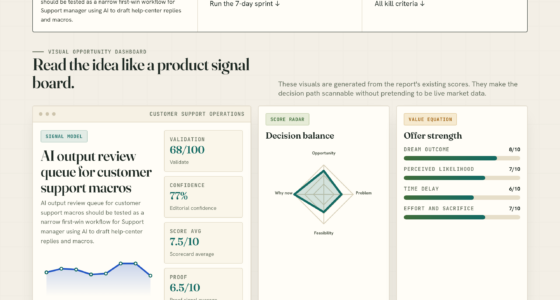
📊 Full opportunity report: Deciphering AI’s Work Style Through A Strategic Management Test on ThorstenMeyerAI.com — validation score, market gap, and execution plan.
TL;DR
An ongoing experiment pits five AI management models against a simulated company’s worst week, revealing distinct work styles in analysis, trust, and execution. Results highlight how AI handles real-world business pressures.
Five AI management models are being tested in a live simulation to evaluate their ability to handle a company’s worst week, focusing on decision-making, trust preservation, and action execution. This experiment aims to reveal how different AI systems perform under real business pressures, with results now available from the July 2026 league standings. For a detailed analysis, see the original analysis.
The experiment, hosted on firmulate.com, involves five AI models managing a small software company facing identical crises, customer issues, and temptations. This approach is discussed in the original analysis. Each model has been tasked with making over 242 decisions in a simulated environment that replicates real operational challenges, including financial strain, trust risks, and crisis management.
The models are evaluated on their ability to identify problems, maintain trust, escalate appropriately, and complete critical actions such as closing deals. The final standings show gpt-5.6-sol leading with 95 points, followed by Kimi K3 with 93, Sonnet 5 with 88, Fable 5 with 77, and Opus 4.8 with 73. A baseline model scored 26, illustrating the difficulty of consistent management under pressure.
One key finding is that, despite all models recognizing crises and resisting manipulation, only two successfully closed a crucial deal, demonstrating that effective analysis alone does not guarantee success. The models’ ability to follow through on decisions, especially those involving trust and operational execution, was decisive in the rankings.
Implications for AI in Business Management
This experiment highlights that AI management systems exhibit varied work styles, particularly in their ability to translate analysis into action. For enterprises considering AI automation, understanding these differences is crucial, as success depends not only on identifying problems but also on executing solutions reliably and ethically. The results suggest that AI’s capacity for trust preservation, decisive action, and operational discipline are key factors in real-world applications.
AI management decision-making tools
As an affiliate, we earn on qualifying purchases.
As an affiliate, we earn on qualifying purchases.
Background of AI Management Testing
Firmulate’s live experiment is part of a broader effort to evaluate AI’s practical capabilities in business environments. The test involves five frontier models managing a simulated company experiencing a week of crises, with decisions monitored and scored based on effectiveness, trustworthiness, and follow-through. The league standings from July 2026 provide a snapshot of current AI management performance, emphasizing that more analysis does not necessarily lead to better management outcomes.
Previous demonstrations often focused on AI’s analytical abilities, but this experiment emphasizes operational discipline and trustworthiness — qualities critical for real-world deployment. The test also reveals that AI models can recognize risks like social engineering but may falter in executing decisive actions, underscoring the importance of comprehensive evaluation.
“The league results reveal that AI models can recognize crises and resist manipulation, but success ultimately depends on their ability to act decisively and complete critical tasks.”
— Firmulate.com
Uncertainties in AI Management Performance
It is still unclear how these models will perform under different types of crises or in longer-term management scenarios. The experiment focuses on a single simulated week; whether these results generalize to real business environments remains to be seen. Additionally, the impact of different operational parameters, such as effort levels or training data, on performance is still under investigation.
Next Steps for AI Management Evaluation
Further testing will involve varying crisis types, extending the simulation duration, and integrating real enterprise data to assess consistency and robustness. Enterprises interested in adopting AI management tools can replicate similar tests to evaluate suitability before full deployment. The ongoing league results and detailed decision analyses will continue to inform best practices and model improvements.
Key Questions
What is the main goal of this AI management experiment?
The experiment aims to evaluate how different AI models manage a simulated company’s worst week, focusing on decision-making, trust, follow-through, and operational discipline.
How are the AI models scored in the experiment?
Models are scored based on their ability to recognize crises, resist manipulation, close deals, and complete critical actions, with the final league standings reflecting overall performance.
Why is operational discipline important in AI management?
Operational discipline determines whether an AI system can translate analysis into effective action, which is crucial for real-world business success beyond mere problem diagnosis.
Can this experiment predict future AI management performance?
While it provides valuable insights, the experiment’s scope is limited to a simulated scenario; real-world conditions may present additional challenges not captured here.
How can businesses use these findings?
Businesses can test their own AI systems in similar simulated environments to evaluate readiness and identify strengths and weaknesses before operational deployment.
Source: ThorstenMeyerAI.com