
📊 Full opportunity report: Radar That Never Blinks: What SAR Actually Does — for Companies, Institutions, and Governments on ThorstenMeyerAI.com — validation score, market gap, and execution plan.

Get business pricing on office and shipping supplies
- Business-only prices and quantity discounts
- Tax-exempt purchasing
- Multiple users, one account, clear invoices
TL;DR
Synthetic Aperture Radar (SAR) is a satellite imaging technology that uses microwave pulses to capture images regardless of weather or light conditions. Its expanding commercial and governmental use is transforming Earth observation, especially in disaster response, infrastructure monitoring, and security.
Commercial SAR satellite constellations have rapidly expanded in 2026, offering persistent, all-weather Earth imaging that surpasses optical systems. These systems are now used by companies, governments, and institutions for applications ranging from disaster response to infrastructure monitoring, marking a significant shift in Earth observation capabilities.
Unlike optical satellites, SAR (Synthetic Aperture Radar) satellites transmit microwave pulses toward the ground and record the reflected signals, enabling imaging in any weather, day or night. This active sensing technology, which synthesizes a large antenna from the satellite’s movement, can resolve objects as small as 16 centimeters and detect ground deformation with millimeter precision through a technique called InSAR.
Over the past decade, the number of commercial SAR satellites has surged, with companies like ICEYE, Umbra, Capella Space, and others deploying constellations that revisit the same location multiple times per hour. European nations are also investing in national SAR constellations, emphasizing sovereignty and strategic independence in Earth monitoring.
For enterprises, SAR provides critical data for insurance, infrastructure, and maritime industries, offering early warnings and real-time insights that were previously impossible. For institutions, SAR is vital for disaster response, environmental research, and civil safety, as it can operate independently of weather and daylight constraints.
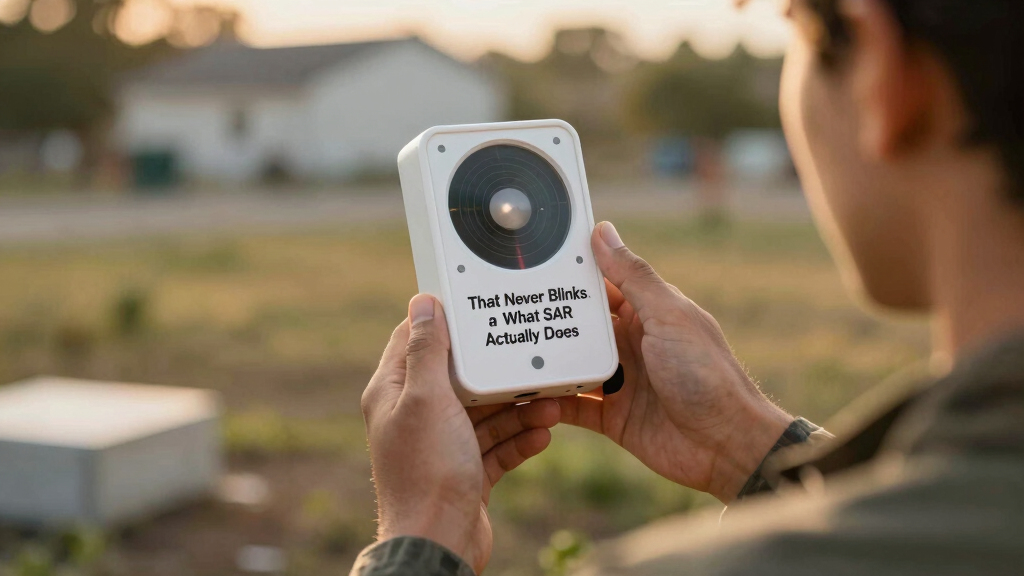
Radar That Never Blinks
What SAR Does — for Companies, Institutions, Governments
Active microwave imaging: its own illumination, any weather, any hour. The sensor is solved — the reading of it isn’t.
Three consequences of the physics
Active sensor: transmits its own microwave pulses. Same image quality at 3 a.m. in a North Sea storm as at noon in the Sahara.
Phase-coherent imaging enables InSAR: ground deformation at millimeter scale — subsiding dams, sagging bridges, hidden excavation.
Metal reflects radar strongly. A ship that switches off its transponder vanishes from tracking sites — not from a radar image.
Who buys it, and why — three different answers
- Insurance: flood-extent maps within hours, through the storm — parametric payouts before adjusters arrive
- Infrastructure & energy: InSAR subsidence alerts on pipelines, rail, dams — no ground sensors
- Maritime & commodities: dark-vessel detection, port congestion, storage monitoring
- Caveat: buy analytics, not raw phase histories — the value is in the interpretation layer
- Disaster response: damage proxies and flood maps while optical is blind
- Climate science: ice velocity, deforestation under perpetual cloud (Sentinel-1, free & open)
- OSINT & journalism: verifiable all-weather evidence — normalized by Ukraine, institutionalized since
- Caveat: radar literacy is scarce — misread speckle becomes a confident, wrong “convoy”
- Deterrence: continuous all-weather watch closes the cloud-cover exploit window
- Verification: arms-control and sanctions evidence that doesn’t blink
- Autonomy: a subscription can be throttled by a foreign provider; a nationally-tasked constellation can’t
- Caveat: collection has outrun exploitation — the analyst corps can’t screen sub-hourly revisit manually
Europe is buying constellations, not just imagery
THE EXPLOITATION GAP
The scarce resource is no longer the satellite — it’s the software that turns phase histories into detections and decisions, in the jurisdiction the mission requires. Whoever owns the software that reads the radar owns the value of the constellation above it. Buying satellites while importing the exploitation stack just moves the dependency one layer up.
Impacts of Commercial SAR Expansion on Global Earth Monitoring
The proliferation of commercial SAR satellites is transforming how industries and governments monitor the Earth. This technology enables timely, reliable data that can improve disaster response, infrastructure safety, and strategic sovereignty. As constellations grow, the ability to detect subtle ground movements and track vessels or structures in all weather conditions becomes a new standard, with broad implications for security, economic stability, and environmental management.
Synthetic Aperture Radar (SAR) satellite imagery
As an affiliate, we earn on qualifying purchases.
As an affiliate, we earn on qualifying purchases.
Rapid Growth of Commercial SAR Constellations in 2026
Historically, spaceborne radar technology was limited to national military and research programs. Today, the commercial sector dominates, with ICEYE operating over two dozen satellites and targeting revenue above €1 billion in 2026. Other players like Umbra, Capella Space, and international firms are expanding their constellations, driven by demand from European and global clients. European nations are also deploying their own SAR constellations, signaling a shift toward strategic independence in Earth observation capabilities.
This growth reflects a broader trend: SAR is no longer an exotic military tool but a vital commercial resource, with a market projected to reach $18.8 billion by 2034. The technology’s ability to provide persistent, high-resolution data regardless of weather or light is fueling its adoption across multiple sectors.
“Our constellation provides near real-time imaging that is critical for disaster response and infrastructure monitoring.”
— ICEYE spokesperson
Unresolved Challenges and Limitations of Commercial SAR
While the growth of SAR constellations is rapid, challenges remain in data processing, interpretation, and integration into decision-making workflows. Raw SAR imagery is complex and requires specialized expertise and processing tools, which can limit immediate usability for some users. Additionally, issues regarding data privacy, sovereignty, and cost are still evolving as markets mature.
It is not yet clear how widespread adoption will be across different sectors, or how regulatory and technical standards will develop to manage the expanding constellation networks.
Future Developments in Commercial SAR Technology and Market Adoption
Expect continued expansion of SAR satellite constellations, with more countries and private companies deploying large-scale networks. Advances in data processing, machine learning, and analytics will make SAR data more accessible and actionable for non-expert users. Regulatory frameworks and standardization efforts are likely to evolve to facilitate broader, responsible use of SAR imagery globally.
Additionally, new applications in climate monitoring, urban planning, and security are anticipated as the technology matures and becomes more integrated into routine operations.
Key Questions
How does SAR imaging work differently from optical satellites?
SAR uses microwave pulses to actively illuminate the ground and record reflected signals, allowing imaging in any weather or lighting conditions. Optical satellites depend on sunlight and clear skies, limiting their usefulness during storms or at night.
Who are the main commercial players in SAR satellite deployment?
ICEYE, Umbra, Capella Space, and other companies are leading the market with large constellations. European firms and national agencies are also deploying their own SAR systems for strategic and operational purposes.
What are the main applications of commercial SAR data?
Applications include disaster response, infrastructure monitoring, maritime surveillance, agriculture, and environmental research. The technology provides timely, all-weather insights critical for decision-making.
What challenges does SAR technology face moving forward?
Challenges include data processing complexity, interpretation difficulties, regulatory issues, and costs. Making SAR data more user-friendly and integrating it into operational workflows remain ongoing efforts.
Source: ThorstenMeyerAI.com
Evergreen bestsellers Picks
bestsellers
As an affiliate, we earn on qualifying purchases.