For an LED light mask for acne, my best overall pick is the Aphrona FDA Cleared Moonlight, which pairs blue and red light with a stated 450 LED chips. The Shark CryoGlow stands out for shoppers who also want under-eye cooling, while the blue-light-focused FDA-cleared mask is a more targeted option for acne care. The main tradeoffs are treatment focus, fit and comfort, mode complexity, and how much evidence the product provides about its light specifications. More LEDs or extra colors do not automatically make a mask a better acne choice. Read on for my full breakdown of all 14 options and a guide to choosing one that fits your skin concerns and routine.

Get business pricing on office and shipping supplies
- Business-only prices and quantity discounts
- Tax-exempt purchasing
- Multiple users, one account, clear invoices
Key Takeaways
- Aphrona leads this lineup for acne-focused versatility: its stated 450 LED chips and red-and-blue-light combination give it a clearer acne-care rationale than masks described mainly for general skin rejuvenation.
- Acne-specific light information matters more than a long color list: the blue-light-focused FDA-cleared option is easier to match to an acne-first goal than seven-color masks with less specific treatment detail in their product names.
- Multi-mode devices suit mixed concerns, not every acne buyer: INIA’s four-mode options and the 13th mask’s nine modes offer more choice, but extra settings can add complexity without making acne treatment more straightforward.
- Comfort features can change whether a mask fits daily life: Shark’s under-eye cooling is a distinctive add-on, while cordless and rechargeable designs among the lineup favor easier movement during a session.
- Product claims are unevenly specific: some listings state LED counts, wavelengths, or FDA clearance, while others provide little detail in their names; compare documentation and instructions instead of treating a higher chip count as proof of better results.
| Aphrona FDA Cleared Moonlight LED Facial Mask for Skin Care, Red and Blue Light Therapy, 450 LED Chips |  | Best Acne-Focused Pick | LED chips: 450 | Red wavelength: 630 nm ±5 nm | Blue wavelength: 415 nm ±5 nm | VIEW ON AMAZON | See Our Full Breakdown |
| Shark CryoGlow LED Face Mask with Red Light Therapy and Under‑Eye Cooling (FW312) |  | Best for Preset Acne Treatment | LED colors: Red, blue, deep infrared | Skin-clearing program: 8 minutes | Other treatment modes: Better Aging (6 minutes); Skin Sustain (4 minutes); Under-Eye Revive (5–15 minutes) | VIEW ON AMAZON | See Our Full Breakdown |
| INIA Red Light Therapy Face Mask with 4 Light Modes |  | Best for Mode Flexibility | LED chips: 220 | Light modes: Red-L, Red-H, blue, red plus blue | Wavelengths: 620 nm, 630 nm, 460–470 nm, 460–630 nm; optional 850 nm near-infrared | VIEW ON AMAZON | See Our Full Breakdown |
| Red Light Therapy Mask for Face, Treats Wrinkles & Acne, Redness |  | Best Lightweight Cordless Option | Wavelengths: Blue 460 nm; yellow 590 nm; red 660 nm; infrared 850 nm | LED beams: 336 | Battery capacity: 2000 mAh | VIEW ON AMAZON | See Our Full Breakdown |
| INIA Red Light Therapy Face Mask with Near-Infrared and 4 Light Modes | 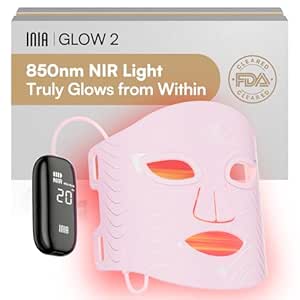 | Best for Rechargeable Routine Control | LED chips: 220 | Light modes: Red-L, Red-H, blue, red plus blue | Wavelengths: 620 nm, 630 nm, 460–470 nm, 460–630 nm; near-infrared 850 nm | VIEW ON AMAZON | See Our Full Breakdown |
| Red Light Therapy for Face, FDA-Cleared Blue Light Mask for Acne |  | Best for Consistent Acne-Focused Sessions | LED count: 432 LEDs | Wavelengths: 630 nm red, 415 nm blue, 850 nm near-infrared | Power density: Up to 105 mW/cm² | VIEW ON AMAZON | See Our Full Breakdown |
| LanAqua Red Light Therapy Face Mask with 7 Colors and Rechargeable Battery |  | Best for Flexible, Cordless Routines | Wavelength range: 415–850 nm | LED chips: 222 | Battery capacity: 6000 mAh | VIEW ON AMAZON | See Our Full Breakdown |
| Red Light Therapy Mask, FDA-Cleared, Dual NIR, Skin Rejuvenation for Women |  | Best for Face-and-Jawline Coverage | Wavelengths: 630 nm, 415 nm, 830 nm, 850 nm | LED count: 432 | Battery capacity: 5000 mAh | VIEW ON AMAZON | See Our Full Breakdown |
| iRestore LED Face Mask for Youthful Skin, Red Light Therapy for Face, Red, Blue & Infrared Therapy with 360 LEDs |  | Best for a Simple 10-Minute Routine | LED count: 360 | Wavelengths: 635 nm red, 830 nm infrared, 415 nm blue | Session duration: 10 minutes | VIEW ON AMAZON | See Our Full Breakdown |
| Red Light Therapy Mask for Face Acne Wrinkles, 400 LEDs |  | Best for Cordless Mode and Timer Control | Wavelength modes: 460 nm, 590 nm, 660 nm, 850 nm | LED beads: 400 | Intensity levels: 3 | VIEW ON AMAZON | See Our Full Breakdown |
| Red Light Therapy Mask for Face |  | Best for a Simple, Cordless Routine | Light type: Red LED | Session duration: 15 minutes | Recommended frequency: 3–5 times weekly | VIEW ON AMAZON | See Our Full Breakdown |
| 7-Color LED Light Therapy Mask for Face, Soft Silicone, Rechargeable |  | Best for Adjustable Sessions | Light colors: 7 | Specified wavelengths: 630 nm and 850 nm | LED count: Not specified | VIEW ON AMAZON | See Our Full Breakdown |
| Red Light Therapy Face Mask with 280 LEDs, 850nm NIR / 630nm Red / 465nm Blue, 9 Modes, Cordless, Portable for Skin Rejuvenation and Acne |  | Best for Blue-Light Acne Focus | Wavelengths: 850 nm NIR, 630 nm red, 465 nm blue | LED count: 280 | Modes: 9 | VIEW ON AMAZON | See Our Full Breakdown |
| FDA Cleared Red Light Therapy for Face and Neck, 4 Modes LED Mask Light Therapy for Wrinkles and Acne |  | Best for Face-and-Neck Coverage Options | Light modes: 4 | Power levels: 3 | Timer options: 4 | VIEW ON AMAZON | See Our Full Breakdown |
| led light mask for acne | Wavelengths |
|---|---|
| Aphrona FDA Cleared Moonlight | — |
| Shark CryoGlow LED Face Mask w | — |
| INIA Red Light Therapy Face Ma | 620 nm, 630 nm, 460–470 nm, 460–630 nm; optional 850 nm near-infrared |
| Red Light Therapy Mask for Fac | Blue 460 nm; yellow 590 nm; red 660 nm; infrared 850 nm |
| INIA Red Light Therapy Face Ma | 620 nm, 630 nm, 460–470 nm, 460–630 nm; near-infrared 850 nm |
| Red Light Therapy for Face | 630 nm red, 415 nm blue, 850 nm near-infrared |
| LanAqua Red Light Therapy Face | — |
| Red Light Therapy Mask | 630 nm, 415 nm, 830 nm, 850 nm |
| iRestore LED Face Mask for You | 635 nm red, 830 nm infrared, 415 nm blue |
| Red Light Therapy Mask for Fac | — |
| Red Light Therapy Mask for Fac | — |
| 7-Color LED Light Therapy Mask | — |
| Red Light Therapy Face Mask wi | 850 nm NIR, 630 nm red, 465 nm blue |
| FDA Cleared Red Light Therapy | — |
More Details on Our Top Picks
Aphrona FDA Cleared Moonlight LED Facial Mask for Skin Care, Red and Blue Light Therapy, 450 LED Chips
For a buyer prioritizing acne-targeted light therapy over extra modes, the Aphrona Moonlight is a focused choice: its 415 nm blue light is paired with 630 nm red light, and its 450 LED chips give it the highest stated chip count among these five options. FDA 510(k) clearance is a useful distinction from the INIA masks, whose supplied details do not state clearance. Its adjustable 5-to-50-minute sessions allow more control over routine length, but the broad timer range also means you need to follow the product’s directions rather than assume longer sessions are better. Unlike Shark CryoGlow, Aphrona has no cooling feature or multiple named programs. I’d choose it for a straightforward red-and-blue setup, while buyers seeking cordless use or a built-in acne program should compare Shark or INIA instead.
Pros:- Pairs 415 nm blue light with 630 nm red light for an acne-focused red-and-blue configuration.
- 450 LED chips, the largest stated chip count among these five products.
- FDA 510(k) cleared, according to the supplied product details.
- Treatment duration can be set from 5 to 50 minutes.
Cons:- Requires consistent use, so it may not suit buyers unwilling to maintain a routine.
- Electric power is less convenient for travel or use away from an outlet than the rechargeable Shark and INIA options.
- The supplied description cautions that it may not suit severe skin conditions.
Best for: Buyers who want a specifically red-and-blue acne-oriented mask, FDA 510(k) clearance, and flexible session timing.
Not ideal for: People who want a cordless mask, a short preset acne program, or a cooling feature; the supplied details list electric power and no cooling system.
- LED chips:450
- Red wavelength:630 nm ±5 nm
- Blue wavelength:415 nm ±5 nm
- Energy output:30–80 mW/cm²
- Treatment duration:5–50 minutes
- FDA status:FDA 510(k) cleared
- Power source:Electric
- Distribution:USA
Our verdict“Choose Aphrona if you want a cleared, red-and-blue mask with flexible timing and do not need cordless convenience or built-in cooling.”
Shark CryoGlow LED Face Mask with Red Light Therapy and Under‑Eye Cooling (FW312)
Shark CryoGlow is the most program-led option here for someone who wants acne care folded into a broader routine. Its 8-minute Skin Clearing program gives a defined session, while red and deep infrared modes, other presets, and three cooling levels extend its use beyond acne. Compared with the more focused Aphrona Moonlight, Shark adds under-eye cooling and a rechargeable USB-C design, but also brings extra hardware that makes it bulkier and less travel-friendly. The included remote and clip-on chill pads support a more guided setup; the tradeoff is that buyers seeking only blue-light acne treatment may be paying in complexity for features they will rarely use. The supplied details say it is FDA-cleared and clinically tested, but do not list wavelength values or LED count.
Pros:- Dedicated 8-minute Skin Clearing program makes session planning straightforward.
- Combines blue, red, and deep infrared light with adjustable under-eye cooling.
- USB-C rechargeable design avoids dependence on a wall outlet during sessions.
- Includes a remote and clip-on chill pads, plus four named treatment programs.
Cons:- Cooling components add bulk compared with the simpler Aphrona Moonlight and INIA masks.
- The supplied product data does not provide wavelength values or LED count for a more technical comparison.
- Its additional aging and under-eye features may be unnecessary for buyers focused solely on acne.
Best for: Buyers who want a timed acne program alongside red-light routines and adjustable under-eye cooling in a rechargeable device.
Not ideal for: Minimalists or frequent travelers who want a lightweight, acne-only mask; its cooling hardware adds bulk, and the listed programs cover several concerns.
- LED colors:Red, blue, deep infrared
- Skin-clearing program:8 minutes
- Other treatment modes:Better Aging (6 minutes); Skin Sustain (4 minutes); Under-Eye Revive (5–15 minutes)
- Cooling technology:InstaChill Cold with 3 chill levels
- Power source:USB-C rechargeable
- FDA status:FDA-cleared
- Included items:LED mask, clip-on chill pads, remote, USB-C charging cable
Our verdict“Pick Shark CryoGlow if you want a short, named acne program and cooling in one device, and can accept a bulkier design.”
INIA Red Light Therapy Face Mask with 4 Light Modes
The INIA four-mode mask stands out for giving buyers distinct red, blue, and combined settings rather than just one acne-oriented light configuration. Its 460–470 nm blue mode is listed alongside two red settings and optional 850 nm near-infrared, so it suits someone who wants to switch routines for different skin goals. Compared with the Aphrona Moonlight, it offers rechargeable operation and automatic shutoff, but Aphrona lists a 415 nm blue wavelength and FDA 510(k) clearance, neither of which appears in INIA’s supplied details. The 220-chip count and stated output of up to 105 mW/cm² add useful technical context, though they do not by themselves establish acne results. Sessions run 10 to 30 minutes, and the described routine calls for regular use, so this is better for a committed home routine than quick, occasional treatments.
Pros:- Four modes include blue and red-plus-blue options for acne-oriented use.
- Optional 850 nm near-infrared and two red wavelengths offer more mode choice than Aphrona Moonlight.
- Rechargeable 2600 mAh controller supports at-home cordless sessions.
- Automatic shutoff and 10-, 20-, or 30-minute timer settings make session timing simple.
Cons:- Sessions start at 10 minutes, longer than the shortest setting listed for Aphrona Moonlight.
- The supplied description recommends use 3 to 7 times per week, which demands routine consistency.
- FDA clearance is not specified in the supplied product data.
Best for: Routine-focused buyers who want several red and blue settings, optional near-infrared, and rechargeable operation with timed sessions.
Not ideal for: Shoppers who prioritize stated FDA clearance or a shorter session; Aphrona lists clearance and allows sessions from 5 minutes.
- LED chips:220
- Light modes:Red-L, Red-H, blue, red plus blue
- Wavelengths:620 nm, 630 nm, 460–470 nm, 460–630 nm; optional 850 nm near-infrared
- Energy output:Up to 105 mW/cm²
- Controller battery:2600 mAh
- Timer settings:10, 20, or 30 minutes
- Automatic shutoff:Yes
Our verdict“Choose this INIA mask if you value several light modes and rechargeable timing controls more than stated FDA clearance or shorter sessions.”
Red Light Therapy Mask for Face, Treats Wrinkles & Acne, Redness
This mask makes the most sense for buyers who want an uncomplicated cordless format they can use at home or pack for travel. Its 168 g weight, silicone material, adjustable straps, and claimed 120 minutes of usage time distinguish it from Shark CryoGlow, whose cooling pads add bulk. Four listed wavelengths include 460 nm blue light, which makes this a plausible acne-oriented choice, while red, infrared, and yellow modes broaden its stated skin-care uses. Compared with the INIA masks, it provides a lighter stated weight and more color options, but the product data gives no session timer or output figure to help buyers compare treatment dose. The supplied description also says visible results may take over four weeks and recommends use three to five times weekly. I’d favor it for portability, not for the clearest treatment schedule.
Pros:- Lightweight 168 g design and cordless use suit travel and flexible home routines.
- 460 nm blue light is listed alongside red, infrared, and yellow wavelengths.
- Adjustable straps and food-grade silicone support a customizable fit.
- Stated usage time is up to 120 minutes.
Cons:- The supplied data does not list a timer or preset acne session.
- No energy output figure is provided, making technical comparison with the INIA masks harder.
- The described routine calls for use three to five times weekly, with results potentially taking over four weeks.
Best for: Travel-minded buyers seeking a lightweight, cordless mask with blue light plus additional listed wavelengths and adjustable straps.
Not ideal for: Buyers who need a clearly specified acne program, timer, or energy output; those details are not provided here.
- Wavelengths:Blue 460 nm; yellow 590 nm; red 660 nm; infrared 850 nm
- LED beams:336
- Battery capacity:2000 mAh
- Stated usage time:120 minutes
- Weight:168 g (5.9 oz)
- Material:Food-grade silicone
- FDA status:FDA 510(k) cleared, according to supplied product data
Our verdict“Choose this mask if low weight and cordless portability matter most, but look elsewhere for a clearly defined acne routine and output specifications.”
INIA Red Light Therapy Face Mask with Near-Infrared and 4 Light Modes
This INIA listing shares the same core numbers as the other INIA mask in this group: 220 LEDs, four modes, optional 850 nm near-infrared, and a 2600 mAh rechargeable controller. For acne-minded buyers, its blue and red-plus-blue settings provide the relevant mode choices, while selectable session lengths and automatic shutoff reduce the need to monitor the clock. Compared with Shark CryoGlow, it skips cooling and named treatment programs in favor of a simpler, cordless routine; compared with the INIA B0F18BBHCC listing, the supplied specifications are effectively the same. Its main distinction here is a stated lack of dimensions or fit-adjustment details, so buyers who need a tailored fit may prefer a product with more information. The recommended frequency of three to seven sessions weekly also favors people willing to stick with a regular schedule.
Pros:- Blue and red-plus-blue modes provide options relevant to an acne-focused routine.
- Optional 850 nm near-infrared adds another mode beyond the acne-oriented settings.
- 2600 mAh rechargeable controller supports cordless sessions.
- Automatic shutoff and three timer choices simplify routine timing.
Cons:- The described routine requires repeated use, three to seven times weekly.
- Mask dimensions and fit adjustments are not specified in the supplied data.
- The supplied product details do not state FDA clearance or a preset acne program.
Best for: Buyers who want rechargeable operation, blue or combined-light settings, and automatic timing, and are comfortable with a frequent routine.
Not ideal for: People who need published fit dimensions, adjustable-fit details, or stated FDA clearance; the supplied information does not include them.
- LED chips:220
- Light modes:Red-L, Red-H, blue, red plus blue
- Wavelengths:620 nm, 630 nm, 460–470 nm, 460–630 nm; near-infrared 850 nm
- Energy output:Up to 105 mW/cm²
- Controller battery:2600 mAh rechargeable
- Timer settings:10, 20, or 30 minutes
- Automatic shutoff:Yes
Our verdict“Choose this INIA listing for rechargeable, timed red-and-blue sessions, but skip it if fit details or stated clearance are deciding factors.”
Red Light Therapy for Face, FDA-Cleared Blue Light Mask for Acne
For acne buyers who want blue light paired with red and near-infrared, the MICEYLIVE mask offers a clearly specified trio: 415 nm, 630 nm, and 850 nm. Its corded power avoids battery-life limits during a 10-minute session, while the flexible silicone design is described as covering up to 99% of the face. Compared with the rechargeable LanAqua mask, this is the more coverage-focused option, but it gives up cordless convenience and LanAqua’s selection of seven modes. The 3–5-times-weekly schedule also calls for a regular routine rather than occasional use. Its 432 LEDs and included eye pads add practical appeal, though LED count alone does not establish acne results. I’d pick it for a stable, at-home routine, not for treatment sessions on the go.
Pros:- Specifies 415 nm blue light alongside red and near-infrared wavelengths
- Flexible silicone design is described as providing up to 99% facial fit
- Corded operation avoids dependence on a rechargeable battery during sessions
- Includes protective eye pads and a travel storage bag
Cons:- Cord limits where treatment can take place
- The listed routine of 3–5 sessions weekly may be demanding for occasional users
Best for: People seeking a full-face mask with a stated acne-relevant blue wavelength and who can use it near a power outlet several times a week
Not ideal for: Frequent travelers or anyone who wants to move around during treatment, since the mask is corded
- LED count:432 LEDs
- Wavelengths:630 nm red, 415 nm blue, 850 nm near-infrared
- Power density:Up to 105 mW/cm²
- Fit coverage:Flexible 180° full-face design; up to 99% facial fit
- Power source:Corded
- Session time:10 minutes
- Recommended frequency:3–5 times per week
- Warranty:18 months
- Included items:Protective eye pads and travel storage bag
Our verdict“Choose MICEYLIVE if you want broad facial coverage and a corded, three-wavelength routine centered partly on blue light for acne.”
LanAqua Red Light Therapy Face Mask with 7 Colors and Rechargeable Battery
The LanAqua is the lineup’s flexible-use pick: its rechargeable 6000mAh power bank and 160 g weight make it easier to fit a session around a busy day than the corded MICEYLIVE mask. For acne-focused use, its stated wavelength range begins at 415 nm, but the product data does not map each of its seven colors to a specific wavelength or explain which mode is intended for acne. That makes it less straightforward to choose for a targeted blue-light routine than MICEYLIVE, which lists 415 nm directly. Five light levels and three timer settings offer more adjustment, though more modes do not by themselves mean better acne care. I’d favor LanAqua for convenience and experimentation, while buyers seeking clearly specified treatment wavelengths may prefer a simpler option.
Pros:- Rechargeable 6000mAh power bank supports cordless use
- Lightweight design at 160 g
- Seven light modes and five intensity levels allow routine adjustment
- Timer choices include 10, 15, and 20 minutes
Cons:- Product data does not identify the wavelength for each individual color mode
- Removable eye pads may need frequent cleaning
- The listed benefits depend on regular use, without a stated acne-specific schedule
Best for: People who want a lightweight, rechargeable mask with adjustable sessions and are comfortable choosing among several light modes
Not ideal for: Buyers who want clearly stated wavelengths for each acne-focused mode or a more directly specified treatment setup
- Wavelength range:415–850 nm
- LED chips:222
- Battery capacity:6000 mAh
- Light modes:7
- Light levels:5
- Timer settings:10, 15, or 20 minutes
- Weight:160 g
- Power options:Rechargeable; described as usable with a power bank or plug-in
Our verdict“Choose LanAqua for a light, cordless mask with plenty of settings, but choose MICEYLIVE if explicit acne-relevant wavelength details matter more.”
Red Light Therapy Mask, FDA-Cleared, Dual NIR, Skin Rejuvenation for Women
This mask earns its place for buyers who want face and jawline coverage without giving up a specified blue wavelength. Its 432 LEDs and listed wavelengths—630 nm, 415 nm, 830 nm, and 850 nm—give it a broader stated range than the iRestore mask, whose specifications list 830 nm infrared but do not include the extra 850 nm wavelength. The rechargeable 5000mAh battery also avoids MICEYLIVE’s cord, although this model’s 5–20-minute session range is less prescriptive than a fixed 10-minute routine. The tradeoff is a bulkier design, which may make storage and travel less convenient, and the product data does not set out a specific acne schedule. I’d consider it when coverage and a rechargeable setup matter more than compactness or a tightly defined routine.
Pros:- Lists 415 nm blue light alongside red and two near-infrared wavelengths
- 432 LEDs and described face-and-jawline coverage
- Rechargeable 5000mAh battery supports cordless sessions
- Session length can be set from 5 to 20 minutes
Cons:- Bulkier design may be inconvenient to pack or store
- Product data does not provide a recommended use frequency for acne
- Multiple modes and wavelengths may be more than buyers seeking a simple routine need
Best for: At-home users who want a rechargeable mask with stated blue light and coverage extending across the face and jawline
Not ideal for: Travelers seeking a compact mask or buyers who prefer a clearly specified acne-treatment schedule
- Wavelengths:630 nm, 415 nm, 830 nm, 850 nm
- LED count:432
- Battery capacity:5000 mAh
- Session time:5–20 minutes
- Battery life:Up to 450 minutes
- Coverage:Full face and jawline
- Power source:Rechargeable battery
Our verdict“Pick this mask if jawline coverage and a rechargeable multi-wavelength setup outweigh the bulk and lack of a specified acne schedule.”
iRestore LED Face Mask for Youthful Skin, Red Light Therapy for Face, Red, Blue & Infrared Therapy with 360 LEDs
The iRestore makes the most sense for someone who wants a fixed 10-minute session rather than a menu of treatment lengths. Its listed 415 nm blue light gives acne-focused buyers a specific wavelength to look for, alongside 635 nm red and 830 nm infrared. Compared with the 432-LED MICEYLIVE mask, iRestore has fewer LEDs and does not provide a coverage figure or power-density specification, so buyers have less detail for comparing light delivery. In return, its schedule—10 minutes, 3–5 times weekly—is easy to understand. The description emphasizes aging concerns as well as acne, making it a multi-concern option rather than a dedicated acne-only device. I’d shortlist it for a straightforward routine, while skipping it if detailed fit or output measurements are central to the decision.
Pros:- Lists 415 nm blue light with red and infrared wavelengths
- Fixed 10-minute sessions simplify routine planning
- Recommended use is specified as 3–5 times per week
- Triple-wavelength setup addresses more than one stated skin concern
Cons:- Provides no coverage or power-density figure in the supplied product data
- Has fewer LEDs than the 432-LED MICEYLIVE and dual-NIR mask
- Description focuses heavily on signs of aging, not acne alone
Best for: People who want a short, repeatable home routine with explicitly listed blue, red, and infrared wavelengths
Not ideal for: Buyers who need published coverage or power-density details to compare masks, or who want a device presented specifically around acne
- LED count:360
- Wavelengths:635 nm red, 830 nm infrared, 415 nm blue
- Session duration:10 minutes
- Recommended use:3–5 times per week
Our verdict“Choose iRestore for a clearly timed, multi-wavelength routine; choose MICEYLIVE if published coverage details are a higher priority.”
Red Light Therapy Mask for Face Acne Wrinkles, 400 LEDs
This mask stands out for practical session controls: it is wireless and rechargeable, with three intensity levels and 5-, 10-, or 20-minute timers. Its 460 nm mode is the closest listed wavelength to blue light among these picks, while the other modes are 590 nm, 660 nm, and 850 nm. That differs from the 415 nm blue light specified by MICEYLIVE and iRestore, so buyers comparing acne-focused options should not treat the wavelength lists as interchangeable. The 400-bead count and silicone material add useful fit and construction details, but the product information does not give a treatment frequency or battery capacity. I’d choose it for timer flexibility and cordless use, not when a well-documented acne routine is the deciding factor.
Pros:- Wireless rechargeable design allows use away from an outlet
- Three intensity levels provide adjustment options
- Timer settings of 5, 10, and 20 minutes suit different routines
- Silicone construction and adjustable straps support a flexible fit
Cons:- Listed 460 nm mode differs from the 415 nm blue wavelength specified by MICEYLIVE and iRestore
- Product data does not state battery capacity or recommended treatment frequency
- Description advises caution for very sensitive skin without prior testing
Best for: People who want a cordless silicone mask with adjustable intensity and several session lengths
Not ideal for: Buyers specifically seeking a listed 415 nm blue wavelength or wanting a stated acne-use schedule and battery capacity
- Wavelength modes:460 nm, 590 nm, 660 nm, 850 nm
- LED beads:400
- Intensity levels:3
- Timer options:5, 10, or 20 minutes
- Material:Silicone
- Power:Rechargeable and wireless
Our verdict“Choose this model for cordless convenience and flexible timers, but favor a mask with a stated 415 nm wavelength if that is your acne-focused priority.”
Red Light Therapy Mask for Face
This mask suits buyers who want a straightforward red-light routine rather than a multi-color device. Its cordless 4D contour is designed to cover the face closely, with a stated 5 mm light distance that may help limit gaps between the mask and skin. Sessions are set at 15 minutes, 3–5 times weekly, so the routine is easy to plan, though results depend on keeping it up consistently. Compared with the 7-Color LED Light Therapy Mask, this model gives up wavelength and intensity options in exchange for a simpler setup. It also focuses on smoother-looking skin and an even makeup base; its red-only output is a limitation for shoppers specifically seeking a blue-light acne option. Note that the package includes a USB-C cable, not a charging adapter.
Pros:- Cordless design allows use while seated or lying down.
- 4D contour and stated 5 mm light distance are intended to support close facial coverage.
- Fixed 15-minute sessions make the routine easy to schedule.
- USB-C charging cable is included.
Cons:- Red LED only; there is no blue-light mode or wavelength choice.
- Charging adapter is not included.
- The recommended frequent use may be hard to maintain, and the product data does not establish a result timeline.
Best for: People seeking a cordless, red-only mask with a fixed session length and a close-fitting facial design.
Not ideal for: Shoppers seeking blue light for acne-focused treatment, multiple light settings, or a complete charging kit with wall adapter.
- Light type:Red LED
- Session duration:15 minutes
- Recommended frequency:3–5 times weekly
- Design:Ergonomic 4D contour; stated 5 mm light distance
- Power:Battery powered
- Charging:5V/1A via USB-C; cable included, adapter not included
- Cordless:Yes
- Safety feature:Charging safety lock
Our verdict“Choose this for a simple cordless red-light routine, but skip it if acne-specific blue light or adjustable modes are priorities.”
7-Color LED Light Therapy Mask for Face, Soft Silicone, Rechargeable
The main draw here is flexibility: seven light colors and five intensity levels give users more ways to adjust sessions than the red-only Red Light Therapy Mask for Face. The soft silicone construction is designed to bend around different face shapes, which may suit buyers who find rigid masks uncomfortable. Its stated wavelengths include 630 nm and 850 nm, but the supplied details do not identify the wavelength or intended use for every color; buyers focused specifically on acne should not assume every setting is relevant to that goal. Sessions can run 10–20 minutes, while the charge is described as lasting 8–12 sessions. That offers travel-friendly flexibility, but frequent use means recharging is part of the routine. Unlike the 280-LED mask in this roundup, no LED count is given, making direct hardware comparisons difficult.
Pros:- Seven light colors and five intensity levels allow session adjustments.
- Soft silicone is designed to contour to different face shapes.
- Rechargeable design supports cordless home use and travel.
- USB charging cable is included.
Cons:- The supplied specifications identify only two wavelengths, leaving the other color settings unclear.
- A charge is stated to cover only 8–12 sessions.
- Recommended use of 3–5 times weekly calls for regular charging and follow-through.
Best for: Buyers who want a flexible silicone fit and adjustable intensity, and are comfortable choosing settings without detailed wavelength information for every color.
Not ideal for: People who want a clearly specified blue-light acne setting, a fixed routine, or a stated LED count for comparing hardware.
- Light colors:7
- Specified wavelengths:630 nm and 850 nm
- LED count:Not specified
- Intensity levels:5
- Session duration:10–20 minutes
- Sessions per charge:8–12
- Recommended use:3–5 times weekly
- Material and charging:Soft silicone; rechargeable via USB, cable included
Our verdict“Pick this for a flexible fit and adjustable sessions, but choose a more clearly specified blue-light option if acne treatment is your main goal.”
Red Light Therapy Face Mask with 280 LEDs, 850nm NIR / 630nm Red / 465nm Blue, 9 Modes, Cordless, Portable for Skin Rejuvenation and Acne
For an acne-oriented roundup, the clearest distinction is its stated 465 nm blue-light wavelength, paired with 630 nm red and 850 nm near-infrared. That gives this mask a more specific acne-related light option than the red-only Red Light Therapy Mask for Face, while its 280 LEDs and nine modes offer more configuration than that simpler model. The tradeoff is a short, fixed 10-minute session: easy to fit into a routine, but less flexible than the 10–20-minute range on the 7-Color LED Light Therapy Mask. A 2000 mAh battery is stated to provide about 12 sessions, so frequent use will require charging. The product description claims visible improvement in four weeks, but that is a product claim rather than a guaranteed outcome; consistent use is still required.
Pros:- Lists 465 nm blue light, making its acne-related wavelength information clearer than the red-only mask.
- Combines blue, red, and near-infrared wavelengths.
- Cordless design and stated 12 sessions per charge support portable use.
- Automatic 10-minute shut-off provides a defined session limit.
Cons:- Sessions are limited to 10 minutes with no stated duration adjustment.
- Battery life may vary, and regular use means recharging.
- The claimed four-week improvement is not a guaranteed result.
Best for: Buyers who want a cordless mask with a specifically stated blue-light wavelength alongside red and near-infrared options.
Not ideal for: People who want longer or variable session lengths, or who need detailed evidence about how each of the nine modes uses the listed wavelengths.
- Wavelengths:850 nm NIR, 630 nm red, 465 nm blue
- LED count:280
- Modes:9
- Battery capacity:2000 mAh
- Automatic shut-off:10 minutes
- Usage per charge:12 sessions, approximately 120 minutes total
- Cordless:Yes
Our verdict“Choose this if a stated blue-light wavelength and cordless multi-wavelength use matter most; skip it if you want variable session timing.”
FDA Cleared Red Light Therapy for Face and Neck, 4 Modes LED Mask Light Therapy for Wrinkles and Acne
This model stands out for its listed four light modes and three power levels, plus four timer options, giving buyers more session controls than the fixed 10-minute 280-LED mask. Its 180 LED beads each contain four chips, with listed wavelengths of 630, 850, 605, and 460 nm; the 460 nm setting gives it a blue-range option that may interest acne-focused shoppers. The product title claims FDA clearance, but the supplied details do not include a clearance number or supporting documentation, so I would verify that claim before treating it as a deciding factor. At 0.93 lb, it is described as portable, though the leather exterior and spandex lining may feel less flexible than the soft silicone 7-Color mask. Protective goggles are required, adding a step to each session.
Pros:- Four modes, three power levels, and four timer options provide session control.
- Lists a 460 nm blue-range wavelength alongside red and near-infrared options.
- 180 beads with four chips each provide several listed wavelength components.
- Lightweight at a stated 0.93 lb and designed for portability.
Cons:- Protective goggles are required during use.
- Leather exterior and spandex lining may feel less adaptable than the silicone 7-Color mask.
- The supplied product data does not provide documentation to verify the FDA-clearance claim.
Best for: Buyers who want multiple timer and power settings, a blue-range wavelength, and a mask described as covering the face and neck.
Not ideal for: People who prefer soft, flexible silicone, want a routine without protective goggles, or require verified documentation for a regulatory claim.
- Light modes:4
- Power levels:3
- Timer options:4
- LED beads:180 beads, 4 chips each
- Listed wavelengths:630 nm, 850 nm, 605 nm, 460 nm
- Weight:0.93 lb
- Materials:Leather exterior; spandex inner lining
- Safety features:Honeycomb design, temperature control, safety buffer
Our verdict“Consider this for adjustable settings and stated face-and-neck use, but verify its clearance claim and account for the required goggles.”

How We Picked
I ranked these masks by how clearly their stated features match an acne-focused purchase. The main factors were whether blue light is identified, whether red light is included for buyers with broader skin goals, and how much useful detail the product name provides about its LEDs, wavelengths, modes, and intended use. I also considered usability cues such as cordless operation, rechargeable power, face-and-neck coverage, and comfort features, since a device that is awkward to use may be hard to keep in a routine.
The order favors products with a clearer acne-care fit and more decision-useful information, rather than the most colors or the largest stated LED count. That puts Aphrona first for its stated red-and-blue setup and chip count, while Shark ranks as a distinctive comfort-focused alternative and the blue-light-focused FDA-cleared mask suits buyers prioritizing acne over multi-purpose treatment. Multi-mode, general red-light, and less-detailed listings rank lower when their acne-specific advantage is harder to establish from the available product information. FDA clearance is treated as a product claim to verify in the seller’s documentation, not as proof that a mask will clear acne or work equally well for every user.
Factors to Consider When Choosing Led Light Mask For Acne
Choosing an acne mask is less about collecting the most settings and more about finding a device with a clear treatment purpose, usable fit, and instructions you can follow. I would compare the technical details and the practical routine together: a promising light configuration is less useful if the mask sits poorly or its care instructions do not suit your skin.
Match the Light Type to Your Main Concern
Start by deciding whether acne is your main concern or one of several. Blue light is commonly positioned in acne-focused device descriptions, while red light is often included for broader skin-care aims; a combined mask may appeal if you want both types of use. Check the product manual for the specific wavelengths and intended settings rather than relying on a color name alone. A device listing several colors does not explain how each mode is meant to be used. If you mainly want acne care, prioritize clear blue-light specifications and instructions over a long menu of modes. Ask a dermatologist whether light therapy fits your needs, especially if your acne is persistent, painful, or leaving marks.
Read the Evidence Behind Clearance and Claims
Terms such as “FDA-cleared” are not a guarantee of a particular result, and a product title alone does not show what indication or configuration was cleared. Look for the manufacturer’s documentation, intended use, contraindications, and any restrictions on who should use the device. Check that the model name in the documentation matches the mask being sold, since similar listings can use broad or changing product titles. Be cautious of claims that promise to treat every type of acne or replace clinical care. If a listing gives no wavelength or usage details, treat that lack of information as a reason to investigate before buying. Clear documentation can be more useful than a large LED count.
Choose a Routine You Can Follow
Before choosing a mask, check the recommended session length, frequency, and whether it must be used on clean, dry skin. A complicated collection of modes may sound flexible, but it can make it harder to follow one consistent routine. Cordless and rechargeable designs can be convenient if you prefer moving around during a session, while a wired device may be less appealing if the cable gets in the way. Consider where you will store and charge the mask, too. Avoid extending sessions or combining settings beyond the manufacturer’s directions in an attempt to speed results. If you already use acne medication or other treatments, ask a clinician whether the combination is appropriate.
Treat Fit and Eye Comfort as Buying Criteria
A mask needs to sit securely enough for you to use it as directed, without uncomfortable pressure or obvious gaps. Check how it fastens, whether the shape is adjustable, and whether the device gives clear eye-safety instructions. Built-in under-eye cooling, as on the Shark, is a comfort feature rather than proof of stronger acne performance. Soft silicone may appeal to buyers looking for a flexible feel, but material alone does not establish a good fit across face shapes. Check cleaning instructions and whether the mask touches areas where you are prone to irritation. If the device feels uncomfortable or causes a reaction, stop using it and follow the manufacturer’s guidance.
Decide Whether You Need Multi-Mode Versatility
Extra modes make the most sense when you have more than one skin-care goal and the manual explains what each setting is for. They are less compelling if your sole aim is acne care and the product does not clearly identify its acne-directed mode. Count modes as options, not as a measure of performance. Also compare whether a mode changes the light type, timing, or both; those details affect how useful the extra choice may be. A simpler device can be easier to operate consistently, while a multi-mode mask may offer flexibility as your needs change. Pay for complexity only when it serves a use you can name.
Compare Coverage and Specifications Carefully
LED totals are not a direct measure of how well a mask will work for acne. Coverage, light placement, stated wavelengths, treatment instructions, and device documentation all shape the buying decision. A face-and-neck mask may suit someone targeting both areas, but it may be unnecessary if the neck is not a concern. Compare the manufacturer’s stated specifications across models instead of assuming that a higher chip count means better coverage or stronger output. For compact or portable designs, check whether the case, charging method, and controls are practical for your routine. When a listing is vague, verify details with the manufacturer before relying on its claims.
Frequently Asked Questions
Should I choose a blue-light mask or a red-and-blue mask for acne?
If acne is your main goal, begin with a device that clearly identifies its blue-light setting and provides usage instructions for that purpose. A red-and-blue model may make more sense if you also want a device positioned for broader skin-care concerns. The Aphrona and the blue-light-focused FDA-cleared mask illustrate those different priorities in this lineup. Do not assume a combined-light device is automatically stronger for acne, or that blue light will address every type of breakout. Review the manual and ask a dermatologist whether the device suits your skin and treatment plan.
Does FDA clearance mean an LED mask will clear my acne?
No. Clearance is not a promise that a device will produce the same outcome for every person or replace medical care. Check the manufacturer’s documentation to confirm what the specific model is cleared for, how it should be used, and what warnings apply. Product titles may use clearance language without showing those details. If acne is severe, painful, persistent, or causing scarring, a dermatologist can help you choose treatment rather than relying on a mask alone. Treat clearance as one detail to verify, not a guarantee of results.
Are masks with more LEDs or more modes better for acne?
Not by themselves. An LED count does not tell you the wavelength, light placement, output, or whether the device’s instructions match your acne-care goal. More modes may be useful for someone with several skin concerns, but they can also add settings that are irrelevant to an acne-first routine. Compare the listed specifications and manual before treating a larger number as an advantage. In this roundup, the clearer acne-focused descriptions matter more than a long color list. If key technical details are missing, ask the manufacturer before buying.
Can I use an LED mask alongside acne medication?
That depends on the medication, your skin’s sensitivity, and the mask’s instructions, so there is no universal combination rule. Review the warnings for both the device and your medication, then ask your dermatologist or prescribing clinician before adding light therapy. Some acne treatments can make skin more sensitive or irritated, which may affect how a device feels. Do not stop prescribed treatment or increase mask sessions without clinical advice. If you develop discomfort or a new reaction, stop using the mask and seek appropriate guidance.
What should I do if the mask’s product listing does not state its wavelengths?
Look for the exact model’s manual or manufacturer page and check whether it identifies the wavelengths, intended use, session instructions, and safety warnings. Do not infer wavelength from the mask’s color, number of modes, or general phrase “red light therapy.” If those details remain unavailable, contact the manufacturer or choose a more transparent listing. This matters especially when acne is the main reason for buying, since product names may not describe the actual light configuration. A high LED count cannot fill in missing technical information.
Conclusion
For the clearest acne-focused balance in this lineup, I recommend the Aphrona Moonlight as best overall, thanks to its stated red-and-blue setup and 450 LED chips. The best value-style choice is the blue-light-focused FDA-cleared mask for buyers who want a simpler acne-first direction, though they should verify its documentation and operating details. For a premium comfort-focused pick, Shark CryoGlow adds under-eye cooling, while buyers seeking more treatment variety may prefer one of the INIA four-mode masks. Beginners should favor the device with the clearest instructions and a straightforward routine rather than the longest list of modes. For specific needs, choose a cordless rechargeable model if mobility matters, or the FDA-cleared face-and-neck option if you want coverage beyond the face; in every case, match the mask’s documented use to your skin concerns and seek clinical advice when acne needs more than a home device.