
To compare campaign performance fairly across segments, start by dividing your audience based on demographics, behaviors, or interests. Use relevant conversion metrics like click-through and conversion rates, and normalize them for audience size or engagement differences. Set clear, segment-specific benchmarks and goals to guarantee meaningful comparisons. Incorporate visual tools and advanced analytics for deeper insights, and stay aware of external factors that may affect data. Keep these strategies in mind to make smarter, more accurate evaluations as you explore further.
Key Takeaways
- Segment audiences based on demographics, behaviors, or interests to ensure relevant comparisons.
- Use normalized conversion metrics like rate and cost per acquisition to account for audience size differences.
- Set segment-specific benchmarks aligned with historical data and campaign goals for meaningful evaluation.
- Leverage visual tools and advanced analytics to identify patterns, trends, and anomalies across segments.
- Consider external factors and maintain data integrity to ensure accurate and fair performance assessments.
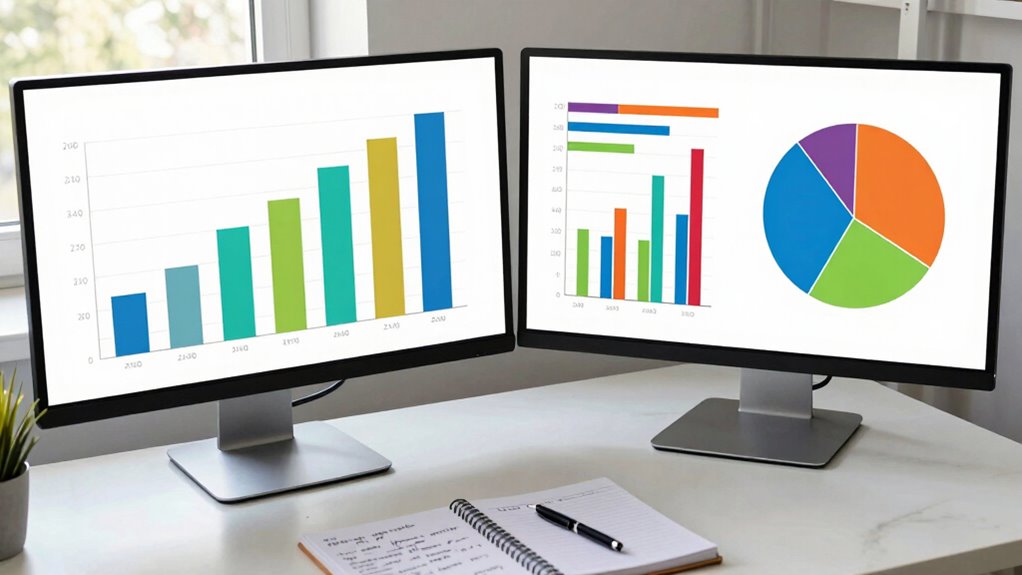
Are you struggling to determine which of your marketing campaigns is truly performing the best? When comparing campaign performance across different segments, it’s vital to use a clear, fair approach. Audience segmentation plays a key role here. By dividing your audience into specific groups based on demographics, behaviors, or interests, you can better understand how each segment responds to your campaigns. This way, you avoid making inaccurate assumptions based on aggregated data that might hide valuable insights. For example, a campaign might perform exceptionally well among younger audiences but underperform with older groups. Recognizing these differences helps you allocate resources more effectively.
To compare campaigns fairly, focus on robust conversion metrics. These metrics—such as click-through rates, conversion rates, and cost per acquisition—offer concrete data on how well each segment responds to your marketing efforts. However, it’s vital to consider the context of each metric. For instance, a high click-through rate in one segment might not translate into a high conversion rate if the audience isn’t completing desired actions. Comparing raw numbers without considering conversion metrics can lead to skewed conclusions. Instead, normalize these metrics to account for differences in audience size or engagement levels. This ensures you’re evaluating performance based on the quality and effectiveness of your campaigns, not just raw volume.
Another important aspect is to set consistent benchmarks across segments. If you compare a campaign targeting a niche audience to one aimed at a broad demographic, make sure you’re measuring against relevant, segment-specific goals. This might mean customizing KPIs or adjusting expectations based on historical data. Additionally, use visual tools like charts and dashboards to see performance trends across segments at a glance. Visual comparison helps identify patterns or anomalies that might be overlooked in raw data tables. Incorporating audience segmentation insights can help you uncover nuanced performance differences that might otherwise go unnoticed. Moreover, integrating advanced analytics techniques can enhance your ability to interpret complex data and improve decision-making. Regularly reviewing these metrics ensures that your analysis remains aligned with evolving privacy policies and data collection practices, which can influence how data is gathered and interpreted. Furthermore, considering external factors such as cybersecurity challenges and their impact on campaign performance can provide a more comprehensive understanding of variability across segments. By systematically applying audience segmentation insights, focusing on meaningful conversion metrics, and maintaining consistent benchmarks, you create a fair comparison framework. This approach not only reveals which campaigns genuinely perform best but also guides smarter decision-making for future marketing efforts. Remember, fair comparison isn’t about raw numbers alone—it’s about understanding how different segments respond and optimizing accordingly.

Executive Marketing & Brand Performance Dashboards: 135+ KPI Templates for CMOs, Marketing Analytics, Brand Strategy & ROI: Strategic Customer & … (Executive Project Governance Series)
As an affiliate, we earn on qualifying purchases.
As an affiliate, we earn on qualifying purchases.
Frequently Asked Questions
How Do Seasonal Trends Affect Campaign Comparison?
Seasonal fluctuations can considerably impact campaign comparison, making some periods look better or worse than they truly are. To account for this, you should incorporate trend analysis, which helps identify underlying performance patterns beyond seasonal effects. By doing so, you guarantee you’re comparing campaigns on a level playing field, recognizing genuine growth or decline rather than temporary seasonal influences. This approach provides a clearer, more accurate assessment of your campaign performance across different segments.
What Metrics Are Most Reliable for Cross-Segment Analysis?
You’ll find conversion rate and ROI the most reliable metrics for cross-segment analysis. These figures cut through segmentation differences, offering clear insights into performance. Use segmentation strategies to group similar audiences, then rely on data visualization to compare metrics visually. This approach helps you identify trends and outliers, making it easier to allocate resources effectively and optimize your campaigns across diverse segments.
How to Account for Different Audience Sizes?
To account for different audience sizes, you should normalize your data considering demographic factors and geographic differences. Use metrics like conversion rates or engagement percentages instead of raw totals, which can be skewed by larger audiences. Adjust for demographic diversity and regional variations to guarantee fair comparisons. This approach highlights genuine performance differences, allowing you to make informed decisions regardless of audience size disparities.
Should I Normalize Data Across Segments?
Yes, you should normalize data across segments to guarantee fair comparisons. Data scaling and metric standardization help you account for differences in audience sizes and engagement levels. By applying these techniques, you convert metrics into a common scale, making it easier to identify true performance variations. This way, your analysis becomes more accurate, and you avoid misleading conclusions caused by raw data disparities across segments.
How Often Should Performance Comparisons Be Updated?
Ever wonder how often you should update your performance comparisons? For effective benchmarking strategies, you should review your data regularly—ideally weekly or bi-weekly—especially when working with diverse audience segmentation. Consistent updates help you spot trends early and adjust campaigns promptly. Keep in mind, the frequency depends on campaign scale and goals; more dynamic campaigns may require even more frequent evaluations to stay ahead.
Conclusion
Just like a chef tasting each dish to guarantee consistency, comparing campaign performance across segments requires careful, fair tasting. Remember, a campaign’s success in one segment doesn’t guarantee the same in another—think of it as different ingredients blending uniquely. So, always measure with the same spoon, adjust for context, and stay curious. When you do, you’ll discover the secret sauce that makes each segment perform at its best, turning insights into your winning recipe.