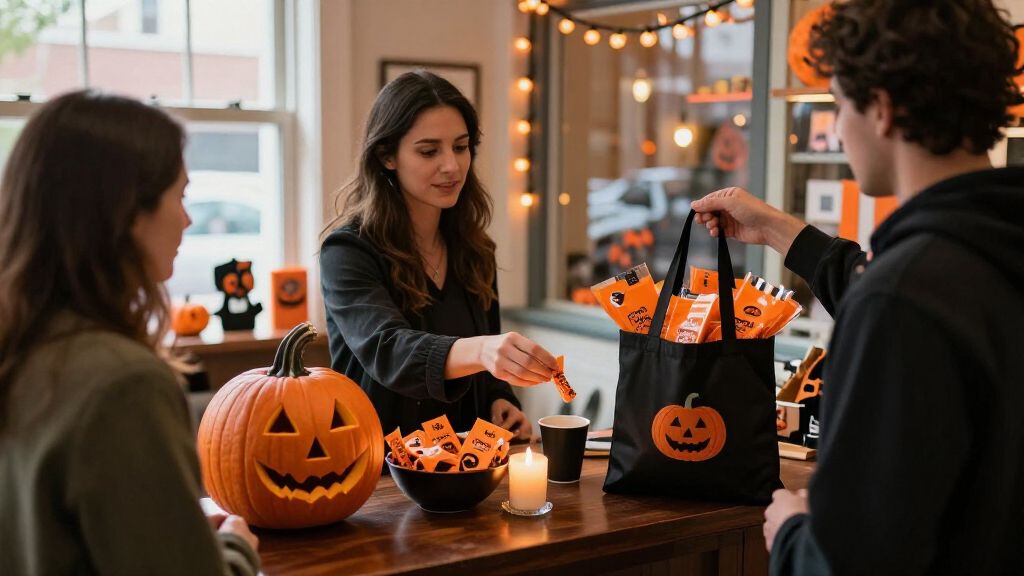

Use this guide to plan a Halloween promotional product campaign, choose useful branded items, prepare artwork, place an order, and distribute products on schedule. It is for small business owners, event organizers, and marketing teams with basic planning experience. Allow 2-6 weeks for the full task; custom manufacturing or large orders may take longer.

Get business pricing on office and shipping supplies
- Business-only prices and quantity discounts
- Tax-exempt purchasing
- Multiple users, one account, clear invoices

Thenshop 50-Piece Halloween Ballpoint Pen Set
- ✔ Brand: Thenshop
- ✔ Quantity: 50 pens
- ✔ Designs: 5 Halloween styles, 10 of each

INKNOTE Halloween Scratch-Off Cards, 120 Count, 3 Styles
- ✔ Brand: INKNOTE
- ✔ Quantity: 120 cards and 120 scratch-off labels
- ✔ Material: Thick cardstock

FFNIU Halloween Pumpkin-Shaped Rollerball Pens, 30-Pack
- ✔ Brand: FFNIU
- ✔ Quantity: 30 pens
- ✔ Instrument type: Rollerball pen
A completed campaign has a defined audience and budget, products that fit the occasion and your brand, approved proofs, a delivery plan, and a way to track results. Start early enough to review samples or artwork and correct shipping or production problems before your event or promotion.
Difficulty: Beginner | Time: 2-6 weeks, depending on product sourcing and order size
What You’ll Need
Tools & Materials:
- Campaign brief or planning document
- Budget and purchasing approval
- Brand logo and approved brand colors
- Artwork or design software, if creating original graphics
- Supplier quotes and product specifications
- Calendar with campaign and delivery dates
Knowledge:
- Basic familiarity with your audience and brand
- A rough estimate of the number of recipients
- An understanding of where and how products will be distributed
Plan backward from the date people must receive the products. Ask suppliers for current production and shipping estimates, and leave time for proof approval, packing, and delivery. For food, toys, cosmetics, or items used by children, check applicable labeling and safety requirements before ordering.
Thenshop 50-Piece Halloween Ballpoint Pen Set
For organizations that need a simple handout for a class, office, or Halloween gathering, the Thenshop 50-piece set offers the easiest balance of useful function and seasonal variety. Its 50 plastic ballpoint pens come in five Halloween designs, so a group can share a coordinated theme without receiving identical-looking favors. At 5.31 inches long with black 0.7 mm ink, each pen has a familiar format for routine notes and forms. That everyday usefulness gives this set a broader role than a novelty favor that recipients may only enjoy during October.Compared with the FFNIU pumpkin pens, Thenshop provides 20 more pens and five listed styles rather than a single pumpkin-topped concept. That makes it the more practical choice when distribution volume and varied designs matter more than a distinctive topper or refillable construction. Against the INKNOTE cards, the advantage is readiness: pens can be handed out as they are, while cards need a message and scratch-off labels applied before they become a promotion. The tradeoff is that a pen is less interactive and carries no custom offer on its own. Its plastic construction and black-only ink also limit its appeal for buyers seeking a more substantial or colorful writing gift.
Pros:
- 50 pens support distribution to a larger group.
- Five Halloween designs add variety within a coordinated giveaway.
- Black 0.7 mm ballpoint ink suits everyday writing and note-taking.
- Ready-to-share format requires no card assembly or personalization.
Cons:
- Plastic construction may feel basic compared with a more substantial gift.
- Black ink is the only listed color, and the pens do not offer the interactive promotion of scratch-off cards.
Best for: Event organizers, teachers, and offices that want a high-quantity Halloween handout people can use for ordinary writing.
Not ideal for: Promoters who need a custom coupon or prize mechanic, or buyers who prefer refillable pens or non-plastic materials.
Bottom line: We recommend Thenshop as the most adaptable bulk Halloween giveaway when practical writing use matters more than personalization.
“We recommend Thenshop as the most adaptable bulk Halloween giveaway when practical writing use matters more than personalization.”
INKNOTE Halloween Scratch-Off Cards, 120 Count, 3 Styles
When the Halloween handout needs to carry an offer, prize, or personal message, INKNOTE’s scratch-off cards do something neither pen set can: they create a small reveal. The package includes 120 blank cards and 120 scratch-off labels, leaving the buyer free to write or print a coupon, gift certificate, or event prize before covering it. Three Halloween styles help keep the presentation seasonal, while the 3.5-by-2-inch rectangular format is compact enough to distribute at a party or with a customer purchase.This is the more promotion-focused pick compared with Thenshop and FFNIU, whose pens mainly provide a useful or decorative object. A scratch-off card can give recipients a reason to engage with a business or event, but the flexibility comes with preparation. The cards are blank, and each label has to be applied by the user; buyers who need a ready-to-hand-out item may prefer the pens. The uncoated cardstock is described as easy to write on, which helps with small batches or handwritten prizes, although buyers planning a polished campaign should account for the work of preparing and checking every card. The labels and cards also form a one-time promotional interaction rather than an everyday item people keep using.
Pros:
- Blank cards support custom prizes, coupons, and gift certificates.
- Includes 120 cards and 120 matching scratch-off labels.
- Thick, uncoated cardstock is described as easy to write on.
- Three Halloween styles suit seasonal events and customer handouts.
Cons:
- Labels must be applied by the buyer, adding preparation time.
- Blank cards need custom writing or printing before distribution.
- Less useful after the promotion than either set of everyday pens.
Best for: Small businesses, party hosts, and event teams that want to attach a custom offer, prize, or message to a Halloween giveaway.
Not ideal for: Buyers who need a ready-made favor with no writing, printing, or label application, or who prioritize lasting everyday utility.
Bottom line: We’d choose INKNOTE when a customizable reveal is central to the promotion and we can budget time for assembly.
“We’d choose INKNOTE when a customizable reveal is central to the promotion and we can budget time for assembly.”
FFNIU Halloween Pumpkin-Shaped Rollerball Pens, 30-Pack
FFNIU leans into the holiday more visibly than the other products: each of its 30 rollerball pens has a silicone pumpkin-shaped topper. That makes the pen feel more like a themed favor than a standard office supply, which can help it stand out on a party table or in a small gift bag. The listed 0.5 mm black water-based ink and refillable design give it practical potential beyond its seasonal decoration, so it sits between a novelty item and an everyday writing tool.Compared with Thenshop’s five-design assortment, FFNIU puts its visual identity into one clear pumpkin motif and offers refillability, but supplies 20 fewer pens. It is therefore a better fit for a smaller gathering where presentation matters more than maximizing handouts. The scratch-off cards are more adaptable for business offers, while these pens provide immediate gift appeal without the cards’ assembly. The compromises are the seasonal look, which may not suit recipients’ daily preferences, and the lack of information about how many refills are included. Buyers should not treat “refillable” as confirmation that extra ink comes in the package. With plastic and silicone construction and black ink only, this is a focused decorative pick rather than the most flexible promotional option.
Pros:
- Pumpkin-shaped silicone toppers make the Halloween theme immediately visible.
- Refillable construction may extend use beyond the event.
- Thirty pens offer a shareable favor format.
- 0.5 mm black water-based ink is specified.
Cons:
- The overtly seasonal design may not suit everyday preferences.
- The number of included ink refills is not specified.
- Smaller quantity than Thenshop’s 50-pen assortment.
Best for: Hosts and organizers preparing smaller Halloween parties or gift bags where a visible pumpkin accent is part of the appeal.
Not ideal for: Large events needing the highest listed pen quantity, recipients who prefer understated stationery, or buyers requiring specified replacement refills.
Bottom line: We’d pick FFNIU for a smaller event where pumpkin-themed presentation matters more than maximum distribution or custom messaging.
“We’d pick FFNIU for a smaller event where pumpkin-themed presentation matters more than maximum distribution or custom messaging.”
As an Amazon Associate we earn from qualifying purchases.
Before You Start
Decide whether your campaign is for customers, employees, event visitors, or another group. That choice affects product type, quantity, packaging, and shipping. Set a total budget that includes product cost, customization, setup charges, freight, taxes, storage, and distribution. Do not approve a design or order quantity until the supplier has confirmed the specifications, total cost, and expected delivery date in writing.
Keep Halloween imagery appropriate for your audience and location. Use original artwork or graphics you have permission to reproduce; avoid unlicensed characters, movie imagery, and logos. If products will go to children, select age-appropriate items and review relevant warnings and labeling with the supplier.
Step-by-Step Instructions
Step 1: Define the campaign and audience
Write a short campaign brief with the goal, audience, delivery method, date, and desired action. For example, you might give branded treat bags to visitors at a store event, send a seasonal package to selected customers, or provide desk items to employees. Specify how the product supports the goal: attracting people to a booth, thanking customers, or prompting a visit to a landing page.
Estimate how many people will receive an item. Add a modest reserve for late registrations, damaged stock, or staff use, but do not order a large surplus without a storage plan. If you are mailing products, count packaging and postage requirements as part of the quantity and budget calculation.
Tip: Write down the single action you want recipients to take, such as visiting a web page or attending an event. Use that action to guide the product and message.
Check: Your brief names one primary audience, one campaign goal, a distribution method, an approximate quantity, and a date when products must be ready.
Step 2: Set a realistic budget and schedule
Set a spending limit and divide it among product cost, customization, shipping, packaging, and distribution. Request quotes at several quantities because unit cost can change as order size rises. Compare the full delivered price, not just the advertised price per item. Ask whether artwork setup, individual packaging, rush production, or freight carries a separate charge.
Work backward from the delivery date. Include time for comparing suppliers, ordering a sample if needed, reviewing the digital proof, approving production, and receiving the shipment. Ask each supplier to confirm the production window and shipping method. If the date is fixed, select an item that can be produced and delivered within that schedule.
Tip: Treat a supplier’s delivery estimate as a date to verify, not an assumption. Confirm whether the estimate begins after proof approval or after payment.
Check: You have a written budget that covers likely extra charges and a calendar with deadlines for ordering, artwork approval, shipment, and distribution.
Step 3: Choose products that suit the audience
Choose products people can use, enjoy, or share in the setting where you will distribute them. Options include treat bags, stickers, reusable cups, tote bags, notebooks, reflective accessories, or small desk items. Match the item to the recipient: a family event may call for simple take-home items, while a customer package may suit a practical branded product.
Check size, material, print area, colors, minimum order, and packaging before deciding. Ask whether the product is appropriate for the expected ages and use. If you include candy or other food, review ingredient and allergen information, packaging, and storage needs. Do not describe an item as safe, recyclable, or food-grade unless the supplier can support that claim.
Compare at least two suitable product options. Consider usefulness after Halloween, ease of transport, and whether the item gives your logo enough space to remain readable. Pick one main item or a coordinated set rather than adding products that do not support the campaign.
Tip: Request a physical sample when color, size, texture, or fit matters. A product photo may not show how large the logo will appear in real use.
Check: The selected item fits the recipient, use, budget, and schedule, and you have checked its product specifications and any relevant safety or labeling details.
Step 4: Create a clear seasonal design
Use your approved logo and brand colors as the design foundation. Add one or two seasonal details, such as pumpkins, leaves, bats, or a simple Halloween pattern. Keep the message short enough to read at the product’s actual size. Include a web address, QR code, or call to action only if people can scan or read it easily.
Use artwork you own or have permission to use. Follow the supplier’s file requirements for format, resolution, color mode, and print area. Keep essential text and logos inside the recommended safe area so they do not get cut off or hidden by seams. If using a QR code, test it from a printed or realistically sized version before approving the artwork.
Tip: Avoid relying on color alone to distinguish small text or symbols. Check contrast and legibility against the product material.
Check: The artwork follows the supplier’s specifications, the logo and message are legible at the intended size, and every link or code works.
Step 5: Review the proof and confirm the order
Read the supplier’s proof line by line before approval. Check spelling, dates, web addresses, QR codes, logo proportions, placement, colors, and the number of print locations. Compare the proof with the product size and the supplier’s specifications. Request a revised proof if anything is wrong; do not expect the production team to infer corrections from a separate email.
Confirm the final quantity, item variant, packaging, total price, delivery address, shipping method, and delivery date. Ask who to contact if production or shipping falls behind. Save the approved proof and order confirmation with the campaign brief. Approve production only after the proof and order details match your requirements.
Tip: Ask a second person to check the proof. A fresh reader may spot a typo, incorrect date, or hard-to-scan code.
Check: You have an approved proof and written order confirmation showing the exact item, quantity, charges, destination, and expected delivery date.
Step 6: Prepare distribution and storage
Choose where products will be stored and who will receive and distribute them. For an event, assign a person to transport the items, set them out, and restock the display. For direct mail, confirm package dimensions, recipient addresses, postage, and packing time. For employee distribution, set a pickup date and tell staff how many items they should receive.
Keep products dry, clean, and away from heat if the material or contents could be damaged. Store food according to its packaging instructions. Prepare a simple count sheet so you can compare the quantity received with the quantity distributed and remaining. If the campaign includes a QR code or offer, check the linked page and redemption details before products go out.
Tip: Assign one person to check the shipment when it arrives and report shortages or damage to the supplier promptly.
Check: A named person, location, and distribution method are in place, and the product count can be tracked from delivery through handout or mailing.
Step 7: Inspect, distribute, and record results
Open the shipment promptly and compare the delivered quantity and product details with the order. Inspect several items from different parts of the shipment for print quality, damage, missing components, and packaging problems. Photograph any issue and contact the supplier with the order number and clear evidence. Set aside defective items instead of handing them out.
Distribute the approved products using the plan you prepared. Track how many were handed out, mailed, or left in stock. Record useful campaign results, such as event attendance, QR code visits, offer redemptions, or customer responses. Compare those results with your original goal and note supplier performance, timing, and recipient feedback for your next seasonal campaign.
Tip: Keep a few approved samples and the final proof with your campaign records. They help you compare future products and reorders.
Check: The delivered items match the approved order, distribution counts are recorded, and you have at least one measure tied to the campaign goal.
Common Mistakes to Avoid
- Ordering too late for custom production or shipping. — Plan backward from the handout date, confirm supplier timing, and leave room for proof revisions and delivery delays.
- Choosing a product that is cheap but irrelevant or hard to use. — Match the item’s purpose, size, and packaging to the recipient and distribution setting; compare delivered cost and usefulness.
- Approving artwork without checking the actual print size. — Review the supplier proof at the item’s real scale and test small text, links, and QR codes before production.
- Ordering food or child-directed items without checking details. — Review age suitability, ingredient and allergen information, packaging, and applicable safety or labeling requirements before purchase.
Troubleshooting
Problem: The supplier’s estimated delivery date falls after your event.
Solution: Ask whether a faster production or shipping option is available and request its full cost and confirmed date. If the date still does not work, choose an in-stock item or a simpler product with a shorter production window.
Problem: The digital proof has blurry artwork or text that looks too small.
Solution: Send a higher-resolution file or a vector logo in the supplier’s accepted format. Enlarge or simplify the message, then review a revised proof at actual product size.
Problem: The QR code does not scan reliably.
Solution: Use a shorter destination link, increase the code size and contrast, and keep it away from seams or folds. Test the revised code on a printed sample or a display that matches the final product size.
Problem: The shipment arrives damaged or short.
Solution: Count and photograph the affected items, keep the packaging and order paperwork, and contact the supplier promptly with the order number and requested resolution. Use reserve stock only after recording the discrepancy.
What Success Looks Like
The campaign is complete when the products arrive by the planned date, match the approved proof and order, and are distributed through the intended channel. The design is readable, items suit their recipients, and food or child-directed products have been checked for relevant safety and labeling details. You have a record of quantities received and distributed plus a result connected to the campaign goal, such as attendance, scans, redemptions, or recipient feedback.
Next Steps
Save the final artwork, proof, supplier details, costs, order quantity, and results in one campaign folder. Record what ran late, what recipients used, and what you would change next time. Dispose of packaging and leftover products according to local guidance, and store any usable surplus in a clean, labeled place. Begin planning the next seasonal order early enough to compare suppliers and review samples.
Frequently Asked Questions
How far ahead should I order Halloween promotional products?
Start several weeks ahead and use the supplier’s confirmed production and shipping schedule to set your order date. Custom printing, large quantities, proof changes, and delivery to multiple locations can add time. In-stock products may arrive sooner, but confirm availability and shipping before relying on them.
What Halloween products work well for a business event?
Choose items people can carry away or use afterward, such as treat bags, stickers, reusable cups, tote bags, or small desk items. Match the choice to the audience and event setting, and check that the print area can display your logo clearly.
Should I include candy in a promotional giveaway?
Candy can suit an event, but review ingredient and allergen information, packaging, storage, and the needs of your audience. Offer a non-food option when appropriate, especially when you cannot confirm each recipient’s dietary needs.
How can I tell whether the campaign worked?
Measure an outcome tied to the campaign goal. Track event attendance, QR code visits, offer redemptions, mailing responses, or recipient feedback. Compare the result with your starting goal and record the cost per recipient or response if that will help with future planning.
Fall Picks
fall essentials
As an affiliate, we earn on qualifying purchases.