
📊 Full opportunity report: The City That Watches Itself: The Living Digital Twin, and the God’s-Eye View We’re Building on ThorstenMeyerAI.com — validation score, market gap, and execution plan.
TL;DR
Urban areas are building dynamic digital twins that integrate sensor data, AI, and satellite imagery for real-time city monitoring. This technology enhances planning but also raises privacy and sovereignty issues. The development is ongoing and evolving rapidly.
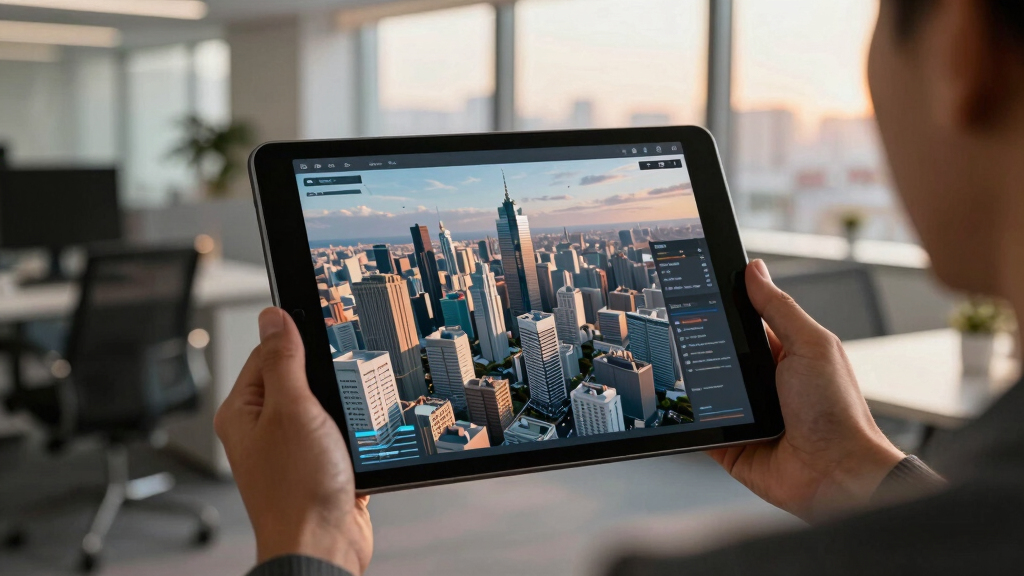
Urban centers are increasingly adopting living digital twins—dynamic, real-time virtual replicas of cities powered by integrated sensor networks and advanced AI. These models enable city officials to monitor, simulate, and manage urban systems with improved accuracy, representing a significant advancement in urban governance and planning. This development involves sophisticated data integration and analysis, which can also be used for surveillance purposes.
The core of this innovation is the integration of wide-area motion imagery (WAMI), all-weather radar, satellite data, and AI models capable of understanding complex urban environments. Cities like Singapore, Helsinki, and Las Vegas are already operating these digital twins to optimize infrastructure, improve emergency response, and support urban planning. The models are updated continuously, capturing various activities in real time, and can be queried using natural language.
These systems are built on the convergence of mature sensor technology, such as WAMI and synthetic-aperture radar, and frontier AI models that can interpret heterogeneous data streams. This fusion transforms static city maps into interactive, queryable living models that can simulate scenarios like traffic rerouting or flood risk management. The capability to rewind and analyze past events adds a new dimension to city management, enabling more informed decision-making.
However, the same capabilities that support urban planning also raise surveillance concerns. The detailed, persistent monitoring of city life prompts discussions about privacy, civil liberties, and sovereignty, particularly when data is managed or hosted by foreign entities. The potential for misuse or overreach is an ongoing topic of debate among policymakers and technologists.
The city that watches itself: the living digital twin, and the god’s-eye view we’re building
Soon most cities will exist twice — once in concrete, once as a live data model you can rewind, simulate, and question in plain language. Persistent sensing + frontier AI turn the planner’s digital twin into an oracle. The most useful thing we’ve built — and the most powerful surveillance instrument. Both at once.
- Plan better — cities & rural: traffic, zoning, energy, land use
- Emergency response — route crews, one live picture, ~50% faster
- Disaster resilience — simulate, track live, assess damage in hours
- Mass surveillance — track everyone, retroactively, forever
- Pattern-of-life — AI links movements, infers associations
- Social control — no warrant, no suspicion (cf. Baltimore, 2021 ruling)
We’re building a city that watches itself, remembers everything, and can be asked anything. The technology won’t choose between saving lives and ending privacy — we will, through the rules we write now, while the twin is still under construction and the defaults haven’t yet hardened into permanence. WAMI and the living twin open our lives to a view from the heavens that, from the dawn of civilization until a heartbeat ago, was reserved for gods and stars. The question is no longer whether we can see everything — it’s who gets to look, and who watches the watchers.
Implications of Self-Watching Cities for Privacy and Governance
This technological development alters how cities are managed and monitored, offering benefits such as more efficient infrastructure use, faster emergency responses, and improved urban planning. Nonetheless, it also introduces the possibility of detailed surveillance that can track individual movements and behaviors in real time, raising privacy and civil rights considerations. The question of data sovereignty becomes relevant when systems are hosted abroad or managed by private organizations.
Furthermore, the ability to simulate and predict urban scenarios could influence policy decisions, but also presents risks related to misuse for authoritarian purposes or targeted surveillance. As these systems become more prevalent, establishing appropriate regulations and safeguards will be important to balance technological benefits with rights protection.

Advances in Sensors, Big Data and Machine Learning in Intelligent Animal Farming
As an affiliate, we earn on qualifying purchases.
As an affiliate, we earn on qualifying purchases.
From Static Maps to Living Digital Cities
The concept of digital twins in urban planning has been evolving over the past decade, with Singapore’s Virtual Singapore leading the way since 2012. This model integrates 3D mapping with real-time overlays of utilities, traffic, and environmental data. Other cities like Helsinki and Las Vegas have adopted operational city twins that support infrastructure management and emergency planning.
The recent integration of wide-area motion imagery (WAMI) and frontier AI advances has transformed these models from static or periodic snapshots into continuous, real-time replicas. This shift is driven by improvements in sensor technology, data fusion, and AI understanding, enabling cities to monitor and analyze their complex systems more comprehensively. The convergence of these technologies has accelerated in recent years, with ongoing pilot projects expanding their scope and capabilities.
“We are witnessing the emergence of cities that can observe, understand, and respond to their own needs in real time—effectively becoming their own intelligent entities.”
— Thorsten Meyer, AI researcher
Unresolved Challenges and Risks of Digital City Twins
While the technological capabilities are advancing, several issues remain to be addressed. The extent of adoption across different cities and the development of regulatory frameworks to address privacy and sovereignty concerns are still evolving. Risks related to data misuse, government overreach, or foreign control of infrastructure are topics of ongoing discussion. Additionally, the security and resilience of these complex systems against cyber threats are under assessment, and their long-term societal impacts are not yet fully understood.
Next Steps for Urban Digital Twin Development and Regulation
Anticipate continued expansion of pilot projects and increased adoption of digital twins for various urban functions. Development of regulatory standards and international agreements will likely address issues related to privacy, data sovereignty, and cybersecurity. Collaboration among researchers, policymakers, and industry stakeholders will be essential to establish safeguards that prevent misuse while enabling the benefits of this technology. Advances in AI and sensor technology will further improve the fidelity and utility of digital twins, influencing future urban management practices.
Key Questions
What is a digital twin in a city context?
A digital twin is a dynamic, virtual replica of a city that integrates real-time data from sensors, satellites, and other sources to monitor, simulate, and assist in managing urban systems.
How does AI enhance digital twin capabilities?
AI models interpret diverse data streams, recognize patterns, understand scenes, and enable natural language queries, transforming the twin from a static map into an interactive, intelligent system.
What are the privacy concerns associated with digital twins?
The detailed, ongoing monitoring can track individual movements and behaviors, raising issues related to civil liberties, data control, and potential misuse by authorities or private entities.
Are these systems secure from cyber threats?
Security remains a concern, as interconnected systems could be vulnerable to cyberattacks, and their long-term resilience is still being evaluated.
Will this technology replace traditional urban planning?
Digital twins are intended to complement existing planning processes, providing additional data and insights. They are tools to support, not replace, human decision-making and regulatory frameworks.
Source: ThorstenMeyerAI.com