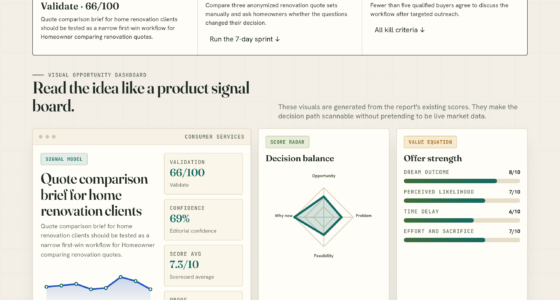

📊 Full opportunity report: The $725 Billion Question: Hyperscaler Capex Q1 2026 and What the Earnings Don’t Answer on ThorstenMeyerAI.com — validation score, market gap, and execution plan.
Listen free for 30 days with Audible
Thousands of audiobooks and originals — cancel anytime.
Start your free trialAs an affiliate, we earn on qualifying purchases.
TL;DR
In Q1 2026, Microsoft, Amazon, Alphabet, and Meta revealed a combined $725 billion in AI-related capital expenditure, the largest in history. While this signals aggressive expansion, market reactions and structural questions cast uncertainty on future revenue growth and profitability.
On April 29, 2026, Microsoft, Amazon, Alphabet, and Meta reported their Q1 2026 earnings, revealing a combined AI infrastructure capital expenditure of approximately $725 billion, marking the largest such cycle in corporate history. This level of investment highlights the ongoing focus of these companies on expanding their AI capabilities, though questions remain regarding the immediate financial impact and long-term sustainability of such spending.
The four hyperscalers collectively allocated around $725 billion to AI-related infrastructure in Q1 2026, a 69% increase year-over-year, with Microsoft at $190 billion, Amazon at $200 billion, Alphabet at $185 billion, and Meta between $125-145 billion. This increase is part of a broader trend where capex as a percentage of revenue has doubled, reaching 25-30%, with some projections suggesting ratios could increase further in 2027.
Despite the record investment, market reactions to NVIDIA, the primary supplier of GPUs for AI workloads, were mixed, with its stock experiencing declines following earnings reports. Analysts are examining whether GPU supply remains a limiting factor or if other constraints—such as power, cooling, or in-house silicon—are becoming more prominent. These factors influence expectations about whether the increased capex will result in proportional revenue and earnings growth in the near term.
$725 billion. The question capex doesn’t answer.
April 29, 2026. Largest capital-expenditure cycle in modern tech history. Lock-in across the Big Four.
Microsoft $190B. Amazon $200B. Alphabet $185B. Meta $125-145B. Up from $670B high-end consensus going in. +69% YoY surge over 2025. NVIDIA fell on the news. The structural questions — depreciation, power, in-house silicon, demand-pull, geopolitical — resolve through 2027-2028.
Four hyperscalers. $725B committed.
Each hyperscaler beat-and-raised in the same 24-hour window April 29. Microsoft / Amazon / Alphabet / Meta. The capex commitment is non-discretionary at this scale — companies cannot back out without creating asset write-downs and capacity gaps.
Three paths. One question.
The capex buildout resolves through one of three structural paths. The honest assessment: the demand signals are real, the supply signals are real, and the balance between them is the structural question.
- Demand +60-100% YoYEnterprise translates fully.
- Utilization 85%+NVIDIA pricing power holds.
- $2.8T by 2028Jensen trajectory matches.
- No impairmentCapex fully accretive.
- Outcome: Multiples expand. Foundation for next decade.
- Demand +30-60% YoYPartial translation.
- Utilization 75-85%Weaker pockets visible.
- NVDA decel 75% → 30-50%Manageable adjustment.
- $30-80B impairmentLimited 2028 cycles.
- Outcome: Multiples compress modestly. No crisis.
- Demand +15-30% YoYEnterprise falls short.
- Utilization 65-75%Capacity glut visible.
- $150-300B impairmentBig Four 2027-2028.
- NVDA sharp decelPricing compression.
- Outcome: 30-50% multiple compression. Post-2001 telecom analog.
Five vectors. Interdependent.
Capital-allocation risks of this magnitude resolve through specific structural channels. The vectors are not independent — power constraints delay deployment which compresses utilization which triggers impairment.
Capital intensity has reset upward as the new baseline for tech-platform leadership. The competitive moat is partly capital availability rather than purely product or technology innovation. Tech-platform leadership now requires capital-deployment scale that fewer companies can execute.
Four assignments. By role.
Reset on structural pricing-power compression.
Bull case requires NVIDIA to maintain addressable share through FY27-FY28; in-house silicon migration argues that share compresses. Position accordingly. Consider AMD, Broadcom, downstream networking suppliers as partial substitutes that may benefit from compression. Stop pricing the $2.8T-by-2028 ceiling literally.
Treat capex as tailwind and risk factor.
Microsoft best-positioned through capacity-constrained Azure demand. Alphabet best-positioned through TPU silicon independence. Amazon best-positioned through Trainium/Inferentia revenue diversification. Meta most exposed through internal-product-only revenue offset. Position differentially rather than treating Big Four as equivalent.
Use the buildout to negotiate.
Capacity becoming abundant; pricing under structural pressure. 2-3 year contracts with capacity guarantees + price-discount escalators that capture unit-cost reduction as buildout absorbs. Multi-cloud sourcing more attractive as capacity scarcity ends. The negotiating window opens through 2026-2027.
Plan for capacity glut by H2 2027.
Capex commitment produces more compute than current demand absorbs at current pricing. API pricing pressure compounds through 2027-2028. China sphere cost gap (5-30× cheaper) makes more acute. Margin guidance for next 18 months should explicitly model capacity-driven price compression. Hedge accordingly in S-1 disclosures.
Implications of the Largest AI Capex Cycle in History
This level of capital expenditure indicates a significant commitment to AI infrastructure by hyperscalers, who are increasing spending relative to their cash flow and leveraging debt to fund expansion. While this reflects a strategic focus on AI development, it also introduces uncertainties regarding future revenue streams and technological constraints. Market perceptions of NVIDIA’s role and the operational benefits of this investment could impact stock valuations and profitability in the coming years.
high-performance GPU for AI workloads
As an affiliate, we earn on qualifying purchases.
As an affiliate, we earn on qualifying purchases.
Background on AI Infrastructure Investment Trends
Over recent years, hyperscalers have increased their investments in AI infrastructure to support growing workloads and the need for more advanced compute resources. Prior to 2026, capex as a share of revenue was around 10-15%, but this has doubled during the current cycle. Major companies like Microsoft, Amazon, Alphabet, and Meta are now investing hundreds of billions annually, with some estimates suggesting global AI infrastructure capex could reach $740 billion in 2026, according to Morgan Stanley.
This increase follows years of gradual growth, but the scale observed in 2026 is notable, reflecting a strategic emphasis on AI leadership and market share. The deployment relies heavily on GPU supply chains, with NVIDIA as the primary hardware supplier, although some companies are developing in-house silicon to mitigate reliance on external providers.
“Our $200 billion plan remains largely unchanged, with a strategic focus on developing in-house silicon (Trainium, TPU v6) to reduce reliance on external GPU suppliers over time.”
— Amazon CEO Andy Jassy
Market Skepticism and Structural Risks
While the capex figures are confirmed, market interpretation remains cautious. Questions persist about whether GPUs continue to be the primary bottleneck, or if other factors—such as power requirements, cooling, or in-house silicon—are becoming more significant constraints. Additionally, it remains uncertain whether the current level of investment will translate into the expected revenue and profit growth, or if depreciation of infrastructure assets could lead to impairments in the coming years.
Monitoring Revenue Growth and Hardware Constraints
Investors and analysts will monitor upcoming quarterly earnings reports from hyperscalers to assess how much of the capital expenditure is contributing to operational growth. Developments in in-house silicon, supply chain stability, and operational efficiencies will also influence the trajectory of this investment cycle. Market responses to NVIDIA and other hardware suppliers will continue to shape perceptions of the AI infrastructure landscape.
Key Questions
Why is the $725 billion capex figure significant?
This figure represents the largest AI infrastructure investment to date, indicating a strategic emphasis on expanding AI capabilities. It also prompts consideration of the sustainability and actual financial returns of such spending.
Will this investment lead to immediate revenue growth?
The impact on revenue growth remains uncertain. While companies are investing heavily in infrastructure, it is unclear whether this will translate into proportional revenue and earnings increases in the short term.
What role does NVIDIA play in this cycle?
NVIDIA supplies the majority of GPUs used in AI workloads, but recent market reactions suggest that concerns about supply constraints or other bottlenecks are being reassessed as the industry evolves.
Could this cycle lead to a financial impairment?
If revenue growth does not meet expectations, the depreciation of infrastructure assets could result in impairments, potentially affecting profitability in subsequent years.
How are companies reducing dependency on external hardware?
Major companies like Amazon and Alphabet are investing in developing in-house silicon (such as Trainium and TPU v6) to decrease reliance on external GPU suppliers and improve operational control.
Source: ThorstenMeyerAI.com
NFL season / tailgating Picks
team gear
As an affiliate, we earn on qualifying purchases.