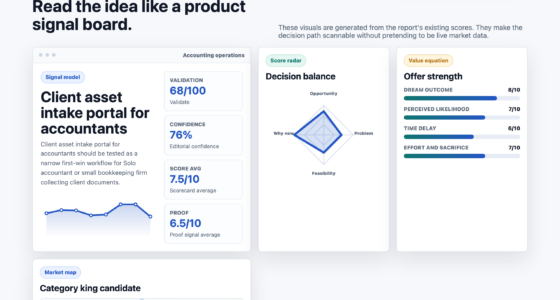
📊 Full opportunity report: The Ghost Story Became a Forecast. on ThorstenMeyerAI.com — validation score, market gap, and execution plan.
TL;DR
Jack Clark’s latest essay presents a bivalent forecast: a 60% probability of automated AI R&D by 2028 and a 40% chance of fundamental paradigm limitations. This shifts the narrative from a speculative ghost story to a serious structural assessment, impacting AI research and policy planning.
Jack Clark’s latest essay assigns a 60% probability to automated AI research and development (R&D) by the end of 2028, with a 40% chance that current technological paradigms will reveal fundamental deficiencies, requiring new human inventions. This marks a significant shift from previous speculative narratives, making the forecast a critical reference point for AI research and policy discussions.
In his recent essay, Clark explicitly states a 60% probability that automated AI R&D will be achieved by 2028, based on current trajectories and corporate commitments. He also emphasizes a 40% chance that this timeline will not materialize, which Clark interprets as evidence of potential fundamental limitations within existing AI paradigms. The 40% scenario implies that progress may stall due to inherent architectural or compute constraints, forcing a reassessment of current assumptions about continuous capability growth.
Clark’s analysis is rooted in detailed assessments of corporate targets, technological feasibility, and the structural barriers facing AI development. His conclusion reframes the earlier ‘ghost story’ of rapid AI takeoff as a bifurcated forecast: either near-term automation or a paradigm shift revealing foundational deficiencies. This duality challenges previous optimistic timelines and underscores the importance of institutional readiness for either outcome.
The ghost story
became a forecast.
Reading Clark’s closing — the bivalent 60%/40% credence. The 30% by 2027 alternative. What it means when a frontier-lab co-founder publicly says “I’m persuaded.”
Jack Clark’s closing section — “Staring into the black hole” — contains the most important sentence in the essay for the public discourse. Not the 60%/2028 number — though that’s the technical claim that gets quoted. The discourse-crossing sentence is the personal credence statement: “I have written this essay in an attempt to coldly and analytically wrestle with something that for decades has seemed like a science fiction ghost story. Upon looking at the publicly available data, I’ve found myself persuaded that what can seem to many like a fanciful story may instead be a real trend.”
The standard discourse reads 40% as benign — “slower AI.” Clark’s actual claim is stronger. The 40% reveals a fundamental deficiency within the current technological paradigm. Both outcomes are major findings. The franchise has read the 60% side. The coda reads the 40% side and the bivalence itself.
“For decades, it has seemed like a science fiction ghost story.“
The most important sentence in the essay is not the 60% number. The discourse-crossing sentence is the personal credence statement. When a frontier-lab co-founder publicly says “I am persuaded by the data that this is no longer science fiction,” the discourse changes.
“I have written this essay in an attempt to coldly and analytically wrestle with something that for decades has seemed like a science fiction ghost story. Upon looking at the publicly available data, I’ve found myself persuaded that what can seem to many like a fanciful story may instead be a real trend.”
Nine pieces. One structural finding.
Six different forms of evidence aggregating to one structural finding: the labs are building what they say they’re building; the forecast is the plan; the institutional response window is the only variable that remains unfixed.
Six different forms of evidence. One structural finding. The labs are building what they say they’re building. The institutional response window is the only variable that remains unfixed.
Three paths. All major. All need capacity.
Three structural possibilities for what the next 32 months produce. Asymmetric cost-of-being-wrong points toward building response capacity now. There is no scenario where the capacity goes unused.
~20 months
~32 months
field correction
Capacity built for 30%/60% paths is useful. Capacity built for 40% path is also useful (for field correction). There is no scenario where building response capacity now is wasted.
Clark stares into the black hole and says he’s persuaded. The franchise has been about reading that statement seriously. The reading: he should be. The implication: so should we.
Impact of Clark’s Structural Forecast on AI Strategy
This forecast fundamentally alters how researchers, policymakers, and industry leaders should approach AI development. The 60% probability of rapid automation suggests that preparations for widespread deployment should accelerate, while the 40% risk of paradigm failure signals a need for contingency planning, including investing in alternative architectures and fundamental research. Recognizing the bifurcation helps avoid complacency and encourages more nuanced risk assessments across the AI ecosystem.
The AI Marketing Canvas, Second Edition: A Five-Step AI Plan for Marketers
As an affiliate, we earn on qualifying purchases.
As an affiliate, we earn on qualifying purchases.
Background of Clark’s Probabilistic Assessment
Jack Clark’s essay builds on prior discussions about AI timelines, corporate commitments, and technological limits. His previous work has explored the plausibility of rapid AI breakthroughs, but the recent essay introduces a formal bivalent forecast, emphasizing that the field faces a critical structural choice: either achieve automation within the next few years or confront fundamental paradigm limitations. Clark’s assessment is informed by ongoing corporate targets, technological milestones, and the history of AI capability growth, which has shown signs of plateauing in certain areas.
“The 40% probability indicates that we may have uncovered a fundamental deficiency within our current technological paradigm, requiring new human invention to move forward.”
— Jack Clark
Unresolved Questions About Paradigm Limits
It remains unclear how precisely the 40% scenario will unfold, including what specific technological barriers might cause a fundamental limitation. Details about the nature of these potential deficiencies, whether they are compute, data, architectural, or other factors, are still emerging. Additionally, the timeline for when such a paradigm shift might occur is uncertain, as is the impact on ongoing AI research efforts.
Next Steps for AI Research and Policy
Stakeholders should prepare for both outcomes: accelerating efforts toward achieving automated AI R&D before 2028 and developing contingency plans if the current paradigm reveals fundamental limitations. Monitoring corporate targets, technological breakthroughs, and research directions will be essential. Further analysis is expected as researchers investigate the structural barriers highlighted by Clark, and policymakers consider regulatory implications for either scenario.
Key Questions
What does Clark’s 60% probability mean for AI development timelines?
It suggests there is a more than even chance that automated AI R&D will be achieved by 2028, prompting stakeholders to accelerate preparations for deployment and regulation.
What is the significance of the 40% chance of paradigm failure?
This indicates a substantial risk that current AI paradigms will encounter fundamental limitations, requiring new inventions and potentially delaying or altering AI progress.
How should policymakers respond to this bifurcated forecast?
Policymakers should develop flexible strategies that support rapid deployment efforts while also investing in foundational research to address potential paradigm shifts.
Does Clark specify what the fundamental deficiencies might be?
Clark suggests they could involve limitations in compute, data, architecture, or other core aspects, but the exact nature remains to be clarified through ongoing research.
Source: ThorstenMeyerAI.com