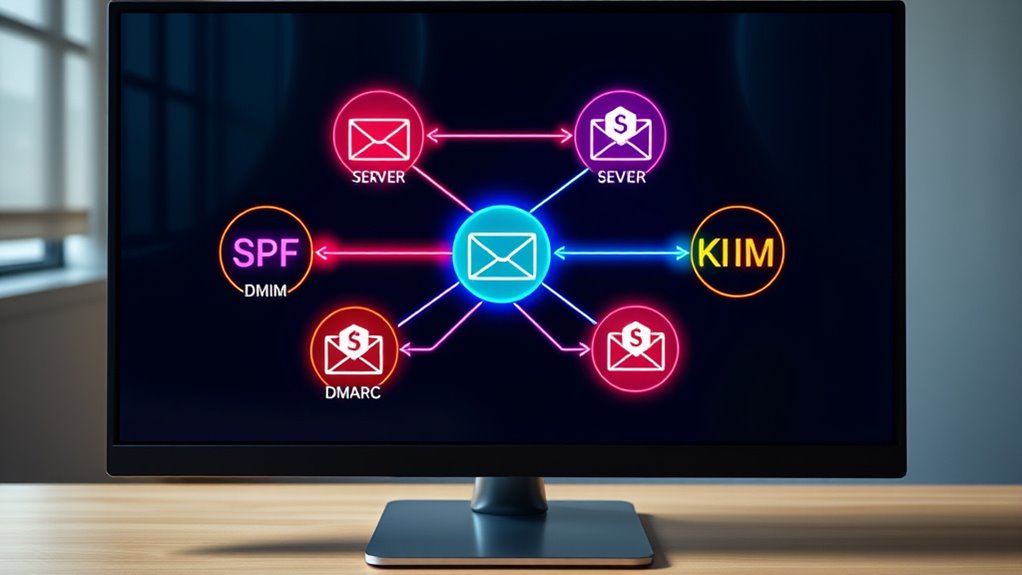

BIMI, SPF, DKIM, and DMARC work together to guarantee your emails are authentic and trustworthy. SPF verifies that messages come from authorized servers, while DKIM adds cryptographic signatures to confirm message integrity. DMARC builds on both by setting policies for handling failed checks and providing reports. BIMI displays your brand logo alongside authentic emails, boosting recognition. Understanding how these standards collaborate helps you strengthen your email security and brand trust—explore further to see how they all connect.
Key Takeaways
- SPF, DKIM, and DMARC authenticate email origins, ensuring messages are legitimate and unaltered during transit.
- DMARC enforces policies based on SPF and DKIM results, instructing recipients to quarantine or reject unauthenticated emails.
- SPF and DKIM provide the foundational verification mechanisms that DMARC relies on for assessing email authenticity.
- BIMI displays brand logos alongside authenticated emails, reinforcing trust when SPF, DKIM, and DMARC validate message legitimacy.
- Together, these protocols create a layered security framework that enhances brand reputation and recipient confidence.
Email security is critical in protecting your brand and preventing phishing attacks, and understanding the key standards—BIMI, SPF, DKIM, and DMARC—can help you achieve that. When you implement these protocols correctly, you create a layered defense that not only guards your email channels but also reinforces your brand’s reputation. Email authentication is at the core of this strategy, ensuring recipients can verify that messages genuinely come from you and haven’t been tampered with during transit. This verification process is essential because it helps prevent malicious actors from impersonating your brand, which could otherwise lead to damaging phishing campaigns.
Effective email authentication safeguards your brand and blocks phishing threats through layered security protocols.
SPF, or Sender Policy Framework, is the first line of defense. It works by letting you specify which mail servers are authorized to send emails on your behalf. When an email arrives claiming to be from your domain, receiving servers check the SPF record to confirm that the message was sent from an approved source. If it wasn’t, the message can be rejected or marked as suspicious. This simple yet powerful protocol helps reduce spoofing, making it clear to your customers that your emails are legitimate, therefore boosting your brand’s credibility.
Next, DKIM, or DomainKeys Identified Mail, adds a cryptographic signature to your outgoing messages. This signature is generated using your private key and can be verified by recipients with your public key published in DNS records. When an email is signed with DKIM, it assures the receiver that the message hasn’t been altered during transmission and genuinely originates from your domain. Implementing DKIM strengthens your email authentication and reassures your audience that your communications are trustworthy, protecting your brand reputation from the damage caused by forged or altered messages.
DMARC, or Domain-based Message Authentication, builds on SPF and DKIM by establishing a policy that instructs receiving servers on how to handle messages that fail authentication checks. It enables you to specify whether to quarantine or reject suspicious emails, giving you control over your email ecosystem. Importantly, DMARC also provides reporting features, allowing you to monitor your email traffic and quickly identify any unauthorized activity. This transparency helps you maintain a strong brand reputation by ensuring your audience receives only genuine messages and that your domain isn’t being exploited for malicious purposes.
Finally, BIMI, or Brand Indicators for Message Identification, enhances your brand visibility by displaying your logo alongside authenticated emails in recipients’ inboxes. It relies on the foundation set by SPF, DKIM, and DMARC to ensure your messages are legitimate before showing your brand’s visual identity. This not only increases trust but also improves brand recognition and engagement. Together, these standards work harmoniously, creating a secure, trustworthy email environment that protects your brand reputation and fosters customer confidence. Additionally, understanding the security vulnerabilities associated with email systems underscores the importance of implementing these protocols effectively to prevent unauthorized access and data breaches.

Canon EOS R100 Double Zoom Lens Kit
EOS R100 Mirrorless camera.
As an affiliate, we earn on qualifying purchases.
Frequently Asked Questions
How Does BIMI Impact Email Deliverability?
BIMI boosts your email deliverability by enhancing your email branding, making your messages instantly recognizable and trustworthy. When recipients see your logo displayed prominently, it increases their trust in your emails, reducing chances of them marking your messages as spam. This improved trust encourages more engagement and ensures your emails reach the inbox. Overall, BIMI helps you build stronger recipient trust, which positively impacts your email deliverability rates.
Can SPF, DKIM, DMARC, and BIMI Be Used Independently?
Yes, SPF, DKIM, DMARC, and BIMI can be used independently, but for ideal email authentication and domain verification, combining them is best. SPF verifies your sender’s IP address, DKIM confirms message integrity, DMARC enforces policies, and BIMI displays your brand logo. Using them separately might improve security somewhat, but integrating all four strengthens your email defenses and enhances your brand’s trustworthiness and deliverability.
What Are Common Issues When Configuring These Email Protocols?
When configuring email authentication protocols like SPF, DKIM, DMARC, and BIMI, you often face common issues such as protocol misconfiguration. You might forget to update DNS records correctly, leading to failed authentication checks. Sometimes, policies are too strict or inconsistent, causing legitimate emails to be marked as spam. Regularly reviewing your DNS settings and ensuring alignment across all protocols helps prevent these issues and improves your email security.
How Often Should DNS Records Be Updated for These Protocols?
Think of DNS maintenance like tending a garden; you need to update your record updating regularly to keep everything healthy. For SPF, DKIM, DMARC, and BIMI, it’s best to review and update your DNS records at least every few months, or whenever you change email servers or policies. Regular record updating guarantees your email security stays strong, protecting your domain from spoofing and phishing attacks.
Are There Any Security Risks Associated With Implementing BIMI?
Implementing BIMI can introduce some security risks, like increasing phishing risks if not properly managed, since attackers might try to forge your brand logo. It could also enable brand impersonation if your DNS records aren’t secure or if your brand logo isn’t verified correctly. To minimize these risks, make certain your SPF, DKIM, and DMARC policies are strict, and regularly monitor your email authentication to protect your brand reputation.

Canon EOS R100 Mirrorless Camera RF-S18-45mm F4.5-6.3 is STM Lens Kit, 24.1 Megapixel CMOS (APS-C) Sensor, 4K Video, RF Mount, Black
Stellar Image Quality: Canon EOS R100 4K digital camera with 24.1 megapixel CMOS (APS-C) sensor for superb image...
As an affiliate, we earn on qualifying purchases.
Conclusion
Think of your email security like a well-guarded castle. SPF, DKIM, and DMARC act as your trusted guards, verifying who you are and blocking intruders. BIMI then lets your brand’s flag fly high, showing your authenticity. When all these work together, your emails are like a fortress—secure, trusted, and recognized. Just like a castle’s defenses protect its inhabitants, these protocols keep your messages safe and your reputation strong.

Sony Alpha ZV-E10 - APS-C Interchangeable Lens Mirrorless Vlog Camera Kit - Black, ZVE10KB
24.2MP APS-C Exmor CMOS Sensor and fast BIONZ X processor
As an affiliate, we earn on qualifying purchases.

Canon EOS R50 Mirrorless Camera RF-S18-45mm F4.5-6.3 is STM Lens Kit, 24.2 Megapixel CMOS (APS-C) Sensor, 4K Video, Hybrid Camera, Photo and Video, Vlogging, Content Creator, RF Mount, Black
High Image Quality: Canon EOS R50 4K digital camera features a 24.2 Megapixel CMOS (APS-C) sensor and DIGIC...
As an affiliate, we earn on qualifying purchases.