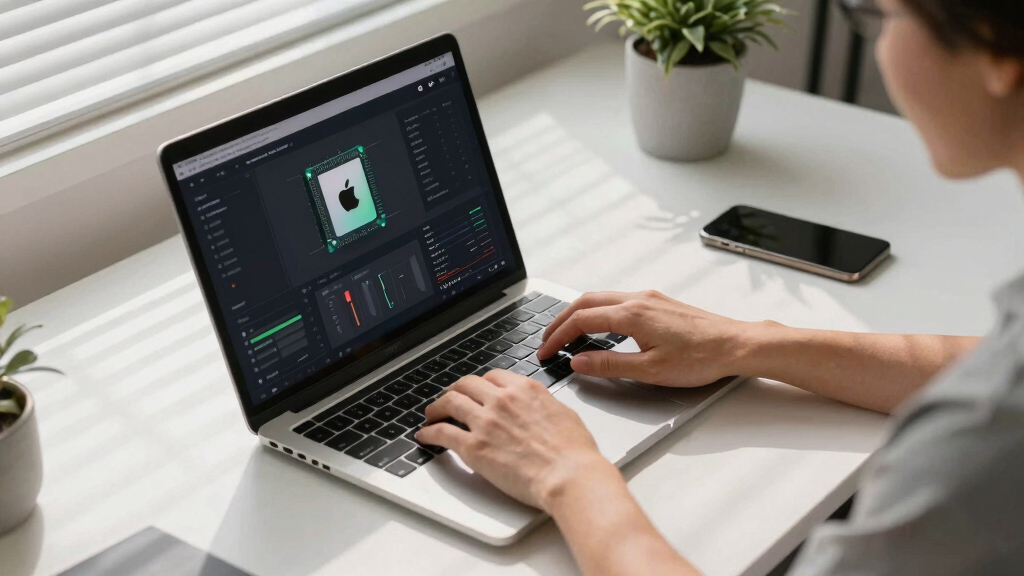

📊 Full opportunity report: Apple Silicon’s Quiet Memory Advantage on ThorstenMeyerAI.com — validation score, market gap, and execution plan.

Get business pricing on office and shipping supplies
- Business-only prices and quantity discounts
- Tax-exempt purchasing
- Multiple users, one account, clear invoices
TL;DR
Apple Silicon’s unified memory architecture allows it to handle larger AI models locally, surpassing traditional GPU limits in capacity. This provides a significant advantage for personal AI use, despite slower inference speeds.
Apple Silicon chips have a distinct shared memory architecture that allows more effective capacity for large AI models, providing a significant advantage over traditional discrete GPUs. This development is confirmed and matters because it changes how consumers can run large models locally, especially given industry-wide memory shortages.
Unlike PCs with separate system RAM and GPU VRAM, Apple Silicon shares a single pool of memory between the CPU and GPU. This means that the total available memory is directly linked to the physical RAM purchased, with configurations reaching up to 256GB or more. As a result, large AI models that typically require multi-GPU setups costing thousands of dollars can now be run on consumer-grade Macs, such as the Mac Studio, with much lower investment.
While the capacity advantage is clear, performance per token is lower compared to high-end NVIDIA GPUs due to lower memory bandwidth. For example, the RTX 4090 offers around 1,008 GB/s bandwidth, while Apple’s M-series chips manage between 546 and 800 GB/s, leading to slower inference speeds. Nonetheless, for models requiring large memory capacity, this trade-off favors Apple Silicon, especially for personal or development use.
Recent industry-wide memory shortages impacted Apple, prompting the company to withdraw certain configurations, such as the 512GB Mac Studio, and raise prices across its lineup. Despite this, the fundamental architectural advantage persists, offering more usable memory per dollar—particularly valuable during ongoing supply constraints.
Apple Silicon’s quiet memory advantage
While the discrete-GPU world fought over 24GB of brutally expensive VRAM, a Mac quietly offered to run the big model on one silent, low-watt box. Not magic — but the rare place an architecture beats the squeeze.
Mac Studio 256GB holds a 70B at near-lossless Q8, or 200B+ at Q4 — no single GPU reaches that at any price. Win zone: 32–200B models at 10–30 tok/s for personal/dev use.
M5 Max ~614 GB/s vs RTX 4090’s 1,008. A 70B runs ~12–18 tok/s on M5 Max vs 40–50 on a 5090. You buy capacity, not raw throughput. Bandwidth & capacity matter — not FLOPs.
Apple turned a laptop-efficiency design — one shared memory pool — into the most elegant answer to the part of the squeeze that hurts most: capacity. Bonus: 25–90W vs a GPU rig’s 600–1,200, ~$35–55/yr to run 24/7 vs $300–400, and silent. Right for large models, privacy, low-power always-on; wrong for max speed on small models or heavy training. Next: Build, Rent, or Quantize.
Impact of Unified Memory on Large AI Model Deployment
This architecture shift means consumers can run larger AI models locally without multi-GPU setups, reducing costs, power consumption, and noise. It also emphasizes that memory capacity and bandwidth are the key factors for AI inference performance, not just raw GPU FLOPs. As AI models grow, this could reshape the market for personal AI hardware, making high-capacity inference more accessible.
Apple Silicon Mac Studio for AI development
As an affiliate, we earn on qualifying purchases.
As an affiliate, we earn on qualifying purchases.
Industry-Wide Memory Shortages and Apple’s Adaptation
The 2026 memory squeeze has affected the entire industry, raising costs and limiting hardware options. Apple’s long-term memory contracts initially insulated it, but supply constraints led to the removal of certain high-capacity configurations and price hikes. Despite this, Apple’s unified memory architecture remains a unique advantage in enabling large-model inference on consumer hardware, a trend that emerged over recent years as AI models expanded in size.
Limitations and Industry Uncertainties in Memory and Performance
It is not yet clear how ongoing supply chain issues will impact future Apple Silicon configurations or if Apple will develop higher bandwidth chips to narrow the speed gap with NVIDIA. Additionally, the long-term scalability of unified memory for even larger models remains uncertain, especially as AI models continue to grow in size and complexity.
Future Developments in Apple Silicon and AI Hardware
Expect Apple to refine its chip designs, potentially improving memory bandwidth or offering new configurations with more RAM. Industry trends suggest a continued emphasis on shared memory architectures for large-model AI inference, with further integration and optimization likely. Monitoring Apple’s product updates and supply chain developments will clarify how these advantages evolve.
Key Questions
Can Apple Silicon fully replace high-end GPUs for AI inference?
Not for maximum speed or throughput; Apple Silicon is optimized for capacity and efficiency, making it ideal for large models at personal speeds but not for high-speed, large-scale AI training or inference where raw bandwidth is critical.
Will Apple Silicon’s memory advantage become obsolete as models grow larger?
It may face limits if AI models surpass the available RAM or if future chips do not improve bandwidth significantly. However, for many current large models, it provides a practical and affordable solution.
How does the power consumption of Apple Silicon compare to discrete GPUs?
Apple Silicon consumes significantly less power—around 25–90 watts—compared to 600–1,200 watts for high-end GPUs, resulting in lower operating costs and quieter operation.
Is the unified memory architecture upgradeable or fixed?
No, the memory is soldered and cannot be upgraded after purchase, so buyers should select a configuration that will meet their needs over the device’s lifespan.
Source: ThorstenMeyerAI.com
Columbus Day / Indigenous Peoples' Day Picks
long weekend sales
As an affiliate, we earn on qualifying purchases.