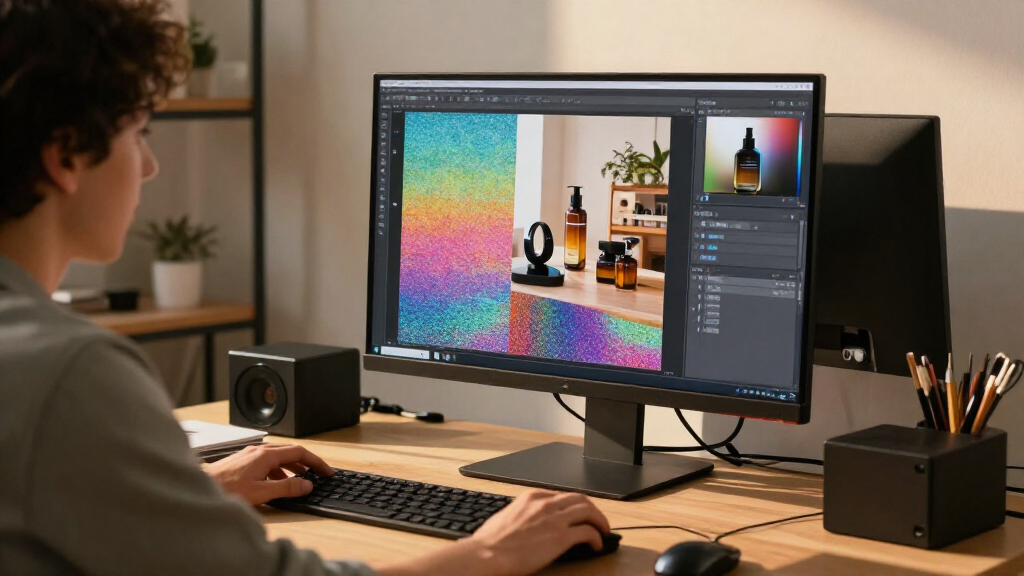
🔍 Read the full analysis: How A Diffusion Model Gradually Creates An Image on ThorstenMeyerAI.com

Get business pricing on office and shipping supplies
- Business-only prices and quantity discounts
- Tax-exempt purchasing
- Multiple users, one account, clear invoices
TL;DR
Diffusion models generate images by starting with random noise and repeatedly predicting and removing part of it. The supplied source explains how this process is trained, how text guides it, and why common limits include unreliable lettering and object placement. It does not provide a new announcement or a complete account of the later steps in the process.
A November 23 explainer from ThorstenMeyerAI.com describes how image-generation diffusion models turn random noise into a picture by repeatedly predicting and removing noise, with a text prompt steering the process. The account connects the method to published research and identifies familiar limits, including unreliable lettering and object placement; it is an explanatory article, not a report of a new model or research finding.
The process has two parts. During training, a model is shown real images that have been progressively corrupted with known amounts of noise. A neural network learns to estimate the noise at different stages. During generation, the model starts with random noise and applies its learned estimates repeatedly to produce an image. In the 2020 paper “Denoising Diffusion Probabilistic Models,” researchers Jonathan Ho, Ajay Jain and Pieter Abbeel used 1,000 steps in their experiments.
The article says the model’s output develops from large-scale features to fine details: broad arrangements take shape before edges and textures. It also describes latent diffusion, which performs the denoising in a compressed representation rather than directly on every pixel. For Stable Diffusion v1, the source says a 512-by-512 image is represented with 48 times fewer numbers in that compressed space.
To direct the output, a text encoder converts the prompt into a numerical representation, and a guidance method steers denoising toward it. The article says stronger guidance can make an image follow the prompt more closely, but may come at a cost to image quality. It also notes that researchers have extracted near-copies of training images from models, while pointing to a 2025 UK court finding that Stable Diffusion itself was not an “infringing copy.”
Why Noise Shapes Image Results
Understanding denoising helps explain both how these tools produce images and why their outputs can fail in predictable ways. The model is not retrieving a finished photograph or painting each object as a person would. It is making repeated estimates about how to remove noise from a representation, with the prompt influencing those estimates. That design can yield convincing scenes, but it does not guarantee precise control over every element.
The distinction matters to people using generated images for work or research. A prompt may specify a particular number of objects, exact lettering or a precise spatial relationship, yet the system can miscount, garble text or put one item in the wrong place. The source presents these as recurring limitations, not as failures that happen in every image. It also separates ordinary generation from the separate question of whether a model may reproduce material from its training data.
Popular right now

Sony WH-1000XM6 Wireless Noise-Canceling Headphones, Black

Ninja Luxe Café Premier 3-in-1 Espresso, Drip Coffee, and Cold Brew Machine

Bose QuietComfort Headphones (2nd Gen) Wireless Noise-Cancelling Headphones, Black
As an affiliate, we earn on qualifying purchases.
From Early Diffusion to Latent Images
The source traces the underlying idea to a 2015 paper by Jascha Sohl-Dickstein and colleagues. Their approach gradually destroys structure in data and learns a reverse process to restore it. In 2020, Ho, Jain and Abbeel’s “Denoising Diffusion Probabilistic Models” helped make the approach practical for image generation. Their paper describes a forward process that adds noise until the original signal is effectively lost, followed by a learned reverse process.
The explainer gives figures from the paper’s noise schedule: the original image’s contribution is about 81.2% after 200 steps, 28% after 500, and 0.6% after 1,000. Those numbers describe the specified schedule, not a universal setting for every diffusion model. Later systems can use fewer generation steps, and latent diffusion reduces the amount of computation by working with a compressed image representation. The source’s discussion focuses on Stable Diffusion v1 and does not establish that every current system uses the same settings.
For training, the article identifies LAION-2B(en) subsets as part of the data used for Stable Diffusion v1. It says a U-Net predicts noise added to the latent representation, describing the training objective as a comparison between the noise added and the network’s prediction. This helps explain the method without implying that the model’s behavior or training data are identical across all image generators.
“a Markov chain that gradually adds noise to the data”
— The 2020 paper “Denoising Diffusion Probabilistic Models”
Where the Explainer Stops
The supplied source text ends partway through its discussion of faster generation, so it does not provide the rest of the article’s account of step reduction, prompt guidance or image-generation pipelines. Its statements about Stable Diffusion settings should not be taken as a description of all models. The source also does not identify the specific UK case or detail which legal questions remain unresolved.
The account says that researchers have extracted near-copies of training images, but the supplied material does not name the studies, specify how often this occurs or establish how representative those examples are. It also does not give a full technical explanation of how attention or the text encoder affects each denoising step. Those details remain outside the evidence provided here.
Further Research and Legal Questions
The source describes the diffusion process and its known limits but announces no upcoming release, experiment or policy decision. Readers seeking a fuller account of faster sampling or prompt guidance would need the complete explainer and the cited technical papers. The text provided here does not say when any additional material will be published.
On the legal side, the explainer points to a 2025 UK court finding about Stable Diffusion itself, while indicating that other questions remain open. It does not specify a next hearing or ruling. The status and outcome of any further legal proceedings cannot be established from the supplied material.
Key Questions
How does a diffusion model create an image?
It starts with random noise and repeatedly predicts and removes part of that noise until an image emerges. A text prompt can guide the process toward a requested subject or style.
How does training teach the model to remove noise?
Training adds known noise to real images at different stages. A neural network learns to estimate the added noise, which gives it the skill used later to reverse the process.
Why can generated images contain misspelled text or misplaced objects?
The method predicts and removes noise rather than following a guaranteed, exact plan for every object and letter. The source lists lettering, counting and object placement among its recurring difficulties.
Does every diffusion model use 1,000 generation steps?
No. The 1,000-step figure comes from the 2020 paper’s experiments. The source says later work cut the number of steps, but the supplied text does not give the full details or a setting that applies to all models.
Does the UK court finding settle all copyright questions?
The source reports that a UK court found in 2025 that Stable Diffusion itself was not an “infringing copy.” It also says other questions remain open, but the supplied material does not identify them or give further case details.
Source: ThorstenMeyerAI.com