
🔍 Read the full analysis: Nvidia Flora And Robot Video Labeling: Lower Costs, License Considerations on ThorstenMeyerAI.com

Get business pricing on office and shipping supplies
- Business-only prices and quantity discounts
- Tax-exempt purchasing
- Multiple users, one account, clear invoices
TL;DR
Nvidia’s GEAR lab released Flora, three models for segmenting, describing and scoring robot videos. Nvidia estimates labeling costs at 72 cents per video hour, compared with $88.49 for a competing model on its test, but the estimates use different cost methods and the models are licensed for research or evaluation, not commercial production. Benchmark results are mixed, and Nvidia conducted most tests itself.
Nvidia’s GEAR robotics lab has released Flora, a set of three models designed to label robot-training video, and estimates that one part of the system could process video for $0.72 per hour. The estimate is far below the comparison API cost Nvidia reports, but it is modeled rather than a measured production bill, and the models’ noncommercial license bars companies from using them as a free production service.
Flora is made up of three models built on Alibaba’s Qwen3.5 family, according to the paper and model cards described by ThorstenMeyerAI.com. Flora-TempSeg, with 9 billion parameters, identifies time intervals for individual actions. The 27-billion-parameter Flora-Captioner writes an instruction for each interval, while the 27-billion-parameter Flora-Rewarder scores an entire episode, evaluates steps, or grades a task against a user-provided rubric.
Nvidia says it used Flora as a data engine for its GR00T-2 robot models. The model cards say training used fewer than 10,000 hours of human and robot video. The models are available through Hugging Face repositories, with inference code included there. The source report says testing used an Nvidia H100 on Linux; it estimates that each 27-billion-parameter model may require about 55 gigabytes of memory for weights in 16-bit precision, putting local use beyond typical gaming computers.
The cost comparison comes from a test of 50 episodes totaling 4,483 seconds, or about 75 minutes, on Nvidia’s DenseCaptionBench. The report says Nvidia priced GPT-6 Astra API usage at $88.49 per video hour using public rates from Oct. 4, 2026. Flora’s $0.72 figure was calculated using a modeled throughput on eight GB300 GPUs priced at an assumed $10 per GPU-hour. Nvidia’s paper gives a range of $0.51 to $1.26 per video hour and says storage and overhead are excluded. The calculation compares unlike measures: reported API usage against an estimated GPU budget.
Infographic 01 · What Flora does
Three models that turn robot video into training labels.
Flora cuts a recording into actions, describes each one and grades how well it went. The 200,000-hour figure is Nvidia’s own production claim.
Flora-TempSeg
9B · adapter on Qwen3.5-9B
- Job: Finds where each action starts and ends
- In: Video windows (one camera, or main + two wrist cameras)
- Out: Time intervals as JSON
Flora-Captioner
27B · fine-tuned Qwen3.5-27B
- Job: Describes each action, using the video before and after
- In: One interval plus context
- Out: One English instruction, e.g. “Place the blue mug on the tray with your right hand.”
Flora-Rewarder
27B · fine-tuned Qwen3.5-27B
- Job: Judges how well the robot did
- In: An episode or a 16-second window, plus the task
- Out: Score 1–5 per episode · normal / suboptimal / failure per 0.5 s · rubric scores
Three labels, three uses
Why robot models need each one, per the paper
| Label | Used for | Made by |
|---|---|---|
| Timestamped captions | Filtering and rebalancing pretraining data | TempSeg + Captioner |
| Process rewards | Reinforcement learning after pretraining: which step went wrong | Rewarder |
| Outcome rewards | Monitoring robots after deployment | Rewarder |
What it is not
model cards
- Not a robot controller: outputs are annotations only
- Not meant to be the sole safety monitor for a physical system
- Not for commercial or production use (noncommercial license)
- Hardware: tested on Nvidia H100, Linux; ~55 GB of weights per 27B model (estimate)
Sources: Flora paper, Nvidia (20 Oct 2026); Hugging Face model cards (15 Oct 2026); Nvidia GEAR project page. Weight-size estimate: Thorsten Meyer (27B parameters × 2 bytes).
Powered by Thorsten Meyer AI
Lower Labeling Costs, With Limits
Video labels help robot developers identify what an action was, when it happened and whether it succeeded. Reducing the cost of producing those labels could make it easier to process large training collections, a potential benefit as developers build systems intended to perform tasks outside controlled demonstrations. Nvidia says Flora can support labeling at scale for its own robotics work, including a claim of up to 200,000 video hours per day on 512 GB300 GPUs; that is a company-reported capacity figure, not an independently established production result.
The headline cost figure needs careful interpretation. The source report calculates a ratio of about 122.5 to 1, rounded by Nvidia to approximately 125 times, by dividing the $88.49 API estimate by Flora’s $0.72 modeled cost. It says the production GPU-hour denominator has not been verified, and 106 of 7,062 Astra attempts had no reported usage, making the API total a known-usage subtotal. The comparison also covers captioning, not Flora’s reward model. The figure is useful as a cost scenario, but it does not establish what a company would pay in a production deployment.
For businesses, licensing may matter as much as performance or compute. The models are distributed under the NVIDIA OneWay Noncommercial License, which the report describes as allowing research or evaluation only, with derivatives subject to the same restriction. That makes Flora potentially useful for evaluation and research, but not automatically a commercial labeling pipeline. Teams would need to review the license and establish what permissions apply to any intended use.
Popular right now

De'Longhi Stilosa Compact Manual Espresso Machine with Milk Frother

Breville Bambino Espresso Machine, Brushed Stainless Steel

Ninja DualZone Smart Air Fryer, 10 Qt, 6-in-1, DZ950
As an affiliate, we earn on qualifying purchases.
How Flora Labels Robot Video
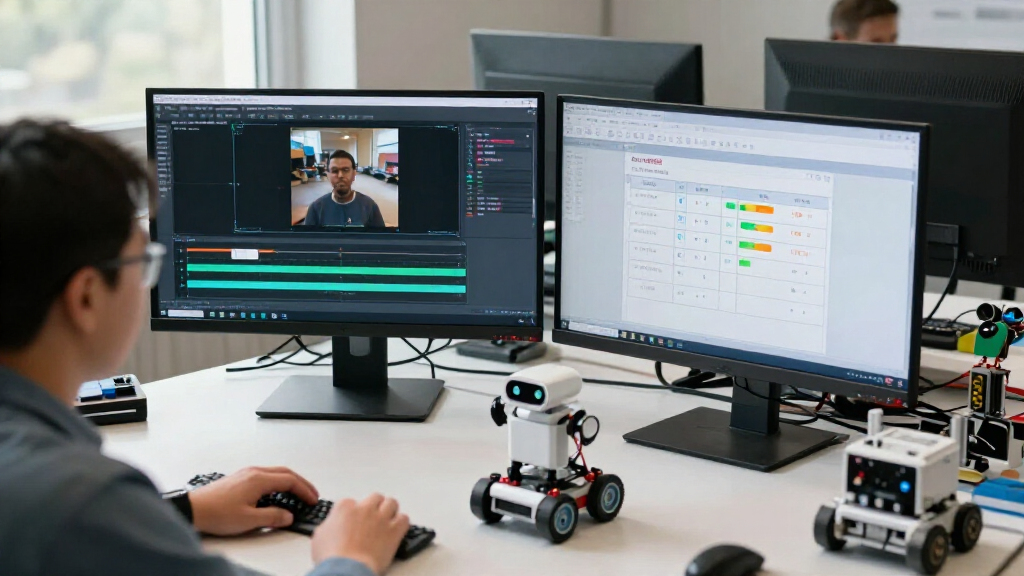
Robot-learning systems can draw on recordings of a gripper placing an object, two robot hands passing a tool, or a person folding fabric. For those recordings to support training, developers need more than raw footage. The Flora paper describes labels such as timestamped action captions, which connect an instruction to the seconds when it occurs, and reward scores that mark a step as normal, suboptimal or a failure. Such labels can help developers locate actions in large datasets and assess where a robot attempt went wrong.
The three Flora models divide that work: TempSeg finds action boundaries, Captioner describes the actions, and Rewarder scores attempts and individual steps. Nvidia’s evaluation, as summarized by ThorstenMeyerAI.com, found a mixed performance picture rather than a clean win across all tasks. Flora scored 57.1% on Nvidia’s selected DenseCaptionBench episodes, compared with 53.7% for GPT-6 Astra. The report says Flora performed better on human videos, action boundaries and partial-success judgments, while Astra remained ahead on robot videos, caption accuracy and rubric scoring.
Those results have limits. The 50 episodes came from Nvidia’s own benchmark, and the source report says Nvidia ran most of the tests. It also cites public benchmark results, including Flora’s 50.3 score against Astra’s 46.0 on WGO-Bench segmentation and a lower error rate for Flora on RoboRewardBench. These comparisons provide evidence about particular tasks, but do not establish how the models will perform across every robot, camera setup or real-world dataset.
““expensive at the scale of modern robot datasets.””
— Nvidia, as quoted in the Flora paper
Cost and Performance Still Need Testing
The $0.72 figure is not an invoice or a measured production cost. It depends on a modeled throughput and an assumed $10 hourly price per GB300 GPU, and excludes storage and overhead. The source does not establish the cost under other hardware prices, workloads or operating conditions. Nor does the 50-episode test show whether the same quality and cost would hold across larger or independently selected datasets.
Quality remains task-dependent: the reported results favor Flora on some human-video and partial-success tests, while Astra leads on some robot-video and captioning measures. The available material also does not provide independent confirmation of Nvidia’s reported processing capacity. Finally, the license terms constrain commercial use, but the source does not detail how every possible deployment, derivative or collaboration would be treated. Organizations should consult the actual license rather than infer permissions from the models’ availability online.
Independent Tests and License Review
The next useful evidence would be independent evaluations on broader robot-video datasets, with the same hardware and clearly reported costs for each model. Production measurements would help test Nvidia’s throughput assumptions and account for storage, orchestration and other operating expenses. Further comparisons should also separate captioning costs from reward scoring, which is not included in the reported 125-times calculation.
Researchers can assess Flora under its stated research and evaluation terms, while companies considering deployment will need to determine whether their intended use is permitted. The source material does not announce a commercial license or a date for additional benchmarks. Until those details emerge, the cost figure is best treated as a modeled estimate, and the performance results as evidence from specific tests rather than a general guarantee.
Key Questions
What does Nvidia’s Flora system do?
Flora includes three models: one identifies action segments in video, one captions those segments, and one scores robot episodes or individual steps.
Is Flora’s $0.72-per-hour cost a measured production price?
No. The figure is a modeled estimate based on assumed GPU pricing and throughput. The report says storage and overhead are excluded and the production GPU-hour denominator has not been verified.
Can a company use Flora commercially?
The source report says Flora is distributed under the NVIDIA OneWay Noncommercial License for research or evaluation, and derivatives inherit that restriction. Companies should check the license text for their intended use.
Did Flora outperform GPT-6 Astra in every test?
No. Flora scored higher on the reported DenseCaptionBench episodes and some other tasks, but the source says Astra led on robot videos, caption accuracy and rubric scoring.
What is not included in the reported cost comparison?
The reported 125-times comparison is for captioning and uses a modeled Flora GPU budget against reported Astra API usage. It does not include Flora’s reward model, storage or operating overhead.
Source: ThorstenMeyerAI.com