
🔍 Read the full analysis: The Creative Journey Behind “Luciole — The Synchronous Fireflies Of Vallon Creux” on ThorstenMeyerAI.com

Get business pricing on office and shipping supplies
- Business-only prices and quantity discounts
- Tax-exempt purchasing
- Multiple users, one account, clear invoices
TL;DR
Room 155 of the FABLE/175 exhibition is an AI-built interactive site about fictional fireflies whose flashes gradually synchronize. Visitors can alter the simulated field and watch it move back toward coherence; the exhibit’s maker says its visuals and model are generated in code, not drawn from field footage.
Room 155 of the FABLE/175 exhibition is an AI-built interactive field notebook that lets visitors watch 96 simulated fireflies move from scattered flashes toward a shared rhythm. Called “Luciole — The Synchronous Fireflies of Vallon Creux,” the piece uses a mathematical synchronization model, as described in the original analysis, and its creators describe the setting and fireflies as fictional rather than a real field study.
Visitors can change the strength of the simulated fireflies’ interaction and click or otherwise disturb the field, scattering their phases. The simulation then continues under the same local-interaction rules, allowing visitors to watch the lights move back toward greater coherence. A live coherence measure, trace and phase diagram are presented as readings from the model, not as illustrations of unrelated data.
The source describes each firefly as an oscillator with its own phase and tempo, influenced by nearby neighbors. The controls expose those dynamics: weaker coupling loosens the collective rhythm, while stronger coupling helps the simulated signals align. The supplied description says the room uses 96 fireflies; a separate creative brief calls for “hundreds,” so the material does not establish that the live site uses that larger count.
The exhibit’s visual and interaction elements are described as built with HTML, CSS, SVG and canvas, without downloaded image assets or prerecorded firefly footage. The source also says the simulation pauses when relevant views are offscreen or the page is hidden, and that reduced-motion preferences receive a calmer presentation. It identifies Room 155 of 175 and links to a live version, but gives no launch date or independent technical verification.
FABLE/175 · ROOM 155 · INTERACTIVE ART
The Creative Journey Behind “Luciole”
“Luciole — The Synchronous Fireflies Of Vallon Creux” turns a mathematical idea into an interactive, fictional field notebook. Visitors can disturb a field of simulated fireflies and watch their scattered flashes move toward a shared rhythm.
01 / THE EXPERIENCE
A rhythm visitors can interrupt
Instead of presenting synchronization as a finished animation, “Luciole” makes the changing pattern visible. The model continues responding as visitors alter its conditions.
OBSERVE
Individual clocks
Each simulated firefly has its own phase and tempo, producing a field of flashes that begins out of step.
INTERACT
Change the coupling
Visitors can adjust interaction strength and disturb the field, scattering the simulated phases.
FOLLOW
Watch coherence return
Under local-neighbor rules, the signals move back toward greater alignment. A live measure, trace and phase diagram report the model’s state.
02 / THE MODEL
From scattered flashes to shared rhythm
The supplied art direction names the Kuramoto model, a mathematical framework for studying coupled oscillators. The visualizations are readings from this simulation, not unrelated field data.
Each oscillator keeps an individual rhythm while nearby neighbors influence its timing. The result depends in part on coupling strength: weaker interaction loosens the collective pattern; stronger interaction helps phases align.
Visitors can perturb the field and then observe how the same local rules shape its response. The piece invites experimentation with a model rather than making claims about a particular species or natural site.
The maker describes the fireflies and Vallon Creux as fictional. The naturalist framing, nighttime palette, and notebook-like annotations are part of the artwork.
Coupling, in the room’s terms
Phases remain more scattered.
Neighbors influence one another over time.
The shared rhythm becomes more coherent.
03 / THE VISITOR LOOP
A small experiment in four moves
The interaction turns an abstract process into something visitors can observe and test directly in the browser.
Watch
See independent flashes across the simulated field.
Adjust
Change how strongly nearby fireflies influence one another.
Disturb
Interrupt the phases and scatter the collective pattern.
Observe again
Follow the model as local interactions move it toward coherence.
04 / MAKING THE FICTION
A field notebook built in code
The room pairs a literary presentation with a browser-based simulation and visual system.
VISUAL LANGUAGE
Forest after dark
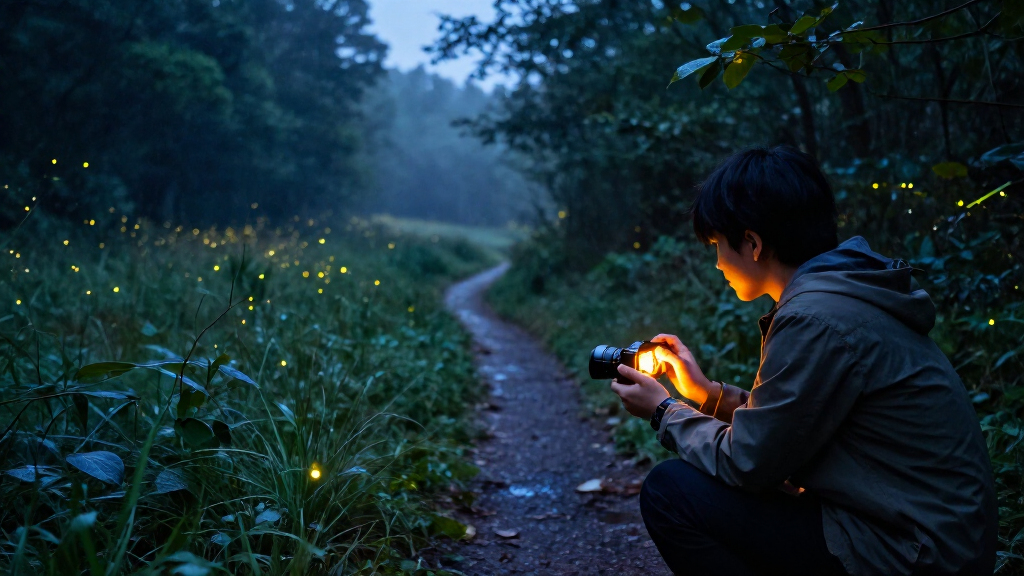
The described palette combines forest-dark green, chartreuse flashes and muted mauve notes, with a literary serif and handwritten marginal details.
IMPLEMENTATION
Made for the browser
The source describes HTML, CSS, SVG and canvas visuals, without downloaded image assets or prerecorded firefly footage.
ACCESSIBILITY
Responsive behavior
The description says the simulation pauses when relevant views are offscreen or the page is hidden, with a calmer presentation for reduced-motion preferences.
05 / WHAT IS ESTABLISHED
Room description and brief, side by side
The supplied material distinguishes features described for the room from ideas requested in its accompanying creative brief.
| Detail | Room description | Creative brief / status |
|---|---|---|
| Firefly count | Specifies 96 simulated fireflies. | Brief asks for “hundreds”; the difference is unexplained. |
| Invented setting | Vallon Creux and the fireflies are described as fictional. | Consistent framing; not a real field study. |
| Synchronization | Individual phases and tempos respond to nearby neighbors. | Kuramoto model named in the art direction. |
| Extra concepts | Not confirmed in the supplied room description. | Species and seasonal calendar appear as requested ideas, not verified live features. |
| Launch and review | No launch date, independent technical review or test results are provided. | Unverified from the supplied material. |
How to read the exhibit: it can help explain the behavior of a synchronization model. It does not provide evidence about real firefly populations, a real place, or field conditions.
06 / KEY QUESTIONS
What visitors should know
What is “Luciole”?
Room 155 of FABLE/175, described as an AI-built interactive field notebook that simulates fireflies whose flashing rhythms gradually align.
Are the fireflies or Vallon Creux real?
No. The source describes both the setting and fireflies as fictional; this is not a real field study.
How many fireflies are shown?
The room description specifies 96. Its accompanying brief requests “hundreds,” and the supplied source does not resolve the discrepancy.
What can visitors change?
They can adjust coupling and perturb the field, then observe how the simulated phases respond under local interaction rules.
OPEN THE ROOM
Visit the live field
Observe the simulated flashes, adjust coupling and test how the model responds. The supplied material announces no future release or exhibition schedule.
FABLE/175 · ROOM 155
“Luciole — The Synchronous Fireflies Of Vallon Creux”
The linked prompt also lets readers compare the stated art direction with the finished room; assessing implementation or performance requires direct testing.
OPEN THE LIVE EXHIBIT ↗Making Synchronization Visible
Rather than showing synchronization as a finished animation, “Luciole” makes it a process visitors can interrupt and observe. Its central idea is that a collective rhythm can emerge from simple interactions among individual agents. The ability to disturb the model and watch its response gives the concept a direct, interactive form.
The piece also puts the AI production process on display. The source says the site was built by AI and that the underlying creative prompt is linked in the exhibition’s footer. That makes the room both an artwork and a demonstration of a workflow: an art-direction brief is translated into a functioning browser experience, with a simulation, visual system and accessibility features. The source does not provide an independent assessment of how much of the implementation was generated by AI or how it was tested.
For visitors, the distinction between a simulated system and a biological observation matters. The exhibit may help explain synchronization, but its fictional location and modeled fireflies do not constitute evidence about real firefly populations. Its value is in showing the behavior of the model and inviting people to test it.
interactive firefly simulation kit
As an affiliate, we earn on qualifying purchases.
As an affiliate, we earn on qualifying purchases.
A Fictional Field Notebook
Vallon Creux is identified in the source as an invented hollow, and Luciole is an invented exhibit setting—not a real organization, place or field study. The title’s naturalist framing, nighttime palette and notebook-like annotations are part of the artistic presentation. The source describes forest-dark green, chartreuse flashes and muted mauve notes, with a literary serif for the main text and a handwritten style for marginal details.
The supplied art-direction brief calls the synchronization approach a Kuramoto model, a mathematical framework for studying coupled oscillators. It describes agents with individual clocks that influence one another and asks for a gradual shift from disorder to unison. The room’s own description specifies 96 simulated fireflies and says the shared rhythm emerges through local interactions. These are accounts of the exhibit’s design, not claims that the simulation reproduces a particular species or natural site.
The brief also outlines intended features such as a “wait for it” section, invented species and a seasonal calendar. The available room description does not confirm which of those brief elements appear in the live experience, so they should not be treated as verified site features.
“breaking the sync and watching it heal.”
— The art-direction brief reproduced by the exhibition
What the Source Leaves Unverified
The supplied material does not state when the room launched, who implemented or reviewed the final site, or whether an external party tested its accessibility and performance. It describes the simulation and its interface but does not provide code, measured frame rates or independent validation of the model’s behavior.
There is also a difference between the source’s room description, which specifies 96 simulated fireflies, and its accompanying brief, which requests “hundreds.” The source does not explain whether the brief was revised during production or whether the live site contains a different count. Nor does it confirm which other requested features—such as invented species or a two-week calendar—were ultimately included.
Visitors Can Test the Live Field
The source invites readers to open the room in a browser at https://fable-25-830.netlify.app/sites/luciole/. There, visitors can observe the simulated flashes, adjust coupling and perturb the field to see how the model responds. No future release, exhibition schedule or additional development milestone is announced in the supplied material.
The linked prompt offers a way to compare the stated creative brief with the finished room. Any assessment of how closely the site follows that brief, or how reliably it performs across devices, would require direct testing beyond the information provided here.
Key Questions
What is “Luciole — The Synchronous Fireflies of Vallon Creux”?
It is Room 155 of the FABLE/175 exhibition, described as an AI-built interactive field notebook. It simulates fireflies whose flashing rhythms gradually align.
Are the fireflies and Vallon Creux real?
No. The source says Luciole and Vallon Creux are fictional and that the exhibit is not a real field study. The fireflies are simulated.
How does the synchronization work?
Each simulated firefly has its own phase and tempo and is influenced by nearby neighbors. Visitors can change the interaction strength and disturb the field, then observe the model’s response.
How many fireflies are in the exhibit?
The room description specifies 96 simulated fireflies. Its accompanying creative brief asks for hundreds, and the source does not clarify that difference.
Where can I see the exhibit?
The source lists the live room at https://fable-25-830.netlify.app/sites/luciole/. The supplied information does not give a launch date or planned end date.
Source: ThorstenMeyerAI.com
Fall Picks
fall essentials
As an affiliate, we earn on qualifying purchases.