
To boost your email response, leverage FOMO and scarcity by creating genuine urgency. Use tactics like countdown timers, limited stock notices, and exclusive offers to trigger emotional responses and tap into loss aversion. Show that the opportunity is rare and time-sensitive to encourage quick action. Incorporating social proof also amplifies the effect. Mastering these strategies will help you harness human psychology for better engagement—if you keep exploring, you’ll discover how to apply them effectively.
Key Takeaways
- Use genuine, immediate scarcity cues like limited stock or time-sensitive offers to trigger urgency and prompt quick responses.
- Incorporate countdown timers and visible stock levels to reinforce the limited availability and increase FOMO.
- Highlight exclusivity for specific groups to make offers feel rare, boosting perceived value and response likelihood.
- Combine social proof, such as “Others are acting now,” to amplify urgency and reinforce scarcity’s impact.
- Ensure scarcity tactics are authentic to maintain credibility and maximize trust, leading to higher engagement.

Have you ever wondered why some email campaigns instantly grab your attention and prompt quick action? The answer often lies in the psychology behind urgency and how marketers design scarcity tactics to create a sense of limited opportunity. When you receive an email that offers a deal ending soon or highlights limited stock, your brain perceives it as a rare chance you shouldn’t miss. This emotional response triggers a fear of missing out (FOMO), making you more likely to open the email, click through, and convert. It’s a clever way to tap into human instincts that prioritize scarcity and urgency over rational decision-making.
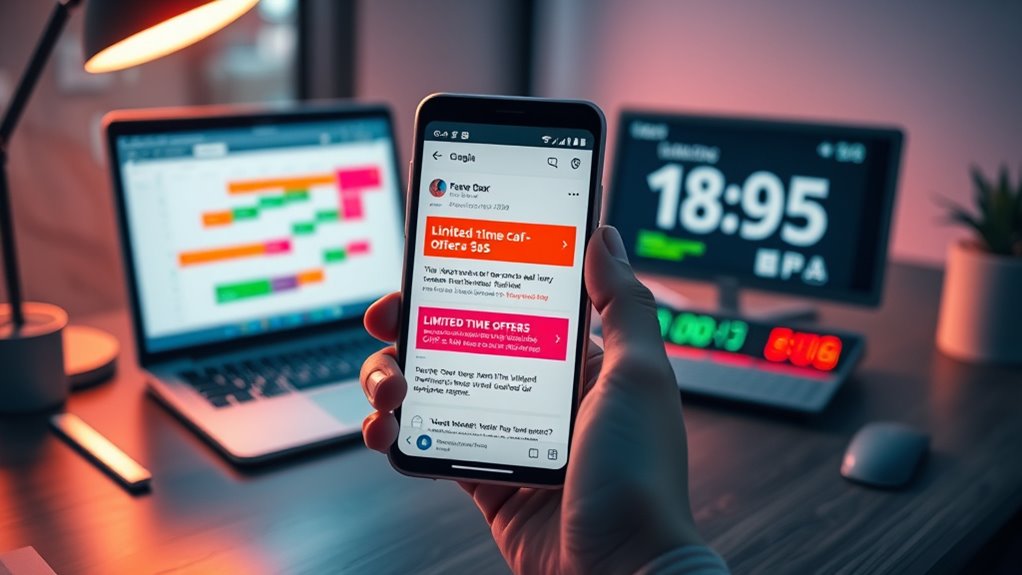
Designing scarcity tactics involves more than just stating “limited time offer.” It’s about framing the message so that your audience perceives scarcity as genuine and immediate. For example, using countdown timers, showing the number of remaining items, or emphasizing that an offer is exclusive to a certain group heightens the sense of urgency. When you see a timer ticking down or a message like “Only 3 left in stock,” your mind quickly assesses that this opportunity might vanish soon. This perception of limited availability pushes you to act swiftly, often without overthinking.
Understanding the psychology behind urgency helps you craft emails that resonate on a subconscious level. Humans are wired to avoid loss more than they seek gain—a concept known as loss aversion. When an email taps into this instinct by highlighting what you stand to lose if you don’t act now, it increases the likelihood of immediate response. Scarcity tactics work because they exploit this bias. By emphasizing exclusivity or limited availability, you create a perception that the offer is rare and valuable, prompting you to prioritize it over other options.
Humans prioritize avoiding loss; scarcity highlights what’s at risk, prompting quick action to avoid missing out.
You’ll notice that successful email campaigns often combine urgency with social proof, such as mentioning how many others have already taken advantage of the offer. This combination amplifies FOMO, making you feel like you’re part of a select group missing out if you don’t act quickly. As a result, your decision to engage feels less like a rational choice and more like an instinctive move to avoid regret. Additionally, leveraging scarcity cues like limited stock or time-sensitive deals can significantly boost response rates by reinforcing the urgency.
In essence, leveraging FOMO and scarcity in your email marketing taps into deep-seated psychological triggers. When you design scarcity tactics thoughtfully, you don’t just inform your audience—you influence their behavior by creating a sense of urgency that compels immediate action. That’s why some campaigns generate such rapid responses—they understand and utilize human nature to their advantage.

Antonki 2 Pack Digital Timer for Kids Classroom Kitchen Timers for Cooking
- Timer Modes: Count up and countdown functions
- Alarm Options: Loud and silent alarm modes
- Display & Controls: Large screen with easy-to-use buttons
As an affiliate, we earn on qualifying purchases.
As an affiliate, we earn on qualifying purchases.
Frequently Asked Questions
How Can I Measure the Effectiveness of FOMO Strategies?
To measure your FOMO strategies’ effectiveness, start by tracking engagement metrics like open rates, click-through rates, and conversions. Conduct A/B testing to compare different scarcity tactics and see which drives higher responses. Look for increases in urgency-driven actions, such as limited-time offers or low-stock alerts. Analyzing these data points helps you understand what resonates most, enabling you to refine your strategies for better email performance.
What Are Ethical Considerations When Using Scarcity Tactics?
Is scarcity a double-edged sword? Absolutely. You must prioritize truthfulness and transparency to respect consumer autonomy. Ethically, you avoid manipulating feelings or creating false urgency; instead, focus on genuine scarcity that offers real value. By doing so, you build trust and foster long-term relationships. Always remember, honesty in your tactics guarantees customers feel respected rather than coerced, turning scarcity into a positive experience rather than a deceptive ploy.
How Do Different Audience Segments Respond to Scarcity?
You’ll find that different audience segments respond uniquely to scarcity, influenced by cultural differences and generational preferences. For example, younger audiences may see scarcity as exciting and urgent, while older groups might view it skeptically. Cultural norms shape perceptions too—some cultures value exclusivity, making scarcity more effective. Tailor your approach by understanding these factors to boost email responses effectively without overwhelming or alienating your audience.
What Timing Best Enhances FOMO Without Causing Annoyance?
Timing is everything, so you should optimize when you send your emails to maximize FOMO without annoying recipients. Aim for moments when emotional triggers are strongest, like right before a deadline or limited-time offer ends. Use timing optimization to create urgency, but avoid overdoing it—sending too many messages too often can backfire. Find that sweet spot where urgency sparks interest without overwhelming your audience.
Can FOMO and Scarcity Be Used in B2B Email Campaigns?
Yes, you can definitely use FOMO and scarcity in B2B email campaigns. These psychological triggers tap into your audience’s sense of urgency, motivating quicker responses. Use marketing tactics like limited-time offers or exclusive access to create scarcity. Just make sure your messaging remains genuine and relevant, so it doesn’t seem manipulative. When done right, these tactics boost engagement and help you close deals faster.
Conclusion
By tapping into FOMO and scarcity, you can make your emails feel urgent and irresistible. When your audience feels they might miss out, they’re more likely to take action. So, why not use these powerful tools to boost your response rates? Remember, hesitation often leads to missed opportunities—so create that sense of urgency today and watch your engagement soar! Are you ready to turn scarcity into your secret weapon?