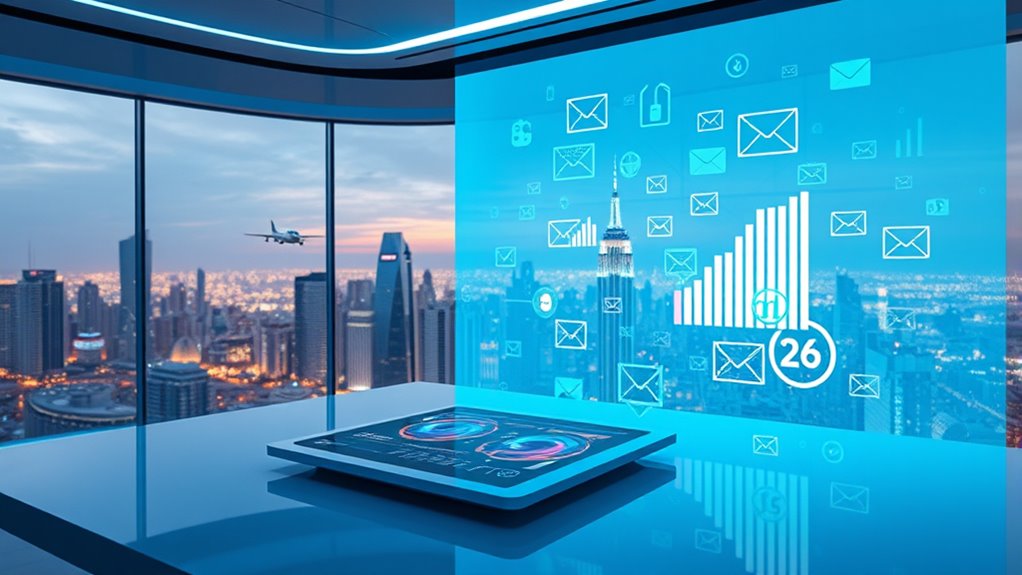

By 2026, email service providers will focus on smarter AI-driven features that personalize content and boost engagement, while also prioritizing privacy with end-to-end encryption and transparent data controls. Expect intuitive interfaces, automatic organization, and intelligent response options that make managing your inbox easier and more secure. Leading providers will balance innovation with privacy protection, building trust and loyalty. If you want to discover how these trends will shape your email experience, keep exploring these exciting developments.
Key Takeaways
- AI-driven personalization and smarter inbox management will enhance user engagement and efficiency.
- Privacy features like end-to-end encryption and transparent data controls will be central to platform differentiation.
- User interfaces will become more intuitive, incorporating automated categorization and smart reply functionalities.
- Integration of advanced analytics and tailored content will optimize marketing strategies and audience targeting.
- A balance between innovative AI features and privacy protections will define the competitive landscape by 2026.
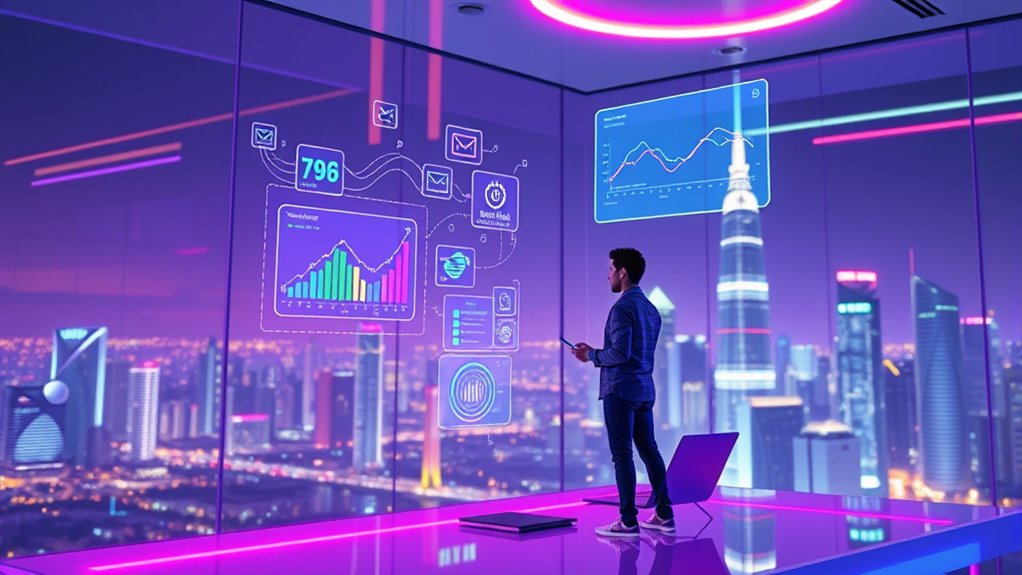
The future of email service providers (ESPs) hinges on their ability to adapt to rapidly evolving technology and user expectations. As we move toward 2026, two key areas are shaping this landscape: AI integration and privacy enhancements. You’ll notice that AI is transforming how emails are managed, personalized, and responded to. Advanced algorithms will analyze your communication patterns to suggest smarter, context-aware responses, making your inbox more efficient. AI will also help filter out spam and phishing attempts more effectively, protecting your data and reducing clutter. These integrations mean you’ll spend less time sorting through junk and more on meaningful interactions. Meanwhile, privacy enhancements will become a top priority for ESPs aiming to build trust and comply with stricter regulations. You’ll see providers adopting end-to-end encryption for your messages, ensuring your communications stay private from sender to recipient. Enhanced privacy features will also include transparent data handling policies, giving you more control over what information is collected and how it’s used. Expect to see privacy dashboards integrated directly into email platforms, allowing you to monitor and manage your data permissions easily. As user expectations grow for seamless, secure experiences, ESPs will invest heavily in these privacy tools, making them a core part of their offerings. Integration of AI and privacy features will also influence how these services develop their interfaces. You’ll encounter more intuitive, user-friendly designs that prioritize security without sacrificing convenience. Features like automatic email categorization, personalized content suggestions, and smart reply options will become standard, all while maintaining high privacy standards. Additionally, content personalization driven by AI will enable ESPs to deliver more relevant and engaging messages, improving overall user engagement. AI-powered analytics will enable ESPs to offer more tailored marketing strategies, helping you reach your audience more effectively without infringing on privacy. This balance between smarter technology and privacy protection will define the next wave of email platforms. As a user, you’ll benefit from smarter inbox management, improved security, and greater transparency. ESPs that invest in these areas will stand out by providing a more reliable, personalized, and secure email experience. They’ll also leverage AI to automate routine tasks, freeing you from mundane chores and allowing you to focus on more important work. Overall, the integration of AI and privacy enhancements isn’t just a trend; it’s a necessary evolution for ESPs to stay relevant in a world that demands both efficiency and security. If you’re looking ahead, expect your email experience in 2026 to be more intelligent, private, and secure than ever before.

The Complete Guide to Proton Services: A Technical Overview
As an affiliate, we earn on qualifying purchases.
As an affiliate, we earn on qualifying purchases.
Frequently Asked Questions
How Will AI Personalize Email Content in 2026?
In 2026, AI-driven personalization will tailor your email content seamlessly using advanced machine learning algorithms. You’ll notice that emails become more relevant, predicting your preferences based on past behavior and interactions. These algorithms analyze your activity in real-time, allowing providers to craft personalized subject lines, offers, and content that resonate with you instantly. This makes your inbox experience more engaging, targeted, and efficient, saving you time and increasing your connection with brands.
What Security Measures Will Protect Email Users in the Future?
Your email security in 2026 will be unstoppable, like a fortress no hacker can breach. End-to-end encryption will safeguard your messages, ensuring only you and your recipient access the content. Biometric authentication, such as fingerprint or facial recognition, will add an extra layer of protection, making unauthorized access nearly impossible. Together, these measures will create a future where your email privacy is protected with the fiercest security technology available.
Will Email Providers Support New Communication Protocols?
Yes, email providers will support new communication protocols as part of email protocol evolution. They’ll actively integrate these protocols into their systems, enhancing security, interoperability, and user experience. Expect providers to adopt standards that streamline communication, reduce spam, and improve encryption. Your email experience will become more seamless and secure, with providers continuously updating their infrastructure to align with emerging protocols for better connectivity and privacy.
How Will Privacy Regulations Impact Email Marketing Strategies?
Privacy regulations will substantially impact your email marketing strategies by emphasizing data privacy and user consent. You’ll need to ensure that your campaigns comply with laws like GDPR and CCPA, which require clear consent from users before collecting or using their data. This means being transparent about data use, obtaining explicit user approval, and prioritizing secure data handling, ultimately building trust with your audience and avoiding legal penalties.
What Emerging Technologies Could Disrupt Email Service Providers?
Blockchain boosts security by building trust, while quantum encryption quickly quells data breaches. These emerging technologies could disrupt email service providers by dramatically enhancing security and privacy, making traditional methods obsolete. You might find your inbox safer and more secure as blockchain‘s transparent trust and quantum’s unbreakable encryption challenge existing security standards. Stay alert, because these innovations could revolutionize how you send and receive sensitive information, reshaping the email landscape entirely.

Gmail App 2026 for Beginners and Seniors: The Complete Step-by-Step Guide to Mastering Email Management, Unlocking AI-Powered Features, and Protecting … Multimedia And Software Updates (AMS))
As an affiliate, we earn on qualifying purchases.
As an affiliate, we earn on qualifying purchases.
Conclusion
As you navigate the evolving landscape of email service providers, staying ahead means embracing innovation and adaptability. With AI-driven personalization, enhanced security, and seamless integrations becoming the norm, are you ready to leverage these trends to boost your communication strategy? The future holds endless possibilities—are you prepared to harness them and remain competitive in 2026 and beyond? The choice is yours; the future of email is in your hands.
privacy-focused email client
As an affiliate, we earn on qualifying purchases.
As an affiliate, we earn on qualifying purchases.

The Almighty Laser Tape Measure Ruler | Laser Distance Measurer, Magnetic Heavy-Duty Tool with Digital Level, Smart Range Finder, Easy-Read Display | 196ft / 60m
DUAL MEASUREMENT IN ONE TOOL. Fast laser distance measurer plus classic tape gives accurate ft, metric and fractions….
As an affiliate, we earn on qualifying purchases.
As an affiliate, we earn on qualifying purchases.