TL;DR

Get business pricing on office and shipping supplies
- Business-only prices and quantity discounts
- Tax-exempt purchasing
- Multiple users, one account, clear invoices
Halloween-themed promotional products are branded items built around spooky imagery, autumn colors, and seasonal traditions. Choose them for the people and setting, keep your branding readable, check safety and full costs, and order with enough time for customization and delivery. Reusable, practical items can stay in use after October, while a clear QR code or offer can connect a giveaway to a measurable campaign.
A glow bracelet can disappear into a child’s costume by bedtime; a sturdy tote bag might carry groceries for months. That difference is the heart of choosing Halloween-themed promotional products: the right giveaway fits the moment and gives people a reason to keep your brand around.
This guide walks you through matching products to your audience, making your logo readable, planning for safety and timing, and measuring whether the promotion worked. You’ll also see how small choices—like sealed candy or a scannable QR code—can make an event feel better organized.
Match the item to the recipient and setting: child-friendly, age-appropriate choices differ from workplace gifts.
Keep Halloween artwork simple enough that your logo, message, and any QR code remain readable.
For children’s products, review age guidance, materials, small parts, and relevant safety requirements.
Compare the full cost, including customization, setup, packaging, shipping, and storage.
Choose a measurement before distribution, such as coupon redemptions, QR visits, or event participation.
What Halloween Promotional Products Can Do for Your Campaign
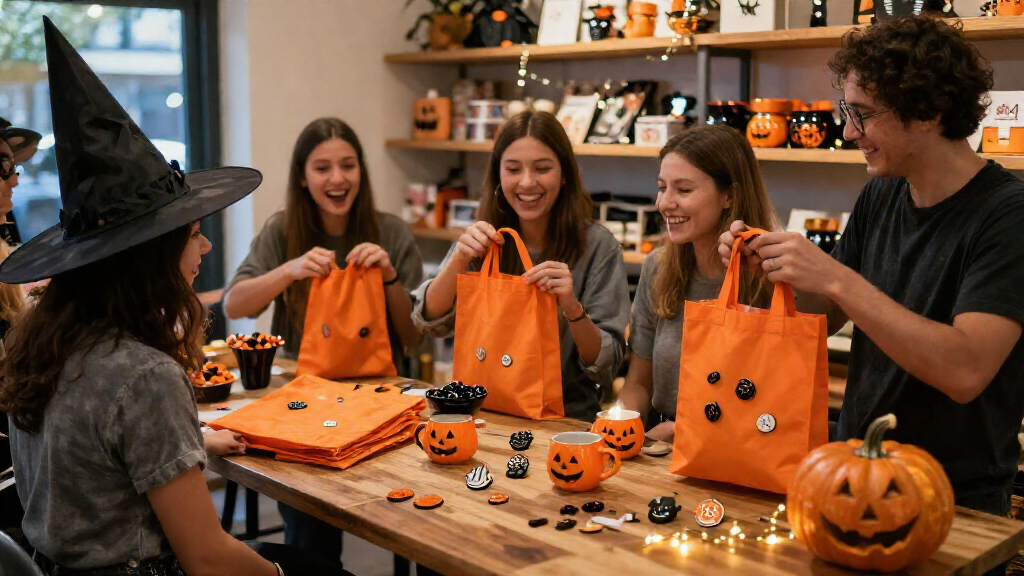
Halloween promotional products are branded items designed around the holiday’s spooky imagery, autumn colors, costumes, and trick-or-treating traditions. Businesses use them at community events, in stores, at trade shows, and for office celebrations. Think of a useful giveaway as a small sign that travels home in someone’s hand.
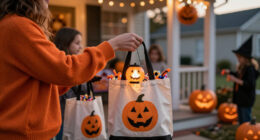
For example, a neighborhood bakery could hand out sealed treat bags with a simple pumpkin logo and a coupon for hot cider. The product gives families something to carry, while the coupon gives them a clear next step. A desk mug at an office event serves a different purpose: it puts the brand in view long after the paper cobwebs come down.
The item should reinforce the campaign rather than feel like a random seasonal extra. A school event with candy restrictions may suit stickers or glow accessories, while an adult customer event could call for a mug or reusable bag. These are branded items designed around a season, but the audience decides whether they feel thoughtful or disposable.
Which Giveaways Fit Children, Adults, and Events?
Choose the giveaway by recipient and setting: treat bags, stickers, and glow items often fit family events, while drinkware, apparel, and desk accessories may suit adult audiences. Product popularity varies by campaign and supplier, so use the list below as a starting point rather than a live ranking. A product that works at a school fair may feel out of place at a professional trade show.
- For children and families: treat bags, stickers, temporary tattoos, glow accessories, or simple toys. Check age guidance and small parts before handing them out.
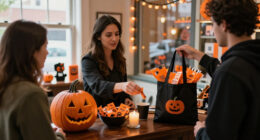
- For adults: mugs, tumblers, socks, T-shirts, reusable shopping bags, or practical desk items.
- For mixed crowds: autumn-themed totes or stickers can suit more ages and feel less startling than gory or frightening designs.
- For food giveaways: use sealed packaging, share ingredient information where possible, and account for allergies and local event rules.
Picture a busy community center where a volunteer has one minute with each family. A bright bag is easy to hand over; a tiny item with several separate parts takes longer to explain and can be easier to lose. The best choice is often the one people can understand and use without instructions.
How Can You Make Your Brand Easy to Spot?
To make a seasonal giveaway easy to recognize, keep the logo legible, use a short message, and leave enough open space around both. Halloween graphics can be loud: orange, black, bats, candy, and ghosts all compete for attention. Your logo should read at arm’s length, like a street sign through a foggy night.
Before approving a design, check a small proof at the size people will actually see. A white logo may vanish against a pale pumpkin, while thin lettering can disappear over busy artwork. For a local bookstore, one orange pumpkin, a clear logo, and “Storytime at 6” could work better than a full scene of ghosts, stars, and tiny text.
A QR code can connect a physical item to a coupon, event page, or seasonal promotion. Give people a reason to scan it—“Scan for tonight’s event schedule” is more useful than an unexplained square—and test it on the finished artwork. Keep the code large enough to scan and avoid placing it across folds or curved surfaces.
What Should You Check Before Ordering?
Before you place an order, check safety, lead time, and total cost, not just the item’s unit price. Custom artwork needs approval, and production and shipping take time; a late box of Halloween bags is still a missed event. Ask the supplier for current lead times and a quote that includes decoration, setup, packaging, and shipping.
- Set the event date and quantity. Include a realistic buffer for extras, damaged pieces, and late registrations.
- Review the audience and rules. For children’s items, check age guidance, materials, small parts, and applicable safety requirements. Confirm venue policies about food and giveaways.
- Approve a readable proof. Check logo contrast, spelling, QR-code scanning, and how the design looks at actual size.
- Confirm every cost and delivery detail. Ask about setup fees, packaging, shipping, storage needs, and the delivery date.
- Choose a way to measure results. Set up a coupon code, QR link, event tally, or another measure before distribution.
Say your office party is October 25 and you need 200 customized mugs. Getting a supplier’s lead time and proof deadline first gives you room to revise a dark logo or fix an address before the boxes head out. The extra planning also makes it easier to compare quotes on the same basis.
How Do Reusable Items and Seasonal Designs Change the Choice?
Reusable products can stay useful past Halloween, while single-use novelties serve a quick moment. Tote bags, drinkware, clothing, and practical accessories can carry a brand into November and beyond. That longer life depends on whether the item suits the recipient; an attractive bag that nobody uses still misses its mark.
Choosing between a reusable item and a novelty is a tradeoff between lasting utility and immediate delight. A glow accessory can make a family event more engaging, but its short useful life may limit how often the brand is seen. A tote or mug can extend that exposure, though it may cost more upfront and take up more storage. Consider the cost per likely use as well as the unit price, and avoid assuming durability alone makes an item a good fit.
Broad promotional-product trends include reusable and recycled-material options, personalization, small-batch orders, and links between in-person giveaways and online campaigns. These are general market patterns, not a current bestseller list, and availability varies by region and supplier. If you describe an item as environmentally friendly, name the specific material or feature and verify the supplier’s evidence instead of relying on a vague claim. Material claims matter because recipients may judge the brand by whether its environmental language matches the product they receive.
Seasonal design can also affect who feels welcome at an event. Pumpkins, falling leaves, and playful bats can create a festive look without relying entirely on frightening or culturally narrow imagery. A community center, for instance, could pair autumn colors with a friendly cat illustration so younger children can enjoy the display without a wall of skeletons. The design can keep its seasonal character while remaining comfortable for a broader mix of ages and backgrounds.
How Can You Tell If the Promotion Worked?
Measure a Halloween promotion by connecting the giveaway to one clear action, such as visiting a page, using a coupon, attending an event, or making a purchase. Count how many items you distributed, then compare that total with the response you wanted. A QR code that leads to a specific seasonal offer makes visits easier to track than a link to a broad homepage.
For example, a café might print a unique “PUMPKIN15” code on 300 treat bags and count redemptions through November 2. A community group could instead track event attendance or how many people visit a signup page. Decide on the measure before printing so the link, code, or tally sheet is ready when the giveaways leave the table.
Results can tell you what happened in that campaign; they do not promise the same outcome next year. Weather, event turnout, distribution, and the offer itself can all shape response. Keep historical figures with their dates and campaign details so your next decision rests on a fair comparison.
Frequently Asked Questions
What Halloween promotional products are popular?
Common choices include treat bags, stickers, glow accessories, apparel, drinkware, and reusable bags. The right pick depends on who will receive it, where you’ll distribute it, and whether you want a quick novelty or something people can reuse.
When should I order customized Halloween giveaways?
Order early enough for artwork approval, production, shipping, and distribution. Ask the supplier for current lead times and proof deadlines before setting your order date, especially if you need customized or imported products.
What are good Halloween giveaways for children?
Treat bags, stickers, glow items, and simple toys are common options. Check age guidance, materials, small parts, and applicable safety requirements; for young children, avoid items with small parts.
What can I give adults instead of candy?
Consider a reusable bag, mug, tumbler, socks, apparel, or a practical desk item. A short seasonal message or a coupon can connect the gift to your campaign without crowding the design.
How much do customized Halloween products cost?
Prices depend on the product, quantity, decoration method, packaging, and shipping. Request a quote that includes setup fees and other charges so you can compare the full cost rather than the unit price alone.
Conclusion
Choose one Halloween giveaway that fits your audience, looks unmistakably like your brand, and has a clear job in the campaign. Check the proof, safety details, full quote, and delivery date before you approve it.
A good seasonal item earns a place in someone’s day after the last paper bat comes down.
Evergreen bestsellers Picks
bestsellers
As an affiliate, we earn on qualifying purchases.