
🔍 Read the full analysis: The AI Benchmark Behind OpenAI’s AMD Chip Design Improvement Claim on ThorstenMeyerAI.com

Get business pricing on office and shipping supplies
- Business-only prices and quantity discounts
- Tax-exempt purchasing
- Multiple users, one account, clear invoices
TL;DR
OpenAI said its models rewrote parts of AMD chip designs and found up to 14% gains in power, performance and area against heavily optimized baselines. That figure is a best-case result reported by OpenAI; the affected blocks, typical gains and independent verification have not been disclosed.
OpenAI said on November 18 that its models had rewritten portions of AMD chip designs and found up to 14% improvements in power, performance and area (PPA) against heavily optimized baselines. The company says some model-generated changes are already in an AMD design sent for manufacturing, but the headline figure is an OpenAI-reported best case, with no public independent audit or detailed account of which chip blocks produced it.
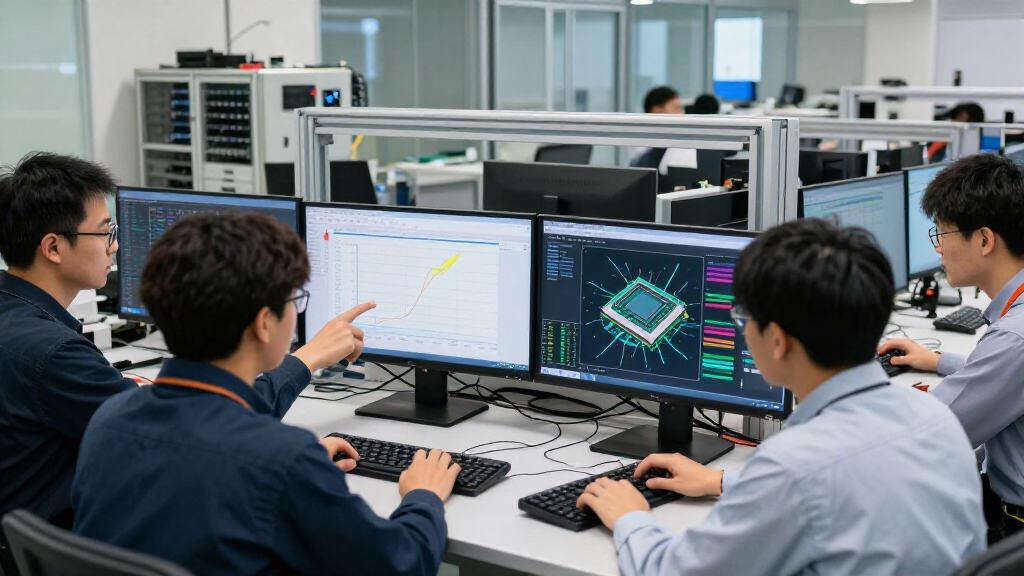
The work targeted register-transfer-level (RTL) code, which describes how a chip’s circuit blocks behave. OpenAI’s models proposed alternative RTL implementations; according to the company, Synopsys design tools then checked whether the rewrites preserved the original behavior and evaluated their PPA trade-offs. These checks are distinct from the model’s proposals: the model suggested the changes, while conventional engineering software tested them.
OpenAI reported separate results for AMD’s products. For a flagship GPU design, it cited gains of up to 14% against what it described as heavily optimized baselines. For key blocks in AMD’s next flagship CPU, OpenAI said AMD had verified single-digit PPA gains. OpenAI also said some GPU changes had entered a design sent for manufacturing, while other changes were added to design files for future versions.
The company described results from its own custom inference chip, called Jalapeño, as well. OpenAI said model-proposed changes reduced standard-cell area by about 13% in one unit and 10% in another, with validation after the first chips returned. Reports differ on the name of the first unit: ANI calls it a vector unit, while Inside AI calls it a warp engine. Those figures concern area in specific blocks, not an overall reduction in chip size.
AI’s Role in AMD Chip Design
If the reported changes hold up in production, AI-assisted RTL work could help engineers explore more circuit implementations without requiring every alternative to be written by hand. Power, performance and area are linked design constraints: an improvement in one can affect the others, and a useful result must also preserve correct behavior. The reported use of established verification tools is therefore central to the claim, not a technical footnote.
The announcement matters to readers because it describes AI being applied to the hardware used to run AI systems, potentially shortening part of the design process. But the evidence supports a narrower conclusion than a general productivity claim: OpenAI reports gains in selected blocks, and some changes are said to have progressed into manufacturing design. It does not establish that all chip-design work is faster, that the gains apply across AMD products, or that the best reported result is typical.
There is also a commercial relationship to keep in view. OpenAI holds a warrant for up to 160 million AMD shares, issued under an arrangement announced in October 2025, with vesting tied to AMD chip deployments. That connection does not disprove the engineering results, but it makes independent disclosure and replication especially relevant when most of the published figures come from OpenAI.
Popular right now

Samsung 55-Inch S90H OLED 4K UHD Smart TV Bundle with Full-Motion Mount and Surge Protector

Breville Barista Express Espresso Machine, Black Truffle

Ninja Foodi Smart 6-in-1 Indoor Grill and Air Fryer, 4 qt, FG551
As an affiliate, we earn on qualifying purchases.
From RTL Rewrites to Silicon
Chip design proceeds through several stages. At the RTL stage, engineers describe a circuit’s behavior in code; synthesis tools convert that description into logic gates, followed by physical design steps that place and connect those gates. OpenAI’s reported work concerns the RTL stage, rather than a claim that its models independently designed and manufactured a complete processor.
OpenAI also reported a benchmark using two public processor designs, PicoRV32 and Ibex, both small RISC-V cores. The company said it ran five models across 9,881 scored runs, with GPT-6.2 Astra achieving the highest score. This is a separate test from the AMD product results: it offers a more publicly identifiable design setting, but the provided reports do not supply enough detail to treat its score as independent confirmation of the 14% AMD figure.
OpenAI president Greg Brockman summarized the AMD effort on X as “roughly an additional year of progress on @AMD’s chip achieved in less than 5 months using our models,” as quoted by Stocktwits. That is a characterization of the pace of progress, not a disclosed measurement of engineering time saved under a defined comparison.
“AMD’s chief executive praised the results.”
— Lisa Su, AMD chief executive, on X, as quoted by Stocktwits
The Missing Benchmark Details
The public accounts do not identify which AMD GPU blocks produced the 14% result, how much of the chip those blocks represent, or whether the figure was measured after synthesis or after physical placement and wiring. OpenAI described the comparison as against heavily optimized baselines, but the reports do not provide the underlying design data, run-by-run results or an average gain. “Up to” indicates the top reported result, not a typical outcome.
The source material says the central figures come from OpenAI’s announcement, as summarized by ANI, The Decoder and Inside AI. It also says no independent audit of the chip-design results has been published and AMD has not issued its own numerical account. Lisa Su’s reported praise is not a substitute for public technical documentation. It remains unclear what exact changes entered the design sent for manufacturing, whether those changes will survive later design steps, and whether they will deliver the reported benefits in finished chips.
OpenAI’s financial link to AMD is another reason to distinguish a company’s reported result from an independently verified one. The relationship does not establish that the figures are wrong; it does mean readers should treat them as company-reported claims until supporting methods and results are available for outside review.
Evidence Needed From AMD and OpenAI
The next useful evidence would be more precise disclosure from OpenAI and AMD: the affected blocks, the measurement stage, the baseline methodology, and the distribution of results rather than only the best case. Publication of repeatable test conditions or an independent technical review could help establish how much of the reported improvement is attributable to the model-generated RTL and whether it persists through later design stages.
For the manufacturing claim, a later update could clarify which proposed changes were included and whether they appear in delivered hardware. OpenAI says some changes are in a design already sent for manufacturing, but the supplied material gives no production outcome or delivery date. Until those details emerge, the announcement shows a reported step in AI-assisted chip design, not a publicly audited measure of finished-chip gains.
Key Questions
What did OpenAI say its models improved?
OpenAI said its models rewrote parts of AMD chip designs and found up to 14% gains in power, performance and area for a flagship GPU design. It also reported single-digit gains in key blocks of an upcoming AMD CPU.
Is the 14% improvement an average across AMD’s GPU?
No such average is given in the supplied reports. OpenAI described the figure as “up to” 14% against heavily optimized baselines and did not identify the blocks or report a typical result.
How were the proposed chip changes checked?
OpenAI said Synopsys design tools checked whether the RTL rewrites preserved the original design’s behavior and assessed PPA. The source material does not describe an independent audit of the AMD results.
Have the changes reached manufacturing?
OpenAI said some model-generated changes are included in an AMD design sent for manufacturing, while other changes went into design files for future versions. The supplied material does not say what hardware has been produced or whether the claimed gains were measured in finished chips.
Has AMD independently published the results?
The supplied source says AMD has not published its own numerical figures. OpenAI reports that AMD verified single-digit gains in CPU blocks, and AMD chief executive Lisa Su reportedly praised the results, but public independent verification is not provided.
Source: ThorstenMeyerAI.com