📊 Full opportunity report: Relationship-Focused Sales? Pre-Call Memory Cards Are Your Best Friend on IdeaNavigator AI — validation score, market gap, and execution plan.
TL;DR
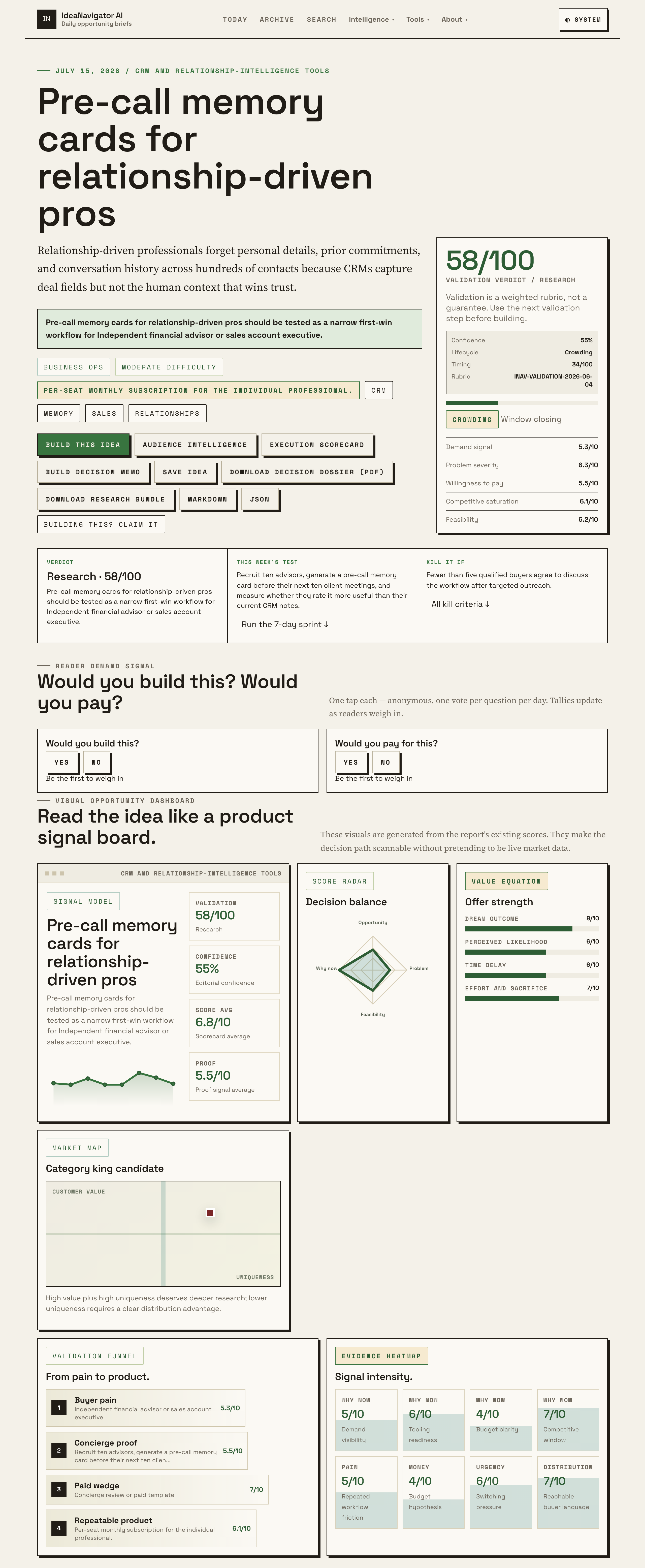
Relationship-focused sales professionals are testing pre-call memory cards to enhance client trust and retention. These cards summarize past interactions, promising a more personalized approach. Their effectiveness is currently being evaluated through pilot programs.
Pre-call memory cards are being tested as a new workflow tool for relationship-driven sales professionals such as independent financial advisors and sales account executives. These cards aim to address the challenge of maintaining personal context across hundreds of contacts by summarizing relevant client history and previous commitments using AI technology, potentially improving trust and engagement.
The concept involves connecting a contact’s past emails and notes to generate a one-page memory card that highlights who the client is, what was last promised, and any open threads. This tool is designed to supplement existing CRM systems, which often lack the nuanced human context that fosters trust in relationship sales. The initiative is driven by the availability of affordable large-language-model summarization, allowing for long conversation histories to be distilled into concise, searchable summaries.
Testing involves recruiting ten advisors who will generate pre-call memory cards before their next ten client meetings. The goal is to measure whether these cards are rated more useful than current CRM notes, providing a potential first-win workflow for relationship professionals seeking to deepen client trust and improve retention. The subscription-based model would charge professionals per seat, making it scalable across the market of CRM and relationship-intelligence tools.
Why Pre-Call Memory Cards Could Transform Relationship Sales
This development could significantly impact how relationship-driven professionals manage client interactions. By providing a quick, comprehensive snapshot of each client’s history and commitments, these cards aim to foster more personalized, trust-based conversations. If successful, they could reduce the cognitive load on advisors, improve client satisfaction, and ultimately lead to higher retention and referral rates. The use of AI summarization makes this approach feasible at scale, addressing a long-standing challenge in maintaining human context across large contact portfolios.
AI client interaction summary cards
As an affiliate, we earn on qualifying purchases.
As an affiliate, we earn on qualifying purchases.
The Growing Need for Context in Relationship-Driven Professions
Many independent financial advisors and sales professionals rely on CRMs to track client interactions, but these tools often capture deal fields rather than the nuanced personal details that build trust. As contact lists grow, maintaining personal memory becomes increasingly difficult, leading to missed opportunities for connection. Recent advances in large-language models have made it possible to automate the summarization of lengthy conversation histories, offering a potential solution to this problem. Pilot programs are now exploring how these AI-generated memory cards can supplement existing workflows to enhance relationship management.
“Using AI to distill long conversation histories into quick-reference memory cards could revolutionize relationship sales.”
— an anonymous researcher
Effectiveness and Adoption of Pre-Call Memory Cards Still Uncertain
It is not yet clear how well these AI-generated memory cards will perform in real-world settings. The pilot programs are ongoing, and initial feedback is still being collected. It remains unknown whether professionals will find the summaries accurate and helpful enough to replace or supplement their current notes, or if clients will notice a difference in the quality of interactions. Broader adoption depends on demonstrated effectiveness and ease of integration into existing workflows.
Next Steps in Testing and Potential Market Adoption
The pilot programs are expected to run over the coming months, with results guiding further development. If advisors find the memory cards useful, vendors may develop more integrated solutions, and broader rollout could follow. Additional validation will focus on measuring improvements in client trust, engagement, and retention. Success could lead to a new standard in relationship management tools, leveraging AI to keep personal context top of mind across large contact portfolios.
Key Questions
How do pre-call memory cards work?
They connect past emails and notes for a contact, then use AI summarization to create a one-page overview of key details, promises, and open threads before a call.
Who can benefit from using these memory cards?
Independent financial advisors, sales account executives, and other relationship-driven professionals seeking to improve client trust and retention.
Are these memory cards replacing CRMs?
No, they are designed to supplement existing CRM systems by providing quick, personalized context that CRMs often lack.
When will these tools be widely available?
Currently in pilot testing; broader availability depends on pilot results and industry adoption, which could take several months.
What are the main challenges in implementing this technology?
Ensuring the accuracy of AI summaries, integrating smoothly into existing workflows, and convincing professionals of their added value are key challenges.
Source: IdeaNavigator AI