
📊 Full opportunity report: Every Car Buyer In The EU Will Now Get A Driver Monitoring Camera on IdeaNavigator AI — validation score, market gap, and execution plan.

Get business pricing on office and shipping supplies
- Business-only prices and quantity discounts
- Tax-exempt purchasing
- Multiple users, one account, clear invoices
TL;DR
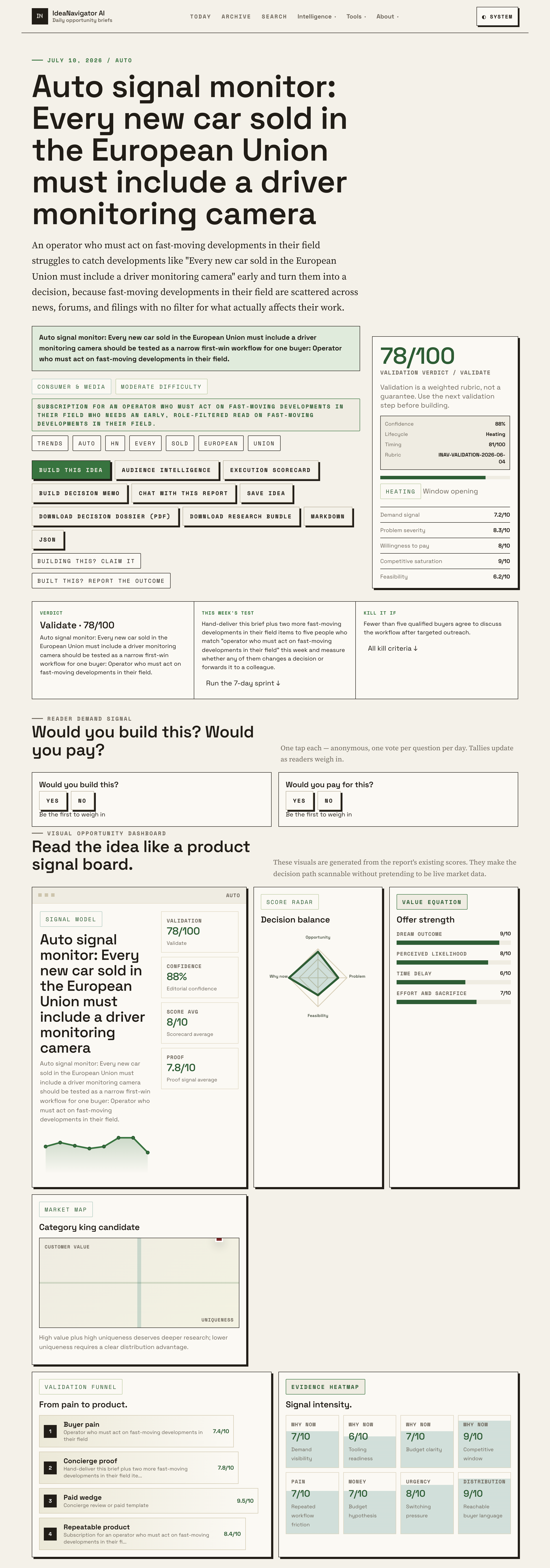
A viral signal claiming every new car sold in the EU must include a driver monitoring camera surfaced on Hacker News and was flagged by IdeaNavigator AI. The EU’s General Safety Regulation does mandate driver drowsiness and attention warning systems, but whether a camera specifically is required is less clear than the headline suggests.
The claim that every new car sold in the European Union must include a driver monitoring camera is circulating widely after a Hacker News discussion flagged it with an 88/100 signal score, according to IdeaNavigator AI, which published a brief on the development. The claim is anchored in a real regulatory shift: the EU’s General Safety Regulation has required advanced driver assistance systems, including driver drowsiness and attention warning, on all new vehicles registered in the bloc since July 2024. What the rules do not plainly say, however, is that a camera must be the mechanism — and that gap is where the story becomes more complicated than the headline suggests.
The confirmed regulatory backdrop is the EU’s General Safety Regulation (Regulation (EU) 2019/2144), which entered into application for new vehicle type approvals in July 2022 and extended to all new cars registered in the EU from 7 July 2024. Among its mandated systems are driver drowsiness and attention warning, advanced distraction warning, intelligent speed assistance, event data recorders, and emergency lane-keeping technology. The aim, as stated by EU policymakers when the regulation was adopted, is to reduce road deaths and serious injuries across the bloc.
The circulating claim sharpens this into a single, punchy statement — that a driver monitoring camera is now compulsory in every new EU car. According to IdeaNavigator AI, the item gained traction on Hacker News as a fast-moving development relevant to operators in the automotive sector who need same-day reads on regulatory shifts. The core factual dispute is narrow but consequential: the regulation mandates that cars detect drowsiness and distraction, but it does not universally prescribe a camera as the only compliant technology.
In practice, many manufacturers are expected to meet the requirement with in-cabin cameras that track eye movement, head position, and gaze direction, because camera-based systems handle distraction detection more effectively than steering-input analysis. Others use or have used steering behaviour sensors that infer fatigue from patterns in how a driver handles the wheel. Which approach dominates in any given model is a manufacturer decision, not a legal mandate for a camera in every car.
Privacy and Compliance Stakes for Carmakers
The distinction between “driver monitoring required” and “camera required” matters for two audiences. For carmakers and suppliers, it determines component sourcing, software integration, and compliance testing across EU markets — a camera-based architecture carries different costs and vendor relationships than steering-sensor-based systems. For drivers and privacy advocates, an in-cabin camera raises questions about what is recorded, where the imagery is processed, and whether data leaves the vehicle. The same EU rules that mandate monitoring also sit alongside the bloc’s GDPR data protection framework, and how manufacturers reconcile continuous in-cabin sensing with data minimisation obligations remains an active area of debate.
For operators monitoring the automotive sector, as IdeaNavigator AI notes in its brief, regulatory items like this one move quickly from discussion to procurement decisions. A same-day, filtered read of such developments can outpace weekly industry roundups when compliance timelines and supplier contracts are on the line.
From 2019 Regulation to 2024 Enforcement
The General Safety Regulation was adopted in November 2019 as part of the EU’s road safety strategy, which targeted a halving of road deaths by 2030. Its provisions were phased: new type approvals first, then all new registrations from July 2024. The regulation followed years of lobbying by safety bodies, including European consumer and transport safety organisations that pushed for standardised driver assistance across all vehicle classes rather than optional premium features.
The current wave of attention appears to be a rediscovery or amplification of the 2024 milestone rather than a fresh legislative act. According to IdeaNavigator AI, Hacker News gave the item an 88/100 signal score, reflecting high engagement. Similar surges of interest have accompanied other EU mandates, such as the intelligent speed assistance requirement, which also drew driver-facing controversy when it took effect.
Where the Camera Claim Overstates the Rule
It is not established that the EU regulation requires a camera in every new car as a matter of law. The regulation sets performance requirements — vehicles must warn of drowsiness and distraction — while leaving the detection method to manufacturers. It is also unclear what share of new EU models currently ship with camera-based systems versus steering-based ones; no consolidated EU-wide figure is cited in the circulating material. Additionally, the provenance of the Hacker News item — whether it referenced a specific news report, a regulation text, or a manufacturer announcement — is not documented in the IdeaNavigator AI brief. Readers should treat the “every car gets a camera” phrasing as an imprecise summary of a broader mandate until verified against the regulation text or official EU guidance.
Enforcement, Retrofits and Data Rules Ahead
Watch for several developments: publication of official EU guidance or type-approval clarifications on which monitoring methods satisfy the distraction-warning requirement; manufacturer disclosures in model-year updates about which sensing technology is deployed; and any EU-level statements on in-cabin data processing under GDPR. Safety organisations are also expected to keep pressing for stricter, camera-based monitoring as semi-automated driving becomes more common, which could narrow the engineering discretion that currently exists. For sector operators, the actionable next step flagged by IdeaNavigator AI is validating whether such filtered briefs change real decisions — a test the firm suggests running by delivering sample briefs to targeted professionals this week.
Source: IdeaNavigator AI
Key Questions
Does every new car in the EU legally have to have a driver monitoring camera?
Not exactly. Since July 2024, all new cars registered in the EU must have systems that warn of driver drowsiness and distraction under the General Safety Regulation. A camera is one common way to comply, but the regulation does not universally mandate camera hardware.
When did the EU driver monitoring rules take effect?
The General Safety Regulation applied to new vehicle type approvals from July 2022 and to all new cars registered in the EU from 7 July 2024.
Do these systems record video of the driver?
It varies by manufacturer. Camera-based systems typically process imagery in real time to track gaze and head position; whether any imagery is stored, and how, depends on the manufacturer and is subject to GDPR data protection rules. The circulating claim does not specify data-handling details.
Why is this claim trending now if the rule dates to 2019?
According to IdeaNavigator AI, the item gained fresh traction on Hacker News with an 88/100 signal score. The surge appears to be renewed attention to the July 2024 enforcement milestone rather than a new law.
Can drivers disable the monitoring system?
The mandated warning functions generally cannot be permanently switched off, though some systems can be adjusted or temporarily muted depending on the manufacturer’s implementation. Specific behaviour varies by model, and the circulating material does not address this.
Source: IdeaNavigator AI
Fall Picks
fall essentials
As an affiliate, we earn on qualifying purchases.