
TL;DR
Open a free Amazon Business account
Business pricing, bulk buying and tax-exempt orders.
Create a free accountAs an affiliate, we earn on qualifying purchases.
Siemens has introduced advanced AI workflows that can verify their own outputs in semiconductor and PCB design processes. This innovation aims to enhance accuracy and reduce errors in electronics manufacturing, marking a significant step in AI-driven automation.
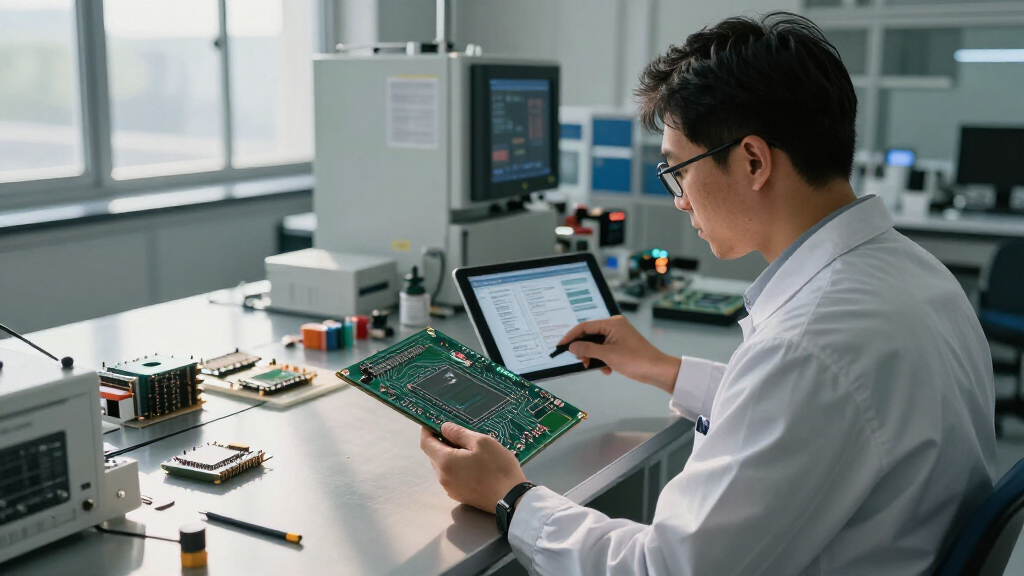
Siemens has unveiled self-verifying agentic AI workflows designed for semiconductor and printed circuit board (PCB) design. This development introduces AI systems capable of independently checking and validating their own outputs, marking a significant advancement in automation for electronics manufacturing. The company states this innovation aims to improve design accuracy and reduce errors in complex chip and PCB production, which is critical for the industry’s efficiency and reliability.
According to Siemens, the new AI workflows incorporate agentic capabilities that enable the AI to perform self-verification during the design process. This means the AI can identify and correct potential errors without human intervention, streamlining workflows and reducing the time needed for quality checks. Siemens claims the technology leverages advanced machine learning models trained on vast datasets of semiconductor and PCB designs, allowing the AI to recognize patterns indicative of design flaws or inconsistencies.
Sources from Siemens indicate that these workflows are built to integrate seamlessly with existing design tools, providing real-time feedback and validation. The company emphasizes that this approach not only accelerates the design cycle but also enhances the overall quality of the final products. Siemens has demonstrated initial prototypes in controlled environments, showing promising results in error detection rates surpassing traditional automated validation methods.
Impact of Self-Validating AI on Electronics Manufacturing
This development is significant because it addresses longstanding challenges in accuracy and error reduction in semiconductor and PCB design. By enabling AI systems to verify their own outputs, Siemens’ workflows could reduce reliance on manual checks, decrease manufacturing errors, and shorten product development cycles. This innovation could also set a new standard for automation and reliability in electronics design, potentially transforming industry practices and boosting competitiveness for companies adopting the technology.
semiconductor design validation tools
As an affiliate, we earn on qualifying purchases.
As an affiliate, we earn on qualifying purchases.
Advances in AI for Semiconductor and PCB Design
Over recent years, AI has increasingly been integrated into electronics design workflows, primarily for tasks like layout optimization and defect detection. However, most systems rely on external validation processes, which can be time-consuming and prone to oversight. Siemens’ move to develop self-verifying AI workflows represents a step toward fully autonomous design systems. This aligns with broader industry trends aiming to leverage AI for end-to-end automation, especially as semiconductor complexity continues to grow and manufacturing standards tighten.
Previous efforts in AI-assisted design focused on improving efficiency and detection accuracy, but self-verification capabilities have remained limited. Siemens’ announcement signals a potential breakthrough in creating AI systems that can ensure their own correctness, which could significantly improve manufacturing yields and reduce costs.
“Our new workflows enable AI to take a proactive role in ensuring design integrity, reducing errors before they reach manufacturing.”
— Dr. Lisa Müller, Siemens AI Research Lead
Unconfirmed Aspects of AI Self-Verification Capabilities
While Siemens has demonstrated promising prototypes, it is not yet clear how well these workflows will perform in large-scale, real-world manufacturing environments. Details about the robustness of the AI’s error detection, its integration with existing tools, and scalability remain undisclosed. Additionally, the long-term reliability and potential limitations of the self-verification process are still under evaluation.
Next Steps for Siemens and Industry Adoption
Siemens plans to conduct further testing in industrial settings over the coming months, aiming for broader deployment within the next year. Industry analysts expect other major electronics design firms to monitor this development closely, potentially adopting similar self-verifying AI workflows if proven effective. Siemens also intends to collaborate with partners to refine and expand the technology’s capabilities.
Key Questions
How does Siemens’ self-verifying AI differ from traditional design tools?
Traditional tools rely on external validation and manual checks, whereas Siemens’ AI can independently verify and correct its own outputs during the design process, reducing errors and speeding up development.
What benefits could this bring to semiconductor manufacturing?
This technology could lead to higher accuracy, fewer design errors, reduced rework, and shorter product development cycles, ultimately lowering costs and improving product quality.
Are these AI workflows ready for industry-wide use?
Not yet. Siemens is still testing the workflows in controlled environments. Broader industry adoption will depend on further validation and integration results.
Could self-verifying AI replace human engineers?
While it can automate validation tasks, human oversight will likely remain essential, especially for complex or novel design challenges.
Source: primary
Flea & tick season Picks
flea and tick prevention
As an affiliate, we earn on qualifying purchases.