
TL;DR
IdeaClyst is a local-first, AI-powered digital war room that helps founders test, discover, and refine ideas in a structured environment. It combines AI council discussions, discovery tools, and a personal workspace—keeping your ideas private and organized on your own machine.
Imagine having a dedicated space—virtual or real—where your ideas get the serious attention they deserve. No more scattered notes, no more gut feelings driving your decisions. Instead, you get a focused, structured environment that helps you decide what to build, and what to scrap.
That’s exactly what IdeaClyst offers: a digital war room for your next big idea. It’s a workspace designed for founders who want clarity, confidence, and control—without sacrificing privacy or flexibility. If you’ve ever stared at a screen full of notes and wondered which idea has real potential, this is your answer.
It’s not just about brainstorming. It’s about transforming raw sparks into actionable plans with real evidence—fast.A war room for your next idea
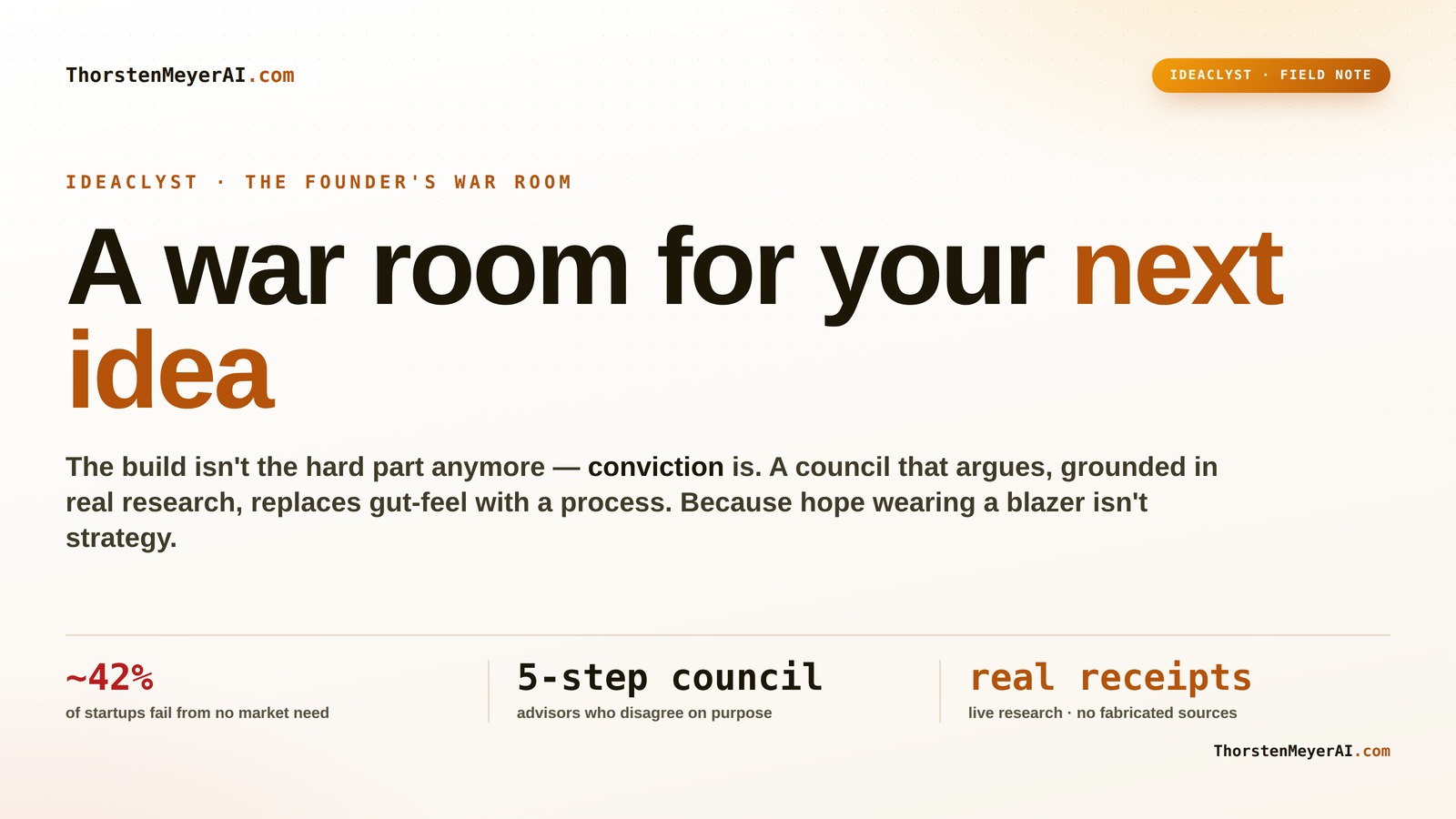
The build isn’t the hard part anymore — conviction is. Knowing which idea deserves the next six months, and being able to defend it. Most founders answer with gut feel and optimistic math. That’s hope wearing a blazer. IdeaClyst replaces it with a process.
The most expensive decision is what to build
The single most valuable thing a tool can do is talk you out of the wrong six months. The numbers make the case better than any pitch.
![DeskFX Free Audio Effects & Audio Enhancer Software [PC Download]](https://m.media-amazon.com/images/I/41fXbDohyuS._SL500_.jpg "A War Room for Your Next Idea: Inside IdeaClyst 3")
DeskFX Free Audio Effects & Audio Enhancer Software [PC Download]
- Audio Transformation: Enhance sound from speakers and headphones
- Sound Quality Enhancement: Adjust audio with various effects
- Audio Control: Manage sound through hardware settings
As an affiliate, we earn on qualifying purchases.
As an affiliate, we earn on qualifying purchases.
Three tools in one — on your own machine
Strip away the framing and IdeaClyst is three things at once, all running locally with nothing leaving your laptop.
An AI council
Pressure-tests an idea you bring it — advisors who argue on purpose.
A discovery engine
Finds ideas you didn’t know to look for by hunting real demand signals.
A founder’s workspace
Carries winners from “interesting” all the way to “ready to build.”
Advisors who disagree on purpose
Not one confident, agreeable answer — a structured five-step deliberation where models play different roles and turn on their own work. The disagreement is the feature.
The five-step deliberation
A council that leads with the bad news surfaces the objections you’d otherwise find the expensive way, on month five.
Product strategy
Who’s it for, what’s the wedge, why now, what’s the business model.
Technical architecture
What would it actually take to build — and where’s the risk.
Critique pass
The council turns on its own work. Where’s the hand-waving? What kills this?
Second, independent critique
A different voice, a different angle — so blind spots don’t survive.
Final synthesis
Everything into one coherent founder packet: strategy, architecture, validation, plan.
When IdeaClyst cites a source, it actually fetched it
The hard departure from “ask an AI what it thinks of my startup.” It runs in a strict, real-data-only mode — if it can’t gather genuine evidence, it says so plainly rather than inventing a plausible paragraph.
Confidence with receipts
No fabricated statistics, no imaginary competitors, no made-up citations. The packet survives a skeptical co-founder or a sharp investor because the reasoning has receipts.
Market research first
Scouts the landscape before the council reasons about anything.
Competitor read
Real positioning, pricing signals, feature claims — differentiation vs. reality.
Validation with links
Not “talk to customers” — concrete signals & sources you can click.
From the blank page to build-ready
Evaluation is half the problem; the blank page is the other half. And a plan is worthless if it dies in a tab you never reopen.
Bring a space, not an idea
“AI for accountants,” “tools for indie game studios” — plus your goal and real capacity. It hunts demand signals across HN, Reddit, Product Hunt, GitHub, pricing pages.
- An honest market read — leads with the bad news when a space is hard
- An opportunity map — high pain, thin competition
- Ranked candidates — wedge, who pays, effort, risk, confidence
- each with KILL CRITERIA — when to walk away
A home and a forward path
Every promising idea gets carried forward, with every artifact in plain files on your disk.
- Validation tooling — sprint board, interview list, evidence browser
- Founder profile — a personal-fit lens; same discovery, different advice
- Build workspaces — funnel, personas, landing draft, version history
- “Build this idea” → a PRD + task queue, ready for a coding agent
Key Takeaways
- A digital war room centralizes your idea development, making progress visible and manageable.
- IdeaClyst’s AI council forces honest critique by simulating multiple perspectives, revealing hidden risks.
- Grounding your ideas in real-time web research reduces false confidence and saves costly mistakes.
- Building your own war room is simple: define, critique, research, and document—fast and private.
- This approach turns vague ideas into validated, actionable plans, saving months of misguided effort.
What’s a digital war room, and why should you care?
A digital war room is a centralized, focused environment where you gather all the pieces of your idea—research, strategy, critiques—and keep them visible. Think of it as your command center, minus the clutter, plus the clarity.
In practical terms, this means creating a space that consolidates your thoughts, data, and feedback in one place, making it easier to see connections and gaps. This visibility is crucial because it reduces cognitive overload—you’re not juggling multiple disjointed notes or files. Instead, you have a single source of truth that guides decision-making.
For example, a founder might use a war room to track the evolution of a SaaS product idea—from initial concept, through technical risks, to customer validation. It’s where you make your progress visible, so everyone involved can see the path forward. This transparency fosters accountability and ensures that all team members or stakeholders are aligned, reducing miscommunication and redundant work.
In the case of IdeaClyst, this space is built into your own machine, keeping everything private while offering the collaborative power of structured debate and discovery. The privacy aspect is vital because it allows you to iterate freely without fear of leaks or premature exposure, which can be especially important during early-stage development or sensitive market strategies.
How IdeaClyst’s AI council forces tough questions—and why that matters
IdeaClyst’s core strength is its AI council—five models that debate your idea from different angles. This multi-perspective critique is essential because it mimics the diversity of opinions you’d encounter in a real team or boardroom, but with the speed and consistency of automation. It pushes you to confront assumptions you might overlook, ensuring your idea is robust before you invest significant time or resources.
Imagine pitching an app idea. The council asks: Who’s the customer? What’s the actual technical challenge? What’s the real market risk? Each model pushes back, forcing you to defend your assumptions, and often revealing overlooked flaws or opportunities. This structured debate compels you to think more critically about your idea, rather than relying on confirmation bias or optimism.
This process matters because many startup failures stem from unchecked assumptions or incomplete analysis. By systematically exposing weaknesses early, the AI council helps you avoid costly mistakes—such as building features nobody wants or misjudging market fit. It’s akin to having a panel of expert critics that never sleep, continuously challenging your ideas and prompting you to refine your approach. The tradeoff is that this might slow down initial ideation, but it dramatically increases the likelihood of success when you move to execution.
Grounded research on your own machine: How IdeaClyst beats hype
Many founders rely on vague market vibes or overly optimistic memos. IdeaClyst cuts through that noise by integrating live web research directly into your idea process, which is critical because market conditions and competitive landscapes evolve rapidly. Relying solely on memory or outdated data can lead to misguided strategies that are obsolete before you even launch.
Instead, the built-in web tools enable your AI council to pull real-time data from trusted sources—such as recent news, regulatory updates, customer reviews, or industry reports—ensuring your decisions are grounded in current facts. This reduces the risk of confirmation bias, where you seek only information that supports your preconceived notions. It also saves you from the trap of overconfidence based on incomplete or outdated data.
For example, if you’re exploring a new health app, IdeaClyst can scan recent trends, regulatory changes, and customer feedback to provide a comprehensive, up-to-date picture. This evidence-backed approach helps you identify genuine market opportunities and avoid investing in ideas that are no longer viable or are based on false assumptions. The tradeoff is that real-time data collection requires some setup and trust in the sources, but the payoff is significantly better-informed decisions that can adapt to changing realities.
Step-by-step: Building your own IdeaClyst war room in 4 easy moves
- Define your idea clearly: Write a brief description or ambition statement, making sure it captures the core problem and your proposed solution. Clear definitions help prevent scope creep and keep your focus sharp.
- Engage the AI council: Let the models discuss, critique, and synthesize your idea into a structured plan. This step is crucial because it forces you to confront assumptions and develop a more nuanced understanding of your concept’s strengths and weaknesses.
- Research and validate: Use the built-in web tools to gather real data backing your assumptions. This validation step ensures your plan is supported by current, relevant evidence, decreasing the likelihood of pursuing outdated or false leads. For more resources, visit Startupsofa.
- Refine and document: Capture the final strategy, architecture, and validation tests into a Markdown file that’s yours alone. Documenting your insights and decisions creates a clear record to revisit, iterate on, or share when needed.
This simple process turns a rough concept into a validated plan—fast and private. It’s like assembling a small, smart team inside your laptop to guide your decision-making. The tradeoff is that it requires discipline and clarity upfront, but the benefits are a more focused, evidence-backed approach to innovation.
Comparison: Traditional brainstorming vs. IdeaClyst’s structured approach
| Feature | Traditional Brainstorming | IdeaClyst War Room |
|---|---|---|
| Location | Physical or scattered online notes | Private, local environment on your machine |
| Focus | Free-form ideas, often unstructured | Structured critique, validation, and synthesis |
| Decision quality | Often based on gut feeling and incomplete info | Data-backed, debated, and documented decisions |
| Collaboration | Depends on team presence and effort | AI models simulate diverse perspectives, no internet needed |
| Privacy | Can be shared or scattered | Always local, owned by the founder |
This comparison shows how IdeaClyst’s approach is not just a fancy tool but a fundamentally smarter way to develop ideas—grounded, debated, and private. It emphasizes the importance of structure and control in the early stages of innovation, where unorganized thinking can lead to costly detours. By centralizing and formalizing the process, founders and teams can make better-informed decisions faster, reducing the risk of pursuing flawed ideas.
What you should do next—turn your idea into a war room
Start by defining your idea clearly. Use a simple document to describe what you’re aiming for. Then, run it through IdeaClyst’s AI council—let the models debate and critique. Pull in real-time data to ground your assumptions.
Keep refining your plan, documenting your progress in Markdown files. This process not only helps you clarify your thoughts but also builds a living record of your decision-making journey. Over time, this disciplined approach reduces the chaos of unstructured ideation and fosters a culture of evidence-based innovation.
Remember: the goal isn’t just to brainstorm. It’s to build a structured, evidence-backed plan that’s ready to ship, minimizing costly mistakes and maximizing confidence in your direction.
Frequently Asked Questions
What exactly is a digital war room?
A digital war room is a dedicated online environment where you organize, analyze, and develop your ideas. It’s designed to keep everything visible, structured, and focused, whether on your laptop or in the cloud.Can I use IdeaClyst alone, or does it need a team?
You can absolutely use IdeaClyst solo. It’s built for founders working alone or teams collaborating asynchronously. Its private, local-first design keeps your ideas secure while still offering deep critique and discovery tools.How does IdeaClyst compare to traditional brainstorming?
Unlike informal brainstorming, IdeaClyst provides a structured, debate-driven environment with AI models that challenge your assumptions. It grounds your ideas in real data, documents everything, and keeps your process private.What tools or templates come with IdeaClyst?
IdeaClyst offers Markdown templates for strategy, architecture, validation, and critique. These keep your work organized, versioned, and ready to share or revisit anytime.Is it difficult to set up or learn?
Not at all. It’s designed to be straightforward—define your idea, run the AI council, gather data, and document your plan. Plus, since it runs on your machine, there’s no complicated setup or subscriptions.Conclusion
Transform your chaotic idea pile into a focused, private command center with IdeaClyst. It’s not just a tool—it’s your personal board of advisors, research assistant, and project tracker all rolled into one. When you treat your ideas like a war, you win faster.
So, what’s stopping you? Set up your digital war room today, and start building smarter, faster, and with more confidence. Your next big idea deserves that kind of focus.