
📊 Full opportunity report: AI Changelog Digest For Open-source Maintainers on IdeaNavigator AI — validation score, market gap, and execution plan.

Get business pricing on office and shipping supplies
- Business-only prices and quantity discounts
- Tax-exempt purchasing
- Multiple users, one account, clear invoices
TL;DR
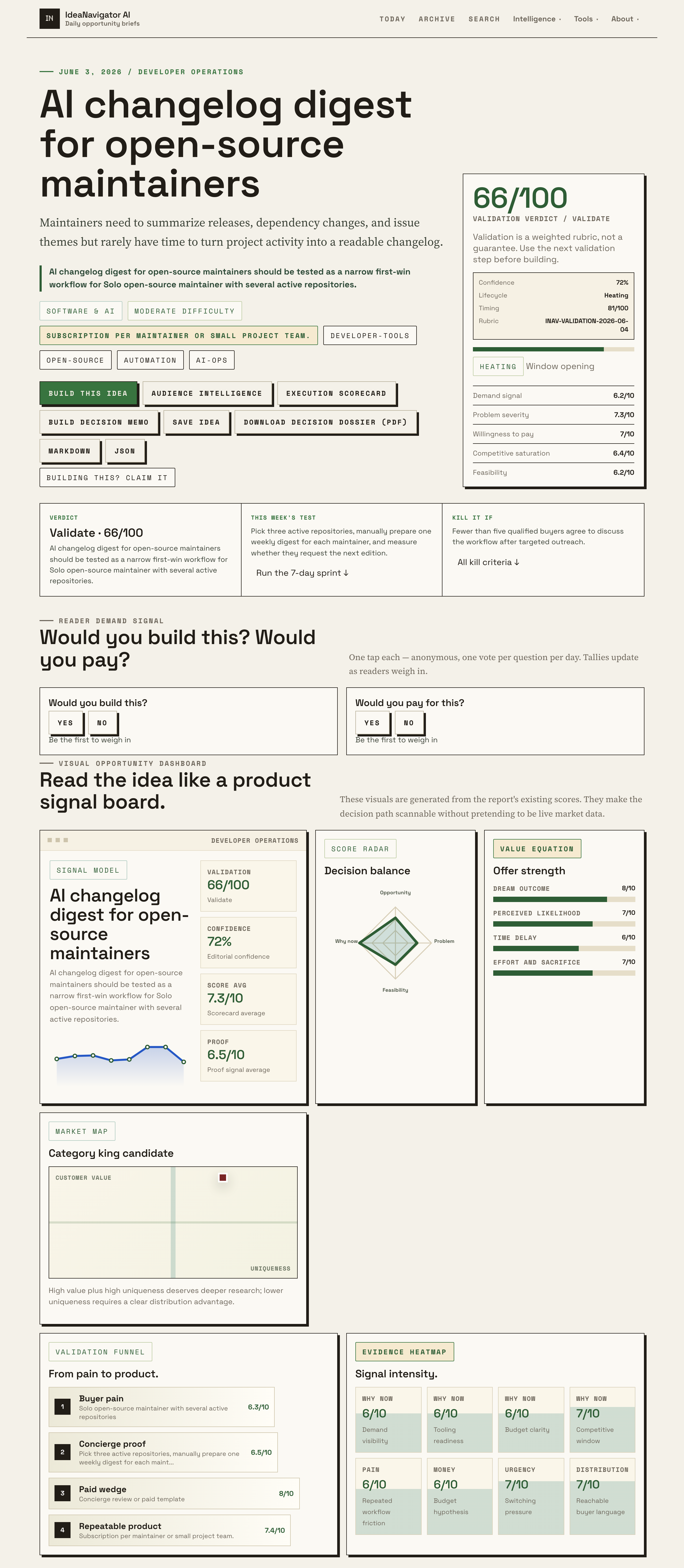
IdeaNavigator AI is testing a new workflow that automatically generates weekly changelog digests for open-source projects. The tool targets solo maintainers managing multiple repositories, aiming to save time and improve communication. Validation involves testing on three repositories to measure demand.
IdeaNavigator AI is testing a new workflow that automatically creates weekly changelog digests for solo open-source maintainers managing multiple repositories. This development aims to help maintainers quickly summarize releases, dependency changes, and top issues without dedicating extensive time, leveraging AI-powered summarization and repository metadata. The initiative reflects a broader effort to improve developer operations and reduce manual effort in project management.
The proposed tool reads data from repositories’ release feeds, merged pull requests, and open issues to generate concise, maintainable summaries. It is designed as a subscription service targeting individual maintainers or small teams, with the goal of producing a draft changelog email for approval. The MVP involves testing this workflow on three active repositories, with success measured by whether maintainers request ongoing editions.
According to IdeaNavigator AI, this approach is feasible because advancements in AI summarization, combined with accessible repository metadata, make it possible to automate what traditionally requires manual effort. The initiative is still in the validation stage, with no official launch date announced, and it remains to be seen how well maintainers will adopt this tool.
Potential Impact on Solo Maintainers’ Workflow Efficiency
This development could significantly reduce the time solo open-source maintainers spend on summarizing project activity, freeing them to focus on development and community engagement. Automating changelog creation addresses a common pain point—keeping project documentation current without extensive manual effort—and could improve transparency and communication with users.
If successful, this tool might set a precedent for more AI-driven automation in developer operations, especially for maintainers managing multiple repositories without dedicated teams. It could also influence how open-source projects communicate updates, making release notes more timely and accessible.
AI-powered changelog generator for GitHub
As an affiliate, we earn on qualifying purchases.
As an affiliate, we earn on qualifying purchases.
The Growing Need for Automated Release Summaries in Open Source
Solo maintainers often struggle to keep up with the administrative side of project management, including summarizing releases, dependency updates, and issue themes. Traditionally, this requires manual effort, which can be time-consuming and inconsistent. Recent advances in AI and the availability of repository metadata have opened opportunities to automate these processes.
Previous efforts have focused on community-driven tools or partial automation, but a fully automated weekly digest tailored for individual maintainers is new. IdeaNavigator AI’s initiative builds on these trends, aiming to test the viability of such automation in real-world scenarios.
“Leveraging AI to generate weekly project summaries could transform how solo maintainers manage their repositories.”
— an anonymous researcher
Unclear Adoption Rate Among Maintainers
It remains uncertain how many solo maintainers will adopt this automated digest tool once tested. While the concept is promising, the actual demand, usability, and integration challenges are still unknown. The project is currently in the validation stage, and no user feedback or adoption metrics are available yet.
Next Steps in Validation and Potential Launch
IdeaNavigator AI plans to test the digest generator on three active repositories, collecting feedback from maintainers to assess demand and usability. If the response is positive, the team may refine the tool and consider a broader rollout, possibly including additional features or integrations. Monitoring engagement and gathering user input will determine the future development timeline.
Key Questions
How does the AI generate the changelog digest?
The AI reads data from repository release feeds, merged pull requests, and top issues, then summarizes these into a concise email draft for the maintainer’s review.
Who is this tool intended for?
It is designed for solo open-source maintainers managing several repositories who need to streamline release summaries and issue tracking.
Is this tool available to the public now?
No, it is currently in a testing phase with a small group of repositories. A broader release has not been announced yet.
What benefits does this offer over manual summaries?
The primary benefit is saving time by automating routine documentation tasks, allowing maintainers to focus more on development and community support.
Will this replace manual changelog writing completely?
It is intended as an aid, providing a draft for approval. Human oversight remains important to ensure accuracy and clarity.
Source: IdeaNavigator AI
Halloween Picks
halloween
As an affiliate, we earn on qualifying purchases.