
🔍 Read the full analysis: 9 AI Mini PCs Worth Comparing For Local AI Work In 2027 on ThorstenMeyerAI.com
TL;DR
A roundup from ThorstenMeyerAI.com compares nine mini PCs for local AI and general computing, ranking the MINISFORUM MS-S1 MAX first based on its listed 128GB of memory, 2TB SSD and connectivity. The comparison uses published specifications, not hands-on benchmarks, so real-world speed, cooling and software support remain unverified.
ThorstenMeyerAI.com has compared nine mini PCs for local AI and everyday computing, naming the MINISFORUM MS-S1 MAX its best overall pick based on its listed 128GB of memory, 2TB SSD and workstation-oriented connectivity. The ranking is a specifications-based assessment, not a report of tested performance, so buyers still need workload-specific benchmarks and software compatibility information.
The roundup puts configuration ahead of the processor label alone, a consideration also explored in choosing an AI mini PC for local workloads. It highlights three models—the MINISFORUM MS-S1 MAX, GMKtec EVO-X3 and BOSGAME M5—as using the Ryzen AI Max+ 395 and offering 128GB memory configurations. The source treats that capacity as useful headroom for memory-intensive local work, while cautioning that it does not guarantee fast results or compatibility with every model or application.
The GEEKOM A9 Max is presented as an alternative for buyers seeking a newer Ryzen AI processor and more storage: its listed configuration pairs a Ryzen AI 9 HX 470 with 32GB RAM and a 2TB SSD, among the options covered in this AI mini PC roundup. The roundup places the GMKtec K15 among simpler, lighter-workload options. It also flags smaller listed capacities on some entry-level systems, including 16GB of RAM for the Glorlin and comparatively small SSDs for the K15 and GEEKOM IT13 MAX.
For the MS-S1 MAX, the source lists dual 10GbE, USB4 V2 and two M.2 PCIe 4.0 slots, alongside its memory and storage. Those details may matter for fast network transfers, external devices and storage expansion. The article says that its rankings weigh processor tier, memory capacity and type, graphics information, SSD capacity and connectivity, but does not establish benchmark results or upgradeability for every model.
The 9 picks
- 1
 MINISFORUM MS-S1 MAX Mini AI Workstation PC, AMD Ryzen AI Max+ 395, 128GB RAM…View on Amazon →
- 2
 GMKtec EVO-X3 Mini PC with AMD Ryzen AI Max+ 395, 128GB LPDDR5X, and 2TB PCIe…View on Amazon →
- 3
 BOSGAME M5 AI Mini PC with AMD Ryzen AI Max+ 395, 128GB LPDDR5X, 2TB SSDView on Amazon →
- 4
 GMKtec EVO-X2 AI Mini PC with AMD Ryzen AI Max+ 395View on Amazon →
- 5
 GEEKOM A9 Max Top AI Mini PC, AMD Ryzen AI9 HX470, 32GB DDR5, 2TB SSDView on Amazon →
- 6
 MINISFORUM AI X1 Pro-370 Mini PC with AMD Ryzen AI 9 HX 370, 32GB DDR5, 1TB P…View on Amazon →
- 7
 GEEKOM IT13 MAX AI Mini PC 2026, Intel Ultra 9 185H, 24GB LPDDR5, 500GB SSDView on Amazon →
- 8
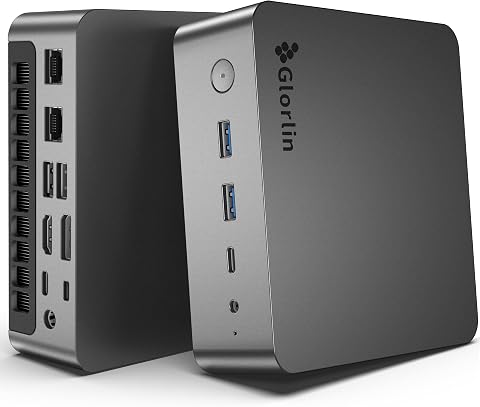 Glorlin AI Mini PC AMD Ryzen 7 Pro 8845HS, 16GB DDR5, 1TB SSD, Gaming & Offic…View on Amazon →
- 9
 GMKtec K15 AI Mini PC Oculink Intel Ultra 5 125U 32GB DDR5 512GB SSD, Desktop…View on Amazon →
Memory and Ports Shape Local AI Choices
The comparison highlights a practical constraint for running AI locally: memory capacity can limit the models and datasets a compact PC can handle, particularly when integrated graphics share system memory. A 128GB configuration offers more room than 16GB or 32GB, but capacity by itself does not determine how quickly a workload runs. Performance also depends on software support, memory bandwidth, cooling and how well a framework uses the system’s CPU, GPU or NPU.
That distinction matters because buyers may be choosing between a higher-capacity workstation configuration and a system with a newer processor but less memory. Storage and ports also affect whether a machine can accommodate model files, datasets, backups, displays and fast external drives. The roundup’s central message is to match the whole configuration to the intended workload, rather than treating an AI-branded chip as a performance guarantee.
How the Nine-Model Ranking Was Built
ThorstenMeyerAI.com says it ranked the machines by how their stated specifications fit likely uses, including local models, development, creative work and general desktop computing. It gave higher placement to systems combining more memory, storage and connectivity for demanding workloads; smaller-memory machines were framed as more appropriate for lighter or everyday tasks.
The source defines value as capability matched to a buyer’s needs, not as a price comparison. It does not supply prices in the provided material, nor does it claim to have tested the systems. Its roundup also advises readers to check whether memory is soldered or replaceable, confirm storage expansion details, and verify that intended software supports the processor’s architecture and acceleration features.
“I ranked these AI mini PCs by how well their stated configurations match likely workloads, rather than treating an AI-capable processor as a guarantee of strong local AI performance.”
— ThorstenMeyerAI.com
Performance and Upgrade Details Remain Open
The supplied material does not include independent benchmark results, sustained-load testing, cooling measurements or direct comparisons of local AI tasks. It also does not establish software compatibility across the nine systems or confirm upgradeability and expansion options for every configuration. Those details can change how a machine performs in practice, even when its headline processor and memory figures look appealing.
Price, regional availability and exact configuration variations are not provided. Buyers should confirm the specific model and memory configuration on sale, including whether RAM is soldered, what storage slots are available, and which ports are present on that version. The ranking should be read as a guide to listed hardware, not a guarantee that a particular model will run a given AI workload at a particular speed.
Check Workloads Before Choosing
The next step for buyers is to compare the machines’ exact configurations with the requirements of their target models, datasets and applications. That includes checking memory needs, supported acceleration features, storage capacity and required network or display connections. For sustained work, seek independent tests using comparable software and workloads, along with cooling and noise information.
Before purchasing, confirm current pricing, availability, memory upgrade options and storage expansion with the manufacturer or seller. Those details could affect which of the nine systems is the better fit, and are not resolved by the source comparison.
Key Questions
Which mini PC does the roundup rank first?
ThorstenMeyerAI.com names the MINISFORUM MS-S1 MAX its best overall pick, citing its listed 128GB memory, 2TB SSD and workstation-oriented connectivity. That is the source’s specifications-based ranking, not a conclusion from published benchmark testing.
Which models are listed with 128GB of memory?
The comparison identifies the MINISFORUM MS-S1 MAX, GMKtec EVO-X3 and BOSGAME M5 as Ryzen AI Max+ 395 models with 128GB memory configurations. Check the exact configuration offered by a seller before purchase.
Does a 128GB mini PC guarantee faster local AI?
No. More memory can provide room for larger models or datasets, but it does not by itself establish speed or compatibility. The source says performance also depends on workload, software support, memory bandwidth and thermal behavior.
What should buyers verify before ordering?
Confirm the exact RAM capacity and upgradeability, SSD size and expansion slots, ports, software compatibility and current price. For demanding or sustained workloads, look for independent tests that use the applications and models you expect to run.
Source: ThorstenMeyerAI.com