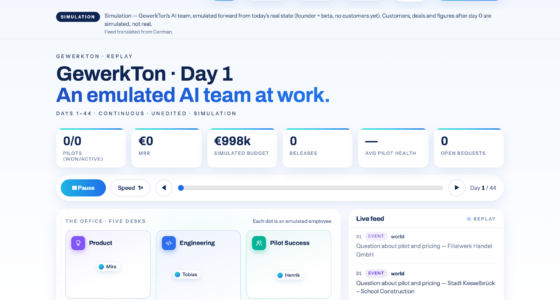

📊 Full opportunity report: AI's Impact On The Sovereignty Market: From Launch To Big Exit on ThorstenMeyerAI.com — validation score, market gap, and execution plan.

Get business pricing on office and shipping supplies
- Business-only prices and quantity discounts
- Tax-exempt purchasing
- Multiple users, one account, clear invoices
TL;DR
Germany has launched significant AI infrastructure with private and public funding, aiming for sovereignty. A major merger between Aleph Alpha and Cohere marks a key development, raising questions about true independence.
Germany’s AI sovereignty efforts have taken a major step forward with the operational launch of the Industrial AI Cloud in Munich, featuring nearly 10,000 NVIDIA GPUs and fully private funding. This infrastructure aims to bolster national AI independence amid rising public and private investments, marking a significant milestone in the country’s strategic AI ambitions.
On February 4, 2026, the German Telekom and NVIDIA inaugurated the Industrial AI Cloud in Munich, equipped with approximately 10,000 Blackwell-GPUs, delivering around 0.5 exaFLOPS of computing power. This infrastructure represents a roughly 50% increase in German AI processing capacity, financed entirely through private funds, and includes partnerships with SAP, Siemens, Mercedes-Benz, BMW, and others, serving as a core element of Germany’s Deutschland-Stack.
Simultaneously, the government announced a €805 million fund for a European AI Gigafactory, with a consortium including SAP, Telekom, Siemens, IONOS, and Schwarz-Gruppe pursuing a joint EU bid—aiming to position Europe as a sovereign AI hub. The European Union also passed the Cloud and AI Development Act, emphasizing a ‘Free Software First’ principle, which has been praised by the Free Software Foundation Europe but criticized by some industry groups for risking isolationism.
Market analysts estimate the global AI services market to exceed $1 trillion annually, with European sovereign cloud spending projected to reach $12.6 billion in 2026—an 83% increase from the previous year. This demand is reflected in recent procurement decisions, such as the Bundesamt für Verfassungsschutz choosing French firm ChapsVision over Palantir, and the Bundeswehr excluding Palantir from cloud projects.
However, a significant development emerged on April 24, 2026, when Aleph Alpha, long considered a flagship of German AI sovereignty, announced a merger with Canadian competitor Cohere. The combined valuation is approximately $20 billion, with Schwarz-Gruppe investing $600 million in Cohere’s Series E funding. This move raises questions about the true independence of German AI models, as the merged entity’s leadership and infrastructure are now partly North American.
Der Souveränitäts-Markt ist real geworden —
und hat im selben Quartal seinen Champion verkauft
Tagesaktuell verifizierter Marktpuls · Geld, GPUs und eine Ironie
Das Geld ist da — drei Belege
Telekom + NVIDIA in München: ~0,5 ExaFLOPS, +50 % deutsche KI-Rechenleistung, privat finanziert. Schwarz-Gruppe: 11 Mrd. €, perspektivisch 100.000 GPUs.
805 Mio. € Gigafactory-Förderung; Konsortium SAP, Telekom, Siemens, IONOS, Schwarz. SPRIND: 125 Mio. € für eigene KI-Labore.
BfV wählt ChapsVision statt Palantir; Bundeswehr schließt Palantir aus der Cloud aus. Gartner: EU-Sovereign-Cloud +83 % auf 12,6 Mrd. $.
DIE IRONIE · 24. APRIL 2026
Mitten im Souveränitäts-Frühling schließt sich Aleph Alpha mit Kanadas Cohere zusammen — die Schwarz-Gruppe finanziert als Lead-Investor mit 600 Mio. $.
Freundliche Lesart: Konsolidierung unter Gleichgesinnten; 20 Mrd. $ Verbund schlägt unterfinanziertes Startup. Unbequeme Lesart: Deutschlands Modellschicht wird künftig in Toronto mitentschieden — und deutsches Kapital finanziert lieber fremde Champions als eigene.
Souveränität ist eine Schichtenfrage
Das Signal: Die souveräne Betriebsschicht ist jetzt kaufbar und bezahlbar — die Modellschicht bleibt Import. Wer Souveränitätsstrategien baut, sollte sie auf die Schichten bauen, die Europa tatsächlich kontrolliert.
Implications of the Aleph Alpha-Cohere Merger and Infrastructure Launches
This development underscores the complex reality of AI sovereignty in Europe. While infrastructure and funding are advancing rapidly, the merger indicates that key AI model development and control are increasingly influenced by North American players, potentially diluting Europe’s independence in the AI model layer. The reliance on U.S.-based chips and cloud providers continues to challenge the narrative of full sovereignty, emphasizing that control over hardware, regulation, and data governance must be aligned to achieve true autonomy.
For European policymakers and industry, the situation highlights the importance of focusing on control over the model layer and regulatory frameworks. The ongoing investments and infrastructure projects are vital, but without independent models, Europe’s strategic AI sovereignty remains limited, impacting future competitiveness and security.
As an affiliate, we earn on qualifying purchases.
Germany’s Strategic Investments and the Reality of AI Sovereignty in 2026
Germany has committed significant resources to AI infrastructure, including the operation of the Munich-based Industrial AI Cloud and state funding for a European Gigafactory, reflecting a deliberate push for technological independence. The EU has also enacted legislation aimed at reducing reliance on non-European cloud providers, emphasizing open-source principles.
Despite these efforts, the recent Aleph Alpha-Cohere merger reveals a gap between infrastructure and model sovereignty. The infrastructure in Munich relies heavily on U.S. chips from NVIDIA, and the model development is increasingly dominated by North American firms like Cohere, which is now part of a larger, international conglomerate.
Historically, Germany and Europe have faced challenges in developing independent AI models, often relying on foreign technology and expertise. This ongoing trend complicates the narrative of sovereignty, as control over the hardware and software layers remains fragmented and influenced by outside actors.
“While infrastructure investments are impressive, the real challenge lies in developing independent AI models that Europe can control and deploy at scale.”
— an anonymous industry expert
Unresolved Questions About True AI Sovereignty in Europe
It remains unclear whether Europe’s investments and infrastructure will translate into genuine control over AI models and data governance. The influence of North American firms like Cohere and the dependence on U.S. chips and cloud services suggest that technological sovereignty may be more limited than official rhetoric indicates. The long-term impact of the Aleph Alpha-Cohere merger on Europe’s AI independence is still evolving, and regulatory measures may take years to fully implement and prove effective.
Next Steps in Europe’s AI Sovereignty Strategy
Europe is likely to focus on fostering independent model development, possibly through increased funding for local startups and research institutions. The EU’s legislative framework, including the Cloud and AI Development Act, will be tested as industry players navigate compliance and sovereignty goals. The upcoming months will reveal whether infrastructure investments can be matched by advancements in autonomous AI models, and how policymakers respond to the shifting landscape post-merger.
Key Questions
Will Europe’s AI infrastructure lead to true sovereignty?
While infrastructure and funding are advancing, control over AI models and data remains influenced by outside actors, making full sovereignty uncertain at this stage.
What impact does the Aleph Alpha-Cohere merger have on German AI independence?
The merger suggests increasing North American influence over AI models, which could limit Europe’s control over its AI ecosystem.
How does U.S. chip dependence affect European AI sovereignty?
Dependence on U.S. chips from NVIDIA means that, despite infrastructure in Munich, critical hardware layers are outside European control, complicating sovereignty efforts.
What role will EU legislation play in shaping AI sovereignty?
The EU’s Cloud and AI Development Act aims to promote open-source and reduce dependence on non-European providers, but its effectiveness remains to be seen.
What are the main challenges for Europe to develop independent AI models?
Key challenges include funding, talent, infrastructure, and reducing dependence on foreign hardware and model providers.
Source: ThorstenMeyerAI.com
Evergreen bestsellers Picks
bestsellers
As an affiliate, we earn on qualifying purchases.