🔍 Read the full analysis: What Should You Look For In An AI Voice Recorder For Meetings? on ThorstenMeyerAI.com

Get business pricing on office and shipping supplies
- Business-only prices and quantity discounts
- Tax-exempt purchasing
- Multiple users, one account, clear invoices
TL;DR
A product roundup from ThorstenMeyerAI.com compares 15 AI voice recorders and traditional recorders with AI features, naming the Plaud Note Pro its best overall pick. Its guidance centers on matching the device to how you record, process, store and retrieve meetings—not choosing by capacity or an “AI” label alone. Subscription terms, language support, app compatibility and some privacy details remain purchase checks rather than confirmed details in the source.
ThorstenMeyerAI.com has published a 15-device roundup of AI voice recorders for meetings, naming the Plaud Note Pro its best overall pick for buyers seeking a dedicated recording and AI note-taking workflow. The comparison also points to the Anker soundcore Work for storage-focused buyers and the iFLYTEK Offline Voice Recorder for people prioritizing offline use, while urging readers to check how transcription, privacy and file exports work on each exact model.
The roundup compares products by how well their stated features support the full process: capturing speech, finding recordings, producing text or notes, and moving that output into a usable workflow. It considers transcription and summaries alongside storage, portability, recording controls, and whether functions depend on offline use, an app or cloud services. The source ranks the Plaud Note Pro first overall, but frames that as its editorial assessment, not a universal measure of performance.
Among its other picks, the source describes Anker soundcore Work as a storage-focused alternative and the iFLYTEK Offline Voice Recorder as the clearest fit for buyers who prioritize offline transcription and playback. It also includes the wearable Plaud NotePin S, traditional-style EVISTR and Tonfarb listings, and other AI-led devices. The supplied material does not provide a complete model-by-model specification table, so readers should verify capabilities on individual product listings.
The comparison stresses that storage capacity does not determine usefulness by itself. Large onboard capacity can reduce file-management chores, but buyers should also consider recording organization, exports and transcription access. It cautions that Plaud Note and Note Pro listings may appear in different colors; color variants should not be mistaken for separate feature tiers.
The 15 picks
- 1
 Plaud Note Pro AI Voice Recorder, BlackView on Amazon →
- 2
 Plaud Note Pro AI Voice Recorder, SilverView on Amazon →
- 3
 Plaud NotePin S AI Voice Recorder, Wearable AI Notetaker, AI Transcribe & Sum…View on Amazon →
- 4
 Pocket AI Voice Recorder with Transcription, 64 GB, Space GreyView on Amazon →
- 5
 Pocket AI Voice Recorder with Auto Transcription, 64 GB, Sierra BlueView on Amazon →
- 6
 Plaud Note AI Voice Recorder, Black, Non-Pro VersionView on Amazon →
- 7
 Anker soundcore Work AI Voice Recorder, 64 GB, MFi-CertifiedView on Amazon →
- 8
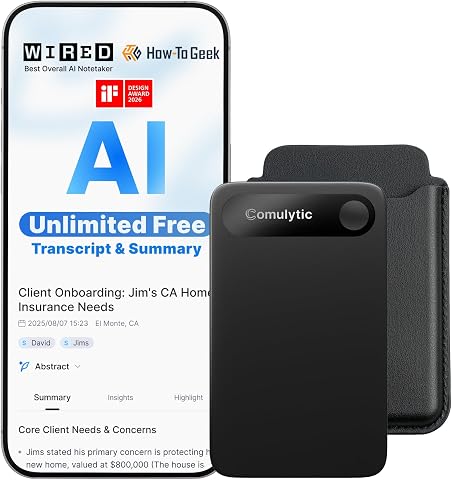 Comulytic Note Pro AI Voice Recorder with Unlimited Transcription and Summari…View on Amazon →
- 9
 Magnetic AI Voice Recorder with Transcription, Summaries, and 64GB StorageView on Amazon →
- 10
 iFLYTEK Offline Voice Recorder with AI Transcription and PlaybackView on Amazon →
- 11
 AI Voice Recorder and Note Taker with 64GB StorageView on Amazon →
- 12
 EurekaMind AI Voice Recorder and Note TakerView on Amazon →
- 13
 EVISTR L359 128GB Digital Voice Recorder with AI TranscriptionView on Amazon →
- 14
 Tonfarb Digital Voice Recorder, 136GBView on Amazon →
- 15
 Elasound Voice Activated Recorder with 128GB Storage and AI Noise ReductionView on Amazon →
The Workflow Matters More Than Storage
Meeting recordings are useful only if people can retrieve and act on them. The roundup highlights a practical distinction between devices built around AI note-taking and recorders whose main strengths are conventional controls or large onboard storage. A recorder may capture a long session, but transcription, searchable text, summaries and export options determine whether that audio can fit into a working routine.
Privacy and connectivity also affect which tool is appropriate. Cloud-based processing may make AI features easier to access, while offline recording or transcription may better suit sensitive conversations. Those are different tradeoffs, not a simple ranking from worse to better: the source advises buyers to check where audio and transcripts are processed and what functions remain available without a network.
For teams and individuals, the choice can affect both convenience and control. A wearable recorder can keep hands free, while a pocket device or recorder positioned on a table may suit a planned meeting better. Buyers should still follow applicable workplace policies and consent requirements; the roundup does not replace those rules.
Popular right now

Samsung 85-Inch M80H Series 4K Mini LED Smart TV (2026)

KitchenAid Artisan Mini Tilt-Head Stand Mixer, 3.5 Quart, Aqua Sky Blue

KitchenAid Commercial Series 8-Quart Bowl-Lift Stand Mixer, White
As an affiliate, we earn on qualifying purchases.
How the 15 Devices Were Ranked
The source says it ranked products by their stated support for a repeatable recording-to-notes workflow, weighing transcription, summaries, storage, portability and offline or cloud requirements. It favored devices with a clear AI note-taking use case, then considered flexibility and likely fit. Traditional recorders with AI features remained in the comparison, but ranked lower when their AI workflow was less clearly defined.
The roundup distinguishes several use cases rather than treating all recorders as interchangeable. A seated meeting may allow a device to be placed near speakers; interviews, lectures or walking conversations can call for different positioning. Wearable, magnetic and pocket designs affect where a recorder can be placed, but the source cautions that form factor alone does not guarantee better sound.
It also flags information that the supplied product listings do not establish consistently, including subscription terms, supported languages and app compatibility. These should be verified for the exact model and service before purchase. A product’s AI label does not establish whether it offers live transcription, post-recording transcription, searchable text or summaries.
“The central tradeoff is convenience versus control.”
— ThorstenMeyerAI.com roundup
Features Buyers Still Need to Verify
The supplied source does not state the roundup’s publication date or provide complete specifications for all 15 products. It also does not establish consistent details on subscription costs, language support, app compatibility, data retention or deletion controls. Those points remain dependent on the exact product and service terms and should not be inferred from the roundup’s rankings.
Offline recording and offline AI processing are not necessarily the same capability. The source advises buyers to confirm whether transcription and summaries work without internet access, and where cloud-dependent features process or store recordings. It also does not establish that a wearable, magnetic or pocket design will produce better audio in every room; placement, distance and background noise can affect results.
The ranking is an editorial recommendation based on stated features, not a guarantee that a device will suit every meeting environment. The supplied material gives no independent test results or detailed evidence on accuracy, so readers should assess transcription quality for their languages, speakers and specialized vocabulary before relying on it.
Check the Exact Model Before Buying
The roundup does not announce a future product launch or testing milestone. For buyers, the next step is to compare the exact model listing against their recording needs: confirm what is transcribed, whether summaries are included, what requires an app or account, and how files can be exported. Check service costs, supported languages and privacy controls before recording sensitive conversations.
Readers choosing among the 15 devices can start with the setting in which they will record most often, then decide whether portability, hands-free use, large local storage or offline access matters most. The source’s recommendations provide a shortlist, but final suitability depends on verified specifications and the buyer’s own workflow.
Key Questions
Which recorder does the roundup rank first?
ThorstenMeyerAI.com names the Plaud Note Pro its best overall pick for buyers seeking a dedicated recorder with an AI note-taking workflow. This is the source’s editorial ranking, not a guarantee that it will fit every user.
Which options are highlighted for storage or offline use?
The source identifies the Anker soundcore Work as a storage-focused alternative and the iFLYTEK Offline Voice Recorder for buyers who prioritize offline use. Confirm which features work without internet access for the exact model.
Does an AI voice recorder always transcribe meetings offline?
No. The roundup warns that offline recording is not necessarily offline transcription. Check whether transcription and summaries need an internet connection, app or account.
What should buyers check besides storage capacity?
Check transcription access, file organization, export options, supported languages, app compatibility and any service fees. Also consider where audio is processed and whether the device suits your usual recording setting.
Source: ThorstenMeyerAI.com