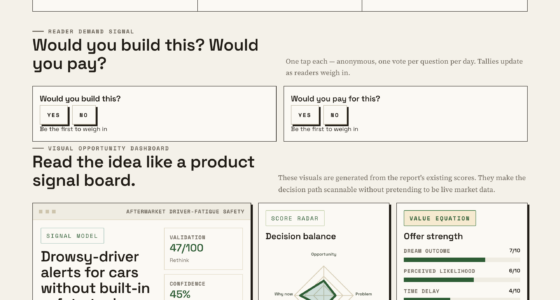

📊 Full opportunity report: The AI-Powered China Open-Weight Window: Opening New Opportunities on ThorstenMeyerAI.com — validation score, market gap, and execution plan.
TL;DR
China is reportedly considering restrictions on overseas access to its advanced AI models, including open weights, as part of a broader policy shift. Meanwhile, the US continues gating its closed models, prompting a strategic divergence that impacts global AI development.
China is reportedly engaging in policy discussions aimed at restricting overseas access to its most advanced AI models, including open-weight releases, despite ongoing US efforts to gate and control access to American models. This development indicates a strategic move by China to maintain control over its AI industry amid escalating geopolitical tensions, making it a significant shift in the global AI landscape.
On July 7, Reuters reported that China’s Ministry of Commerce has been in talks with major domestic AI firms such as Alibaba, ByteDance, and Z.ai about implementing restrictions on international access to the country’s most advanced AI models. These measures could include limiting the export of not only future models but also open weights, which are typically publicly available. The scope of these restrictions remains unclear, and no official statements have been made by the Chinese government or involved companies.
Simultaneously, China has been developing a tiered approach to AI governance, where frontier models might be deployed via API with limited or delayed open weights, while lower-tier models remain openly accessible. This strategy aligns with recent policy trends aimed at safeguarding national security and maintaining technological sovereignty, especially as Chinese AI firms face increased international scrutiny and potential restrictions.
In contrast, the United States has continued to implement gating measures on its own models, including executive orders and export controls, which have temporarily restricted access to certain American models like Anthropic’s Claude Fable 5 and Mythos 5. These actions have demonstrated that the US can effectively gate closed models mid-deployment but cannot restrict access to open weights, which remain globally available and are increasingly attractive as alternatives.
The China Open-Weight Window
Both Superpowers Just Put Their Hands on the Doors
The load-bearing assumption under Europe’s local-first economics is being stress-tested — on both sides, in the same month
Two doors, one month
The American door: gating became a regime
- Jun 2: EO 14409 — classified benchmarks, 30-day pre-release window
- Jun 12–13: export controls on two deployed Anthropic frontier models — trigger reported, not independently confirmed; company disputed; later lifted
- Jun 26: GPT-5.6 Sol ships behind customer-by-customer government approval
- The temporariness taught its own lesson about US supply reliability (CEPA)
The Chinese door: hinges of a subtler design
- May: Supreme People’s Court journal roundtable on tiered open-source governance
- Jun: Manus acquisition unwound; sweeping cross-border investment rules
- Jul 7: MOFCOM talks reported — incl. unreleased and open-weight models; discussions, not decree
- Tiering already visible: Qwen 3.6 open, Qwen 3.7 Max API-only
THE STRUCTURAL ASYMMETRY
The US can gate its closed models; it cannot gate published weights. Every gated American model makes the ungatable open alternative relatively more attractive — a feedback loop that is now official-policy-shaped. Beijing’s version inverts it: keep the mid-tier open for soft power, move the frontier behind the counter.
Five moves while the width is known
The verdict: existing checkpoints are safe — the refresh cycle isn’t. The practical question for 2027 is not “will GLM-5.2 vanish?” but “will GLM-6 ship open at launch?” Watch launch mode, not launch benchmarks. The window’s width will be announced in a launch post, not a policy paper.

Run AI on Your Own Device with Gemma 4: The Beginner's Guide to Private, Offline AI on PC, Mac, and Android with No Subscription and No Cloud
As an affiliate, we earn on qualifying purchases.
As an affiliate, we earn on qualifying purchases.
Implications of China’s Potential Restriction on Open-Weight AI Models
This development signals a strategic shift in China’s approach to AI development and export control, emphasizing domestic sovereignty and national security. If China proceeds with restricting access to open weights, it could significantly alter the global AI ecosystem by limiting the availability of open-source models, which currently serve as the foundation for innovation and adoption worldwide. This move could also intensify the technological competition between China and the US, prompting further policy responses and influencing the future landscape of AI research, deployment, and geopolitics.
Recent US and Chinese AI Policy Movements and Global Impact
Over the past year, the US has enacted several measures to control AI exports and gate access to advanced models, including executive orders and export controls targeting models like Anthropic’s Claude. These actions have underscored a trend toward restricting the deployment of frontier models and emphasizing security.
Meanwhile, China has been actively developing a tiered AI governance framework, with some models available openly and others restricted via API or delayed open weights. The July report indicates that Chinese authorities are considering further restrictions, possibly extending to open-weight releases, as part of a broader effort to safeguard technological sovereignty and prevent foreign access to sensitive models.
This convergence of policies reflects a global shift toward strategic control over AI capabilities, with implications for innovation, international cooperation, and the balance of technological power.
“The tiered approach to AI governance is already evident in market behavior, with some models openly available and others restricted via API, reflecting a cautious yet strategic stance.”
— A Chinese legal expert, summarized in official publications
Unclear Scope and Timing of China’s Restrictions
It remains unclear whether China’s discussions will lead to formal restrictions on open-weight releases, the specific scope of such measures, or the timeline for implementation. Official government statements have not yet been issued, and the policy remains in the consultation or planning stage.
Next Steps in China’s AI Policy and Global Response
Further official announcements from Chinese authorities are anticipated, clarifying the scope and timing of any restrictions. International reactions, particularly from AI developers and policymakers in the US and other regions, will influence how these policies are shaped and implemented. Monitoring of Chinese regulatory developments and potential shifts in open-weight availability will be essential in the coming months.
Key Questions
Could China completely ban the export of open-weight AI models?
It is not yet confirmed whether China will impose a total ban; current reports suggest discussions about restrictions, but official policy details remain undisclosed.
How would restrictions on open weights affect global AI development?
Restrictions could limit access to foundational models, potentially slowing innovation and increasing reliance on domestic or alternative sources, and intensifying geopolitical competition.
What is the difference between gating models and restricting open weights?
Gating models involves controlling access to the models themselves, often via API or licensing, while restricting open weights limits the availability of the underlying model files, which can be freely used or modified.
How does US policy on AI compare to China’s approach?
The US has focused on gating and export controls on advanced models, while China appears to be considering restrictions on both models and open weights, reflecting different strategic priorities.
Source: ThorstenMeyerAI.com