📊 Full opportunity report: Industrial Workforce Training Gets A Boost From VR Factory Solutions on IdeaNavigator AI — validation score, market gap, and execution plan.
TL;DR
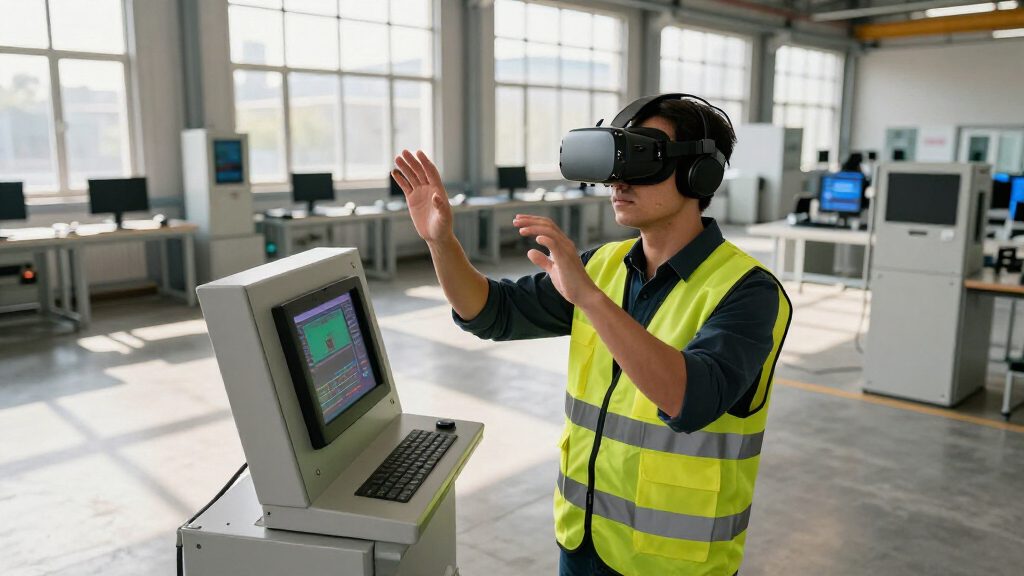
Manufacturers are piloting virtual reality training modules to improve onboarding and safety. Early tests show potential for faster skill acquisition and hazard recognition, addressing industry labor challenges.
Manufacturing companies are testing a new virtual reality (VR) training solution designed to improve onboarding and safety compliance for workers. The pilot program, focused on mid-to-large plants, aims to address persistent labor shortages and skills gaps by delivering faster, more standardized training through immersive technology.
According to sources familiar with the initiative, the VR factory trainer is being tested as a narrow first-use case targeting high-risk procedures such as lockout/tagout and forklift safety. The platform uses standalone Meta Quest headsets connected via cloud streaming, eliminating the need for expensive hardware investments.
Manufacturers face a critical challenge: the U.S. manufacturing sector had approximately 409,000 unfilled positions in August 2025, with projections indicating a need for 3.8 million new workers by 2033. Traditional classroom and on-floor training methods are slow, inconsistent, and pose safety risks, especially when onboarding new hires onto dangerous machinery.
The VR solution includes a library of focused modules for key procedures, complemented by a cloud dashboard that tracks completion rates, hazard recognition accuracy, and quiz scores. Early tests involve shipping 5-10 headsets to a single plant, with the goal of measuring improvements in time-to-competency and hazard detection compared to existing training methods.
Market analysts note that immersive enterprise training is growing at roughly 20% CAGR, with the broader industry valued at USD 14.55 billion in 2025. The VR platform is being offered as a SaaS subscription, with additional revenue from custom scenario development and hardware management services.
Why VR Training Matters for Manufacturing Workforce Development
This initiative could significantly impact how manufacturers onboard workers and reduce safety incidents, addressing critical labor shortages and skills gaps. By enabling faster, more consistent training, VR solutions can lower costs associated with high turnover and safety violations. The potential for improved hazard recognition and quicker skill acquisition makes VR a promising tool for industrial safety and efficiency, especially as hardware costs decline and immersive training adoption accelerates.
As an affiliate, we earn on qualifying purchases.
Manufacturing Labor Shortages and the Push for Digital Solutions
The U.S. manufacturing sector has faced a persistent labor shortage, with nearly 410,000 unfilled positions as of August 2025. Industry projections estimate a need for millions of new workers over the next decade, exacerbated by the difficulty of safely and efficiently onboarding new hires onto complex machinery. Traditional training methods are often slow, inconsistent, and pose safety risks, leading companies to explore digital alternatives such as VR.
Recent advances in cloud-native XR streaming and affordable standalone headsets like Meta Quest and Pico have lowered the hardware barrier, making immersive training more accessible. The immersive enterprise training market is growing rapidly, with estimates reaching USD 14.55 billion in 2025, driven by demand for scalable, effective workforce development tools.
Early pilots focus on high-value, high-risk procedures, aiming to demonstrate measurable improvements in training efficiency and safety outcomes before broader deployment across multiple plants and procedures.
Unclear Outcomes and Long-Term Adoption Challenges
It is not yet clear how quickly and broadly manufacturers will adopt VR training solutions beyond initial pilots. The effectiveness of VR in improving long-term retention, hazard recognition, and overall safety outcomes remains to be validated through full-scale studies. Additionally, questions about integration with existing training programs, costs, and user acceptance are still open as pilots progress.
Next Steps in VR Workforce Training Deployment
Manufacturers involved in the pilot will measure key metrics such as time-to-competency, hazard recognition scores, and supervisor assessments over the next 60-90 days. Success in these pilots could lead to broader rollouts across multiple plants and procedures, with companies evaluating additional modules and scaling hardware deployment. Industry observers will watch for data demonstrating tangible improvements to justify wider adoption and investment.
Key Questions
How does VR training improve safety compared to traditional methods?
VR provides immersive, risk-free environments where workers can practice procedures repeatedly and develop hazard recognition skills without exposing them to real danger, potentially reducing safety incidents.
What equipment is needed for VR training in manufacturing?
Standalone VR headsets like Meta Quest or Pico are used, connected via cloud streaming, eliminating the need for expensive, wired hardware setups.
What types of procedures are suitable for VR training?
High-risk, high-value procedures such as lockout/tagout, forklift safety, and machinery setup are prime candidates for initial VR modules.
When will the results of the pilot be available?
Initial results are expected within 60-90 days, with ongoing assessments to evaluate effectiveness and scalability.
Could VR replace all traditional training methods?
While VR offers significant advantages, it is likely to complement rather than fully replace classroom and on-the-floor training, especially for foundational knowledge and hands-on practice.
Source: IdeaNavigator AI