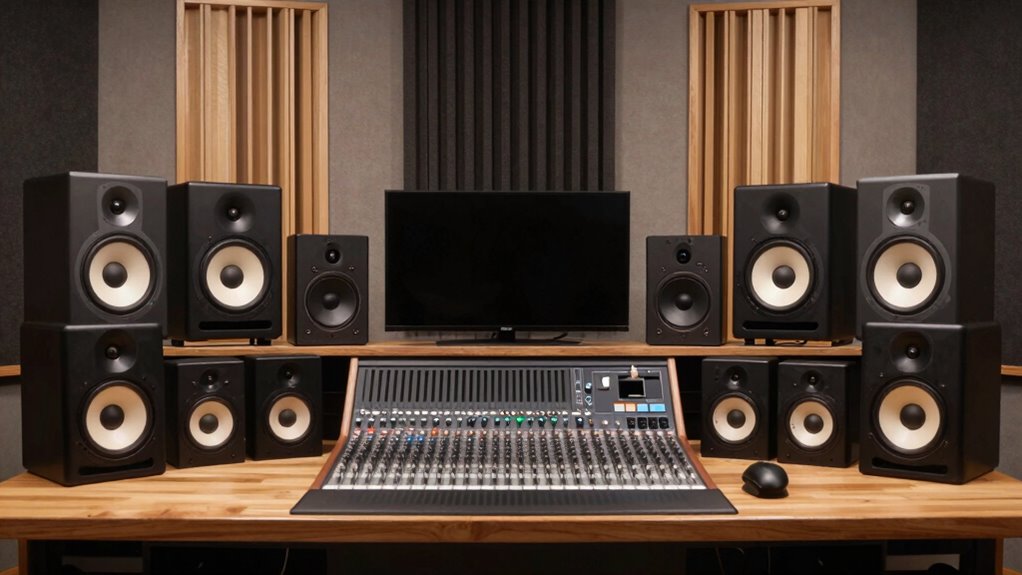
Choosing the right studio monitor speakers for video editing on Amazon USA can significantly impact your workflow and final results. The Yamaha HS5 stands out as the best overall pick for balancing accuracy and price, while the Yamaha HS8 offers larger, more powerful sound for demanding editing environments. For those on a budget, the PreSonus Eris 3.5 provides reliable performance at a lower cost, but might lack the depth of larger models. The main tradeoffs often involve balancing size, sound fidelity, and budget constraints. Keep reading for a detailed comparison to help you find the perfect fit for your setup.

Get business pricing on office and shipping supplies
- Business-only prices and quantity discounts
- Tax-exempt purchasing
- Multiple users, one account, clear invoices
Key Takeaways
- Size and power capacity vary widely; larger monitors generally deliver more accurate bass but take up more space.
- Sound clarity and flat frequency response are essential for precise editing, making studio monitors different from consumer speakers.
- Budget options like PreSonus Eris offer good value but may lack the depth and volume of higher-end models.
- Connectivity options and build quality influence ease of use and durability in long-term setups.
- Choosing between active (powered) and passive monitors depends on your existing audio equipment and setup preferences.
| Yamaha HS4 Powered Studio Monitor (Black, Pair) |  | Best Compact Choice for Small Desktop Setups | Packaging: Pair | Speaker Type: 2-way bass-reflex powered speaker | Woofer: 4.5″ cone | VIEW ON AMAZON | See Our Full Breakdown |
| Yamaha HS5 Powered Studio Monitor (Pair) |  | Best for Accurate, Uncolored Sound in Small Studios | Woofer: 5-inch cone | Tweeter: 1-inch dome | Type: 2-way bass-reflex bi-amplified near-field | VIEW ON AMAZON | See Our Full Breakdown |
| KRK Kreate 5 Latte Studio Monitor (K5L) |  | Best for Customizable Sound and High SPL Tolerance | Woofer: Woven glass fiber composite | Controls: High and Low Frequency Level Adjust | Inputs: Multiple audio inputs | VIEW ON AMAZON | See Our Full Breakdown |
| Mackie CR3.5 Studio Monitors (Pair), 3.5″ Woofers, Black |  | Best Compact Monitors for Desk and Streaming Use | Woofer Size: 3.5 inches | Quantity: Pair | Color: Black | VIEW ON AMAZON | See Our Full Breakdown |
| Yamaha HS8 8-Inch Powered Studio Monitor Pair, Black |  | Best for Deep Bass and Large Room Monitoring | Frequency Response: 38Hz – 30kHz | LF Power: 75W | HF Power: 45W | VIEW ON AMAZON | See Our Full Breakdown |
| JBL 305P MkII 5″ 2-Way Active Powered Studio Reference Monitor (Pair) |  | Best Overall for Precision and Room Adaptability | Speaker size: 5 inches | Type: 2-Way Active Powered Studio Monitor | Amplifier power: Dual 41-Watt Class-D | VIEW ON AMAZON | See Our Full Breakdown |
| ADAM Audio T5V 5-Inch Powered Studio Monitor |  | Best for Detailed High-Frequency Clarity and Room Tuning | Brand: ADAM Audio | Model: T5V | Tweeter: U-ART with HPS waveguide | VIEW ON AMAZON | See Our Full Breakdown |
| Yamaha HS5 W 5-Inch Powered Studio Monitor (White, 2-Pack) |  | Best for Flat, Accurate Playback in Professional Settings | Number of Items: 2 | Color: White | Speaker Size: 5 inches | VIEW ON AMAZON | See Our Full Breakdown |
| KRK Classic 7 Powered Two-Way Professional Studio Monitor (Pair) |  | Best for Deep Bass and Larger Room Flexibility | Power Output: 73 watts | Driver Size: 7 inches | Amplifier Type: Custom bi-amped Class A/B | VIEW ON AMAZON | See Our Full Breakdown |
| PreSonus Eris 3.5 Powered Studio Monitors (Pair) |  | Best Budget-Friendly Compact Choice for Basic Editing | Speaker size: 3.5 inch | Woofer: 3.5″ woven composite | Tweeter: 1″ silk dome | VIEW ON AMAZON | See Our Full Breakdown |
| M-Audio BX5BT 5″ Bluetooth Desktop Studio Monitors (Pair) |  | Best for Wireless Flexibility and Compact Desktop Use | Power: 240W bi-amplified | Woofer: 5″ Kevlar | Tweeter: 1″ silk dome with waveguide | VIEW ON AMAZON | See Our Full Breakdown |
| studio monitor speakers for video editing on amazon usa | Woofer | Tweeter | Inputs |
|---|---|---|---|
| Yamaha HS4 Powered Studio Moni | 4.5" cone | 1" dome | XLR/TRS combo, RCA, Stereo Mini |
| Yamaha HS5 Powered Studio Moni | 5-inch cone | 1-inch dome | XLR and TRS |
| KRK Kreate 5 Latte Studio Moni | Woven glass fiber composite | — | Multiple audio inputs |
| Mackie CR3.5 Studio Monitors | — | — | — |
| Yamaha HS8 8-Inch Powered Stud | 8-inch cone | 1-inch dome | — |
| JBL 305P MkII 5" 2-Way Active | — | — | XLR, TRS |
| ADAM Audio T5V 5-Inch Powered | — | U-ART with HPS waveguide | — |
| Yamaha HS5 W 5-Inch Powered St | — | — | — |
| KRK Classic 7 Powered Two-Way | — | — | — |
| PreSonus Eris 3.5 Powered Stud | 3.5" woven composite | 1" silk dome | TRS, RCA, aux |
| M-Audio BX5BT 5" Bluetooth Des | 5" Kevlar | 1" silk dome with waveguide | TRS with trim controls |
More Details on Our Top Picks
Yamaha HS4 Powered Studio Monitor (Black, Pair)
The Yamaha HS4 stands out for its compact design, making it ideal for small studios or desktop editing setups where space is limited. Compared with larger monitors like the Yamaha HS8, the HS4’s smaller 4.5-inch woofer limits low-end extension, capping its bass response around 60 Hz, which could be a drawback for those needing deep bass for certain video projects. However, its versatile input options, including XLR/TRS combo, RCA, and stereo mini, along with room control and high trim adjustments, allow for straightforward integration into various environments. This model offers enough clarity for most video editing tasks, especially when space constraints matter, but it may require a subwoofer if deep bass accuracy is essential. Best suited for small studios or desktop editors who prioritize space and flexibility over deep bass.
Pros:- Compact size perfect for small spaces
- Multiple input options for flexible setup
- Room control and high trim adjustments for environment tuning
- Includes cables and anti-slip pads
Cons:- Limited low-frequency extension (60 Hz), may require a subwoofer
- Modest 26W power per speaker may struggle in larger rooms
Best for: Small studio owners or desktop video editors who need a compact, versatile monitor
Not ideal for: Producers working on large-scale projects or with critical bass needs, due to limited low-end response
- Packaging:Pair
- Speaker Type:2-way bass-reflex powered speaker
- Woofer:4.5″ cone
- Tweeter:1″ dome
- Frequency Response:60 Hz – 22 kHz (-10 dB)
- Output Power:26 W + 26 W
- Controls:Room control, high trim response
- Inputs:XLR/TRS combo, RCA, Stereo Mini
Our verdict“This monitor is a great fit for small, space-constrained editing environments where flexibility and clarity matter more than deep bass.”
Yamaha HS5 Powered Studio Monitor (Pair)
The Yamaha HS5 offers a step up in accuracy with its 5-inch woofer and 54Hz-30kHz frequency range, making it well-suited for detailed video editing where true-to-life sound is essential. Unlike the smaller HS4, the HS5’s larger driver provides more robust low-end, though it still may fall short in very large rooms without a subwoofer. Its bi-amplified design with dedicated LF and HF amplification ensures clean, distortion-free audio, and the XLR/TRS inputs support flexible connectivity. Compared to the KRK Kreate 5, the HS5’s focus on neutrality makes it better suited for critical listening, though it lacks the high-frequency tuning controls of the KRK. This monitor excels in environments demanding precise audio without coloration but may be overkill for casual editing. Best suited for professionals or serious enthusiasts focused on audio fidelity in small to medium-sized studios.
Pros:- Accurate, uncolored sound reproduction
- Bi-amplified with dedicated LF and HF amps
- Flexible XLR and TRS inputs for versatile connectivity
- Ideal for detailed editing work
Cons:- Limited low-end response (54Hz), may require a subwoofer
- Size may be slightly larger for very tight desktop spaces
Best for: Experienced video editors and audio professionals needing precise sound reproduction
Not ideal for: Beginners or those on a tight budget, due to higher price and setup complexity
- Woofer:5-inch cone
- Tweeter:1-inch dome
- Type:2-way bass-reflex bi-amplified near-field
- Frequency Response:54Hz – 30kHz
- Power:70W total (45W LF + 25W HF)
- Inputs:XLR and TRS
Our verdict“This monitor is perfect for those prioritizing precise, transparent sound in small studio settings.”
KRK Kreate 5 Latte Studio Monitor (K5L)
The KRK Kreate 5 Latte distinguishes itself with a woven glass fiber composite woofer that delivers clear midrange and tight bass, making it suitable for a variety of video editing tasks. Compared with the Yamaha HS5, the K5L offers high and low frequency controls, allowing for better tuning to your room, especially in less-than-ideal acoustic environments. Its built-in protection limiters help maintain distortion-free sound at high SPLs, which is beneficial for loud editing sessions. However, the included foam isolation pad is basic compared to more advanced acoustic treatments, and the overall simplicity may not suit those seeking extensive customization. It’s a strong choice for users wanting a combination of clarity and room tuning flexibility at an accessible price. Best for editors who need adaptable sound tuning and high SPL handling on a budget.
Pros:- Clear midrange and tight bass from woven fiber woofer
- High and Low frequency level controls for environment tuning
- Protection limiters keep sound distortion-free at high SPLs
- Multiple inputs for versatile connectivity
Cons:- Foam isolation pad included, but lacks advanced acoustic damping
- Limited advanced tuning features beyond basic controls
Best for: Intermediate to advanced video editors needing customizable sound and high volume tolerance
Not ideal for: Beginners or those requiring a highly neutral sound without tuning controls
- Woofer:Woven glass fiber composite
- Controls:High and Low Frequency Level Adjust
- Inputs:Multiple audio inputs
- Protection:Precision limiters
Our verdict“Ideal for users who want flexible sound adjustments and high SPL performance without a hefty price tag.”
Mackie CR3.5 Studio Monitors (Pair), 3.5″ Woofers, Black
The Mackie CR3.5 offers a highly portable, space-saving solution with its 3.5-inch woofers, making it perfect for small desks or streaming setups where size is a priority. Its sound profile is fairly flat and uncolored, suitable for quick editing and casual mix checks, but the small woofers naturally limit bass depth, which could be problematic for projects requiring full-range sound. The Tone Knob provides easy voicing adjustments, and the Location Switch helps tailor bass response based on placement—features that enhance usability in diverse environments. Compared to larger monitors like the Yamaha HS4, the CR3.5 compromises some low-end power for extreme compactness, making it less suitable for critical audio work. Best for casual editors or content creators with limited space who value simplicity and convenience.
Pros:- Very compact and space-efficient
- Adjustable voicing via Tone Knob
- Bass response correction with Location Switch
- Includes cables and isolation pads
Cons:- Small 3.5″ woofers limit bass depth
- Less suitable for critical sound editing in larger rooms
Best for: Casual video editors, streamers, or students with tight desk space
Not ideal for: Professional editors or those needing deep bass and high fidelity for detailed editing
- Woofer Size:3.5 inches
- Quantity:Pair
- Color:Black
- Controls:Tone Knob
- Features:Location Switch for bass correction
- Included Accessories:Isolation pads, cables
Our verdict“This monitor is a smart choice for space-constrained environments where casual editing and streaming are the primary tasks.”
Yamaha HS8 8-Inch Powered Studio Monitor Pair, Black
The Yamaha HS8 stands out for its large 8-inch woofer and broad frequency response, making it the best choice for those who need detailed, full-range sound in larger or acoustically challenging spaces. Its 38Hz-30kHz response surpasses smaller monitors, providing richer bass and more accurate low-end reproduction—crucial for certain types of video editing that benefit from full-range audio. The bi-amped 120W system and advanced magnetic circuit ensure high clarity and power. However, the HS8’s size and power requirements mean it’s less suitable for tiny desks or setups where space is limited, and it demands an external audio interface or mixer. Compared to the Yamaha HS5, the HS8 provides more bass but at a higher cost and footprint. This monitor is best for professionals needing large, detailed sound with ample headroom in bigger rooms.
Pros:- Wide frequency response (38Hz – 30kHz) for detailed sound
- Powerful bi-amped 120W system
- Premium magnetic circuit design supports high performance
- Includes a pair of monitors for stereo imaging
Cons:- Requires external audio equipment, not standalone
- Too large for very compact desktop setups
Best for: Large studios or editors working on complex projects needing full-range monitoring
Not ideal for: Small studios or desktop editors with limited space and power capacity
- Frequency Response:38Hz – 30kHz
- LF Power:75W
- HF Power:45W
- Total Power:120W
- Woofer:8-inch cone
- Tweeter:1-inch dome
- Magnet Design:Advanced Magnetic Circuit
Our verdict“This monitor excels in large or acoustically demanding environments where full-range, detailed sound is essential.”
JBL 305P MkII 5″ 2-Way Active Powered Studio Reference Monitor (Pair)
The JBL 305P MkII stands out for its wide sweet spot and accurate imaging, making it ideal for detailed editing work. Its Image Control Waveguide ensures a broad, immersive soundstage, which is particularly advantageous over smaller monitors like the PreSonus Eris 3.5. The adjustable Boundary EQ and HF Trim controls offer valuable room tuning options, a feature less refined on the Yamaha HS5 W. However, the 5-inch driver limits bass response, possibly necessitating a subwoofer for full-range mixing, unlike the KRK Classic 7 which provides larger drivers for more bass. This pick is best suited for editors who prioritize clarity and room flexibility, but it may fall short in deep bass reproduction.
Pros:- Precise, immersive imaging with a broad sweet spot
- Room-tailoring Boundary EQ and HF Trim controls
- Versatile XLR/TRS inputs for various setups
- Rigorously tested for long-term reliability
Cons:- Bass response limited by the 5-inch woofer size
- May require a subwoofer for full-range monitoring
Best for: Video editors working in medium to treated rooms who need precise imaging and room customization
Not ideal for: Editors with large, untreated spaces requiring extended low-end response or those on a tight budget
- Speaker size:5 inches
- Type:2-Way Active Powered Studio Monitor
- Amplifier power:Dual 41-Watt Class-D
- Inputs:XLR, TRS
- Enclosure material:MDF
- Controls:Boundary EQ, HF Trim
Our verdict“This monitor is an excellent choice for those who need accurate imaging and flexible room tuning in a compact form.”
ADAM Audio T5V 5-Inch Powered Studio Monitor
The ADAM Audio T5V excels in delivering detailed, revealing high frequencies thanks to its U-ART tweeter and HPS waveguide, making it ideal for critical listening in video editing. Its DSP-based high- and low-shelf filters provide effective room tuning, especially compared to the less adjustable Yamaha HS5 W. The rear bass reflex port offers flexible placement, but the compact 5-inch woofer means bass might be limited unless paired with the ADAM T10S subwoofer, unlike the larger KRK Classic 7 which offers more bass. This makes the T5V perfect for editors prioritizing high-frequency detail and room customization, but less suitable where deep bass is essential without additional subwoofers.
Pros:- Detailed, revealing high-frequency sound from U-ART tweeter
- DSP-based room correction filters for difficult acoustics
- Flexible placement with rear-firing bass reflex port
- Multiple analog inputs for seamless integration
Cons:- Limited low-frequency response without additional subwoofer
- Bass output may be insufficient for larger rooms
Best for: Video editors needing fine high-frequency detail and flexible room tuning in small to medium spaces
Not ideal for: Editors who require robust low-end for large-scale projects or those with budget constraints
- Brand:ADAM Audio
- Model:T5V
- Tweeter:U-ART with HPS waveguide
- Cabinet:Beveled with rear-firing bass reflex port
- Room Tuning:DSP-based high- and low-shelf filters
- Connectivity:Multiple analog inputs
Our verdict“This monitor is best suited for those who value high-frequency clarity and precise room tuning in a compact form.”
Yamaha HS5 W 5-Inch Powered Studio Monitor (White, 2-Pack)
The Yamaha HS5 W pair offers a flat, high-resolution sound that appeals to professionals aiming for accurate mixing. Their reputation for neutrality makes them a solid choice over more colored monitors like the KRK Classic 7, especially in environments where true sound reproduction is critical. The 5-inch drivers provide a balanced response ideal for nearfield setups, but they lack deep bass extension, making them less suitable for projects demanding full-range monitoring without a subwoofer. The high cost may deter beginners, but for serious editors, their accuracy justifies the investment. Proper placement is essential to avoid tonal bias, unlike larger monitors which can be more forgiving.
Pros:- High accuracy and flat response for precise editing
- Industry-standard design with proven reliability
- Includes a 2-pack for stereo monitoring
Cons:- Expensive for entry-level users
- Limited bass, requiring subwoofer for full-range monitoring
- Placement sensitive, needs careful positioning
Best for: Professional video editors and mixers needing precise, flat response for detailed editing
Not ideal for: Beginners or editors working without room treatment who need more forgiving sound or deep bass
- Number of Items:2
- Color:White
- Speaker Size:5 inches
- Type:Powered Studio Monitor
Our verdict“This monitor is ideal for experienced editors seeking true-to-source sound with minimal coloration.”
KRK Classic 7 Powered Two-Way Professional Studio Monitor (Pair)
The KRK Classic 7 offers a significant upgrade in bass capacity with its 7-inch driver and 73-watt power, making it a solid choice for larger rooms or projects requiring more low-end presence. Its front-firing port enhances placement options near walls, unlike smaller monitors with rear ports that are more placement-sensitive. The custom bi-amped Class A/B amplifiers deliver high headroom and low distortion, superior to the smaller Yamaha HS5 W in terms of power and bass output. However, the larger size and weight may make it less practical for compact setups, and the higher power needs could be overkill for small or treated rooms. It excels where depth and volume are priorities.
Pros:- Powerful 73-watt output with high headroom
- Front-firing port for flexible placement near walls
- Low and high frequency controls for room tuning
- High-quality bi-amped Class A/B amplification
Cons:- Bulky and heavy, not ideal for small desks
- Overpowered for small or well-treated rooms
Best for: Video editors working in larger or acoustically untreated spaces needing robust low-end response
Not ideal for: Desk-bound editors with limited space or those who prefer smaller, more portable monitors
- Power Output:73 watts
- Driver Size:7 inches
- Amplifier Type:Custom bi-amped Class A/B
- Port Type:Front-firing
- Enclosure:Heavy-duty
- Configuration:Two-way active
Our verdict“This monitor is best for those who need substantial bass and volume capacity in larger or less controlled environments.”
PreSonus Eris 3.5 Powered Studio Monitors (Pair)
The PreSonus Eris 3.5 pair offers a compact, affordable solution for those new to video editing or working in space-limited environments. Their 50-watt amplification and 3.5-inch drivers deliver surprisingly accurate sound, especially considering their size, making them suitable for casual editing, gaming, or streaming. The built-in high- and low-frequency tuning controls allow some room correction, comparable to the Yamaha HS5 W, but with a more approachable price point. However, their limited bass response at 80 Hz may necessitate a subwoofer for complete monitoring, and they are less capable in larger or untreated rooms. These are best for entry-level users or secondary setups.
Pros:- Accurate, studio-quality sound for small spaces
- Wide input options for versatile connectivity
- Built-in acoustic tuning controls
- Affordable price point
Cons:- Limited low-end response (80 Hz cutoff)
- Small size restricts use in larger rooms
- May need a subwoofer for full-range monitoring
Best for: Beginners or those with tight spaces who need reliable, accurate sound on a budget
Not ideal for: Pro editors requiring full-range, deep bass monitoring without additional equipment
- Speaker size:3.5 inch
- Woofer:3.5″ woven composite
- Tweeter:1″ silk dome
- Total power:50 watts
- Frequency response:80 Hz – 20 kHz
- Inputs:TRS, RCA, aux
Our verdict“This monitor set is a sensible choice for beginners or space-constrained environments focused on accurate sound.”
M-Audio BX5BT 5″ Bluetooth Desktop Studio Monitors (Pair)
The M-Audio BX5BT stands out for its impressive combination of power and versatility in a compact package, making it ideal for those who need studio-quality sound without taking up much space. Compared with the Yamaha HS4, which offers a more neutral sound profile, the BX5BT provides customizable DSP modes, including HYPE and CUSTOM, allowing users to tailor the sound to their workflow. The inclusion of Bluetooth 5.0 with a 100-foot range adds a significant layer of convenience for wireless streaming, especially for video editors who want to easily connect devices without clutter. However, this wireless feature might be unnecessary for those who prefer wired setups, and the limited rear-panel connectivity (only TRS inputs) could be restrictive for some users planning more complex connections. The app-controlled 5-band EQ is a plus for precise tone shaping, but reliance on the app might be a downside for users who prefer hardware controls. Overall, this pick makes the most sense for editors who value space-saving design combined with flexible connectivity and sound customization.
Pros:- Compact footprint with 240W of bi-amplified studio-quality power
- Versatile DSP modes and app-based 5-band EQ customization
- Bluetooth 5.0 with ultra-low latency and 100 ft wireless range
- Premium components including Kevlar woofer and Burr-Brown converters
Cons:- Requires app for full customization, which may be inconvenient for some users
- Limited rear-panel connectivity (only TRS inputs)
Best for: Video editors who need a compact, wireless, and customizable monitor setup for desktop use.
Not ideal for: Professionals who require extensive rear connectivity options or prefer purely wired setups for maximum reliability.
- Power:240W bi-amplified
- Woofer:5″ Kevlar
- Tweeter:1″ silk dome with waveguide
- Bluetooth:5.0, 100 ft range
- EQ:5-band via M-Audio Studio Control App
- Inputs:TRS with trim controls
- Converters:Burr-Brown A-D
- Includes:Speakers, interconnect cable, 2x isolation pads, power cable, quickstart guide, manuals
Our verdict“This monitor is ideal for video editors seeking wireless convenience and space-efficient studio monitors with customizable sound profiles.”
How We Picked
The products in this roundup were evaluated based on performance, build quality, usability, and value for video editing purposes. Priority was given to speakers that deliver flat, accurate sound reproduction, which is critical for editing audio and video tracks precisely. We also considered size and power output to suit various workspace needs, along with user reviews and overall reliability. The ranking reflects a balance between professional-grade features and affordability, helping editors at different levels find suitable options.| studio monitor speakers for video editing on amazon usa | Inputs |
|---|---|
| Yamaha HS4 Powered Studio Moni | XLR/TRS combo, RCA, Stereo Mini |
| Yamaha HS5 Powered Studio Moni | XLR and TRS |
| KRK Kreate 5 Latte Studio Moni | Multiple audio inputs |
| Mackie CR3.5 Studio Monitors | — |
| Yamaha HS8 8-Inch Powered Stud | — |
| JBL 305P MkII 5" 2-Way Active | XLR, TRS |
| ADAM Audio T5V 5-Inch Powered | — |
| Yamaha HS5 W 5-Inch Powered St | — |
| KRK Classic 7 Powered Two-Way | — |
| PreSonus Eris 3.5 Powered Stud | TRS, RCA, aux |
| M-Audio BX5BT 5" Bluetooth Des | TRS with trim controls |
Factors to Consider When Choosing Studio Monitor Speakers For Video Editing On Amazon Usa
When selecting studio monitor speakers for video editing on Amazon USA, understanding key factors can help you avoid common pitfalls and ensure your investment pays off. Beyond just sound quality, considerations like size, connectivity, and build matter greatly for long-term satisfaction. Making the right choice involves balancing these elements against your specific workspace and editing needs.Sound Precision and Flat Frequency Response
For accurate video editing, your monitor speakers must reproduce sound evenly across all frequencies. Flat response ensures you hear the mix as it truly is, without exaggerated bass or treble. Cheaper or consumer-grade speakers often color the sound, which can mislead your editing decisions. Investing in monitors with a reputation for neutrality helps prevent costly mistakes in post-production.
Size and Power Output
The physical size of your monitors impacts both space and sound. Larger speakers like the Yamaha HS8 deliver more bass and volume, suitable for bigger rooms or professional settings. Smaller models like the KRK Kreate 5 are more space-efficient but may require additional subwoofers for full-range sound. Consider your workspace size and whether you need high volume or tight, controlled sound for detailed editing.
Connectivity and Compatibility
Check what inputs your monitors support—most use XLR, TRS, or RCA connections. Versatile connectivity options make integration easier with your existing audio interface or computer setup. Some models, like the M-Audio BX5BT, include Bluetooth for quick wireless pairing, but this can sometimes compromise audio fidelity. Match your needs with the monitors’ input options to avoid frustration later.
Build Quality and Longevity
Durability matters when your studio setup is permanent or heavily used. Look for monitors with sturdy enclosures and high-quality components, which resist vibrations and provide consistent performance over time. Cheaper models may have plastic parts or less rigid structures, potentially affecting sound stability and longevity. Consider your environment and how much wear and tear your monitors might endure.
Budget and Value
While high-end monitors offer superior sound and build quality, they come with a higher price tag. Budget options like the PreSonus Eris 3.5 can fit tighter budgets but may lack the depth and power needed for larger or more demanding projects. Balancing your budget against your performance expectations is key—sometimes spending a bit more results in significantly better editing accuracy and fewer compromises.
Frequently Asked Questions
Do I need powered or passive studio monitors for video editing?
Most modern studio monitors for video editing are active, meaning they have built-in amplifiers. This simplifies setup and reduces the need for external equipment. Passive monitors require a separate amp, which adds complexity and cost, making active models the better choice for most editors. However, if you already have high-quality amplification equipment, passive monitors might offer some customization benefits.
How important is size when choosing a studio monitor for editing?
Size directly influences sound output and workspace fit. Larger monitors, like the Yamaha HS8, provide more accurate bass response and higher volume, ideal for larger rooms or detailed work. Smaller models are more compact and easier to place in limited spaces but might require additional subwoofers for full-range sound. Match the size to your room dimensions and your need for sound fidelity.
Is Bluetooth connectivity useful for studio monitors?
Bluetooth can be convenient for quick audio playback from your devices, but it often compromises audio fidelity and introduces latency, which is problematic during editing. For critical audio work, wired connections like XLR or TRS are preferred, ensuring cleaner, more reliable sound reproduction. Use Bluetooth only if convenience outweighs the need for absolute accuracy.
What’s the best way to determine the right size for my workspace?
Measure your available space and consider how much room you have for larger speakers. Larger monitors like the Yamaha HS8 are suited for spacious studios where sound accuracy at high volumes is needed. For smaller desks or home setups, compact options like the KRK Kreate 5 or PreSonus Eris 3.5 make more sense. Remember, bigger isn’t always better—overly large monitors in tiny spaces can cause acoustic issues.
Should I prioritize sound quality or affordability?
While affordability is tempting, investing in monitors with accurate, flat sound reproduction is vital for professional-quality video editing. Cheaper models may seem appealing initially but can lead to misjudged audio mixes and revisions down the line. Aim for a balance: choose monitors that fit your budget but also meet the critical requirements for fidelity and durability for your editing work.
Conclusion
The best overall choice for most video editors is the Yamaha HS5 for its reliable accuracy and balanced features. If you need a larger, more powerful option, the Yamaha HS8 makes sense, especially for bigger studios. Budget-conscious editors will find the PreSonus Eris 3.5 offers decent performance without breaking the bank. For beginners, the KRK Kreate 5 provides a manageable size and good sound clarity, while professionals requiring top-tier fidelity should consider premium models like the ADAM Audio T5V. Tailor your choice based on your workspace, budget, and editing needs to get the best results.