
📊 Full opportunity report: Is Your Business Ready To Automate These Workflows? on IdeaNavigator AI — validation score, market gap, and execution plan.

Get business pricing on office and shipping supplies
- Business-only prices and quantity discounts
- Tax-exempt purchasing
- Multiple users, one account, clear invoices
TL;DR
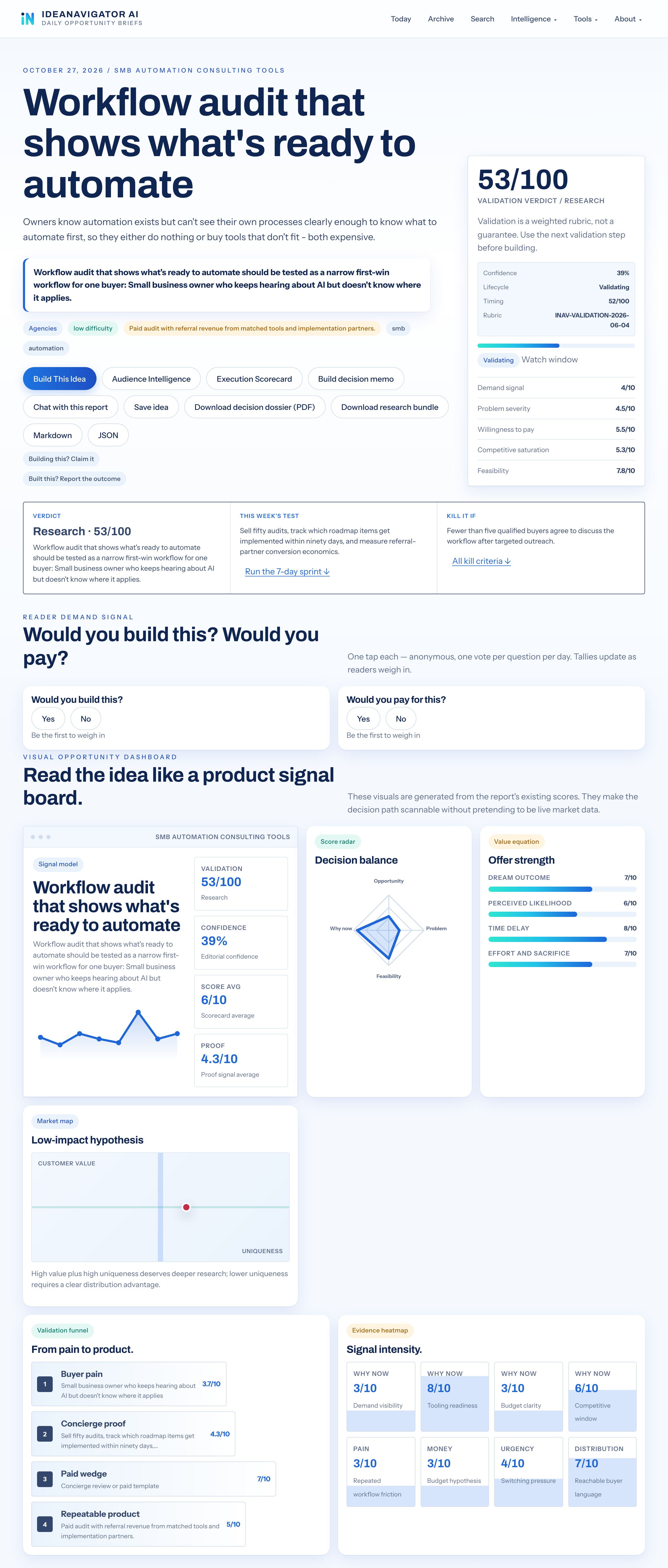
IdeaNavigator AI outlines a proposed workflow-audit product for small-business owners unsure which processes are suitable for automation. Its suggested service would map operations, score potential projects and recommend a 90-day sequence; the concept has not been validated, and the proposed test is to sell 50 audits and track implementation and referrals.
IdeaNavigator AI has proposed a paid workflow-audit service that would help small-business owners decide which tasks are ready for automation, addressing a problem the proposal identifies as growing amid the spread of AI tools. The concept is still at the testing stage: its suggested first validation is to sell 50 audits and track whether customers implement recommendations within 90 days.
The proposed service would interview a business owner about how the company operates, then turn the answers into a process map. Each process would be scored for automation readiness, potential return on investment and implementation difficulty. The customer would receive a sequenced 90-day roadmap and suggestions for tools suited to the recommended steps.
The intended customer is a small-business owner who hears about AI but is unsure where it fits in daily operations. IdeaNavigator AI’s proposal says these owners may struggle to see their processes clearly enough to choose a first project. That uncertainty can lead either to inaction or to buying tools that do not fit the work; the proposal describes both outcomes as costly, but provides no cost estimates or survey data.
The suggested business model combines a paid audit with referral revenue when customers select recommended software or implementation partners. No pricing, partner agreements or tool integrations are specified. The proposal frames the product as a narrow first offering in the small-business automation consulting market, rather than a general-purpose AI platform.
Small Business · Workflow Audit Proposal
Is Your Business Ready to Automate These Workflows?
IdeaNavigator AI proposes a paid audit to help small-business owners map their operations, prioritize automation opportunities and plan a first 90 days. The concept remains unvalidated.
From operating details to an action plan
The suggested minimum viable product is a guided audit, not a broad AI platform.
Map the work
Interview the owner about how the company operates and turn answers into a process map.
Score opportunities
Rate each process for automation readiness, potential return on investment and implementation difficulty.
Plan the first 90 days
Recommend an order of work and tools suited to the selected steps, with room to act over time.
A narrow first step for a crowded tool market
The proposal targets owners who hear about AI but are unsure where it fits in daily operations.
Describe operations
Owner shares recurring tasks and how work moves through the business.
Make processes visible
Audit organizes those details into a map of candidate workflows.
Prioritize a project
Scores help compare readiness, expected return and difficulty.
Take action
Roadmap suggests a sequence, tools and possible implementation partners.
Automation readiness is only part of the decision.
A task can be technically automatable without being worth changing. Setup, system connections, staff training and ongoing maintenance can all affect the real return.
The proposal does not yet explain how its scoring will account for those costs or predict savings accurately.
Proposal versus open questions
The service, commercial terms and evidence are still to be established.
| Area | Proposal describes | Still unknown |
|---|---|---|
| Service | Interview, process map, scores and 90-day roadmap | Launch date, availability and delivery details |
| Scoring | Readiness, potential return and implementation difficulty | Method, accuracy and treatment of setup or maintenance costs |
| Business model | Paid audit plus possible referral revenue | Price, partner agreements and compensation disclosure |
| Results | A proposed test of 50 audits | Whether customers pay, implement, save money or refer others |
Track action after the sale.
IdeaNavigator AI proposes selling 50 audits, then following customers for 90 days to see which recommended workflow changes they implement and how partner referrals convert.
Referral conversions alone would not prove the audit gives useful advice or creates lasting customer benefits.
What would make the pilot useful?
Measures need clear definitions before the first audit begins.
Is the audit already available?
The proposal does not confirm a launch or release date. It describes a minimum viable product and a plan to test demand.
What counts as implementation?
No definition is given for a successful implementation within 90 days, or how progress would be verified.
How will recommendations stay impartial?
It is unclear whether customers will see options without referral arrangements or how partner compensation will be disclosed.
How will sensitive information be handled?
The proposal does not explain interview data safeguards, scoring details or how tools will be matched to each business.
A Practical Filter for Automation Spending
The proposal targets a decision that can precede any automation purchase: identifying a real, repeatable process and deciding whether changing it is worthwhile. A structured audit could give owners a way to compare candidate workflows by readiness, expected return and difficulty, instead of choosing software simply because it is attracting attention.
For small firms with limited time and budgets, an automation project can involve more than a subscription; it may require changing procedures, connecting systems, training staff and maintaining the result. A roadmap that sequences work could help an owner plan changes over time. The proposal does not establish that its scoring method can accurately predict savings or that suggested tools will suit every business.
The proposed commercial model combines audit fees with possible referral payments. A pilot could assess whether customers implement recommendations and whether referral revenue supports the service. Referral conversions alone would not establish that the audit provides useful recommendations or produces benefits for customers.
Popular right now

KitchenAid Artisan Series 5-Quart Tilt-Head Stand Mixer, Dried Rose (KSM150PS)

Dyson V8 Cyclone Cordless Vacuum

De'Longhi Rivelia Automatic Espresso Machine with Milk Frother – White
As an affiliate, we earn on qualifying purchases.
Why Owners May Need a First Step
IdeaNavigator AI’s rationale is that the rapid growth in available AI tools has increased choice while making it harder for some owners to know what to adopt. The proposal points to guided process-mapping interviews as a possible way to turn operational details into a prioritized set of opportunities. It says large language models can automate parts of that structured interview and analysis, but offers no technical details or evidence about the accuracy of such an approach.
The concept is presented as an opportunity to test, not a launched service or a proven product. Its proposed minimum viable product is deliberately limited: interview an owner, map their processes, rate the options and provide a short implementation sequence with matched tools. That limited scope could make it possible to learn whether customers will pay for advice before building a broader software product.
The suggested validation plan is to sell 50 audits, then track which roadmap items customers implement during the following 90 days and how referrals to partners convert. Those measures could reveal whether customers act on the recommendations and whether referrals generate revenue. They would not, on their own, establish that the service produces lasting savings or improves business performance across the wider small-business market.
Product and Results Still Unproven
No evidence is provided that the audit is already available, that customers have paid for it, or that any roadmap recommendations have been implemented. The 50-audit target is a proposed test, not a reported result. There is also no stated launch date, price, target industry, or definition of what counts as a successful implementation within 90 days.
Several practical details remain open: how the interview would handle sensitive business information, how readiness and return would be scored, and how the service would distinguish a task that is technically automatable from one that is worth automating. The proposal does not explain how it would account for setup costs, ongoing maintenance, staff adoption or existing software. Those factors could change the ranking of a workflow even when the task appears suitable on paper.
The referral model is also not yet defined. It is unclear whether recommendations would include tools without referral arrangements, how partner compensation would be disclosed, or whether customers could use the roadmap without buying a suggested product. Until those points and the pilot results are known, the concept’s value and potential revenue remain unverified.
A 50-Customer Pilot Would Test Demand
The next step proposed by IdeaNavigator AI is to offer and sell 50 audits. The test would follow customers for 90 days to record which recommended workflow changes they implement, then examine the economics of referrals to software providers and implementation partners.
For that pilot to provide measurable results, the service would need to define its measures in advance. Reporting could include how many buyers complete the interview, which recommendations they act on, whether implementation requires outside help, and what costs or benefits customers report. Those details are not part of the current proposal, so no conclusions about demand or effectiveness can yet be drawn.
Further development would depend on whether owners pay for the audit and whether its recommendations lead to action. Until a pilot is reported, the service remains a proposed approach to helping small businesses decide what to automate, without demonstrated results.
Source: IdeaNavigator AI
Key Questions
What is the proposed workflow audit?
It is a proposed paid service that would interview a small-business owner, map business processes, score them for automation readiness, potential return and difficulty, and provide a sequenced 90-day roadmap with tool suggestions.
Is the audit already available?
The proposal does not say that the service has launched or provide a release date. It describes a minimum viable product and a plan to test demand, so availability is not confirmed.
How would the proposal be tested?
IdeaNavigator AI proposes selling 50 audits, tracking which recommended projects customers implement within 90 days, and measuring conversion economics from referrals to tools and implementation partners. No pilot results are reported.
How would the service make money?
The proposed model combines customer payments for the audit with potential referral revenue from recommended tools and implementation partners. Prices, partner terms and referral disclosures have not been specified.
Source: IdeaNavigator AI