📊 Full opportunity report: A Law Firm’s Guide To Using An Empty Trust Tracker on IdeaNavigator AI — validation score, market gap, and execution plan.

Get business pricing on office and shipping supplies
- Business-only prices and quantity discounts
- Tax-exempt purchasing
- Multiple users, one account, clear invoices
TL;DR
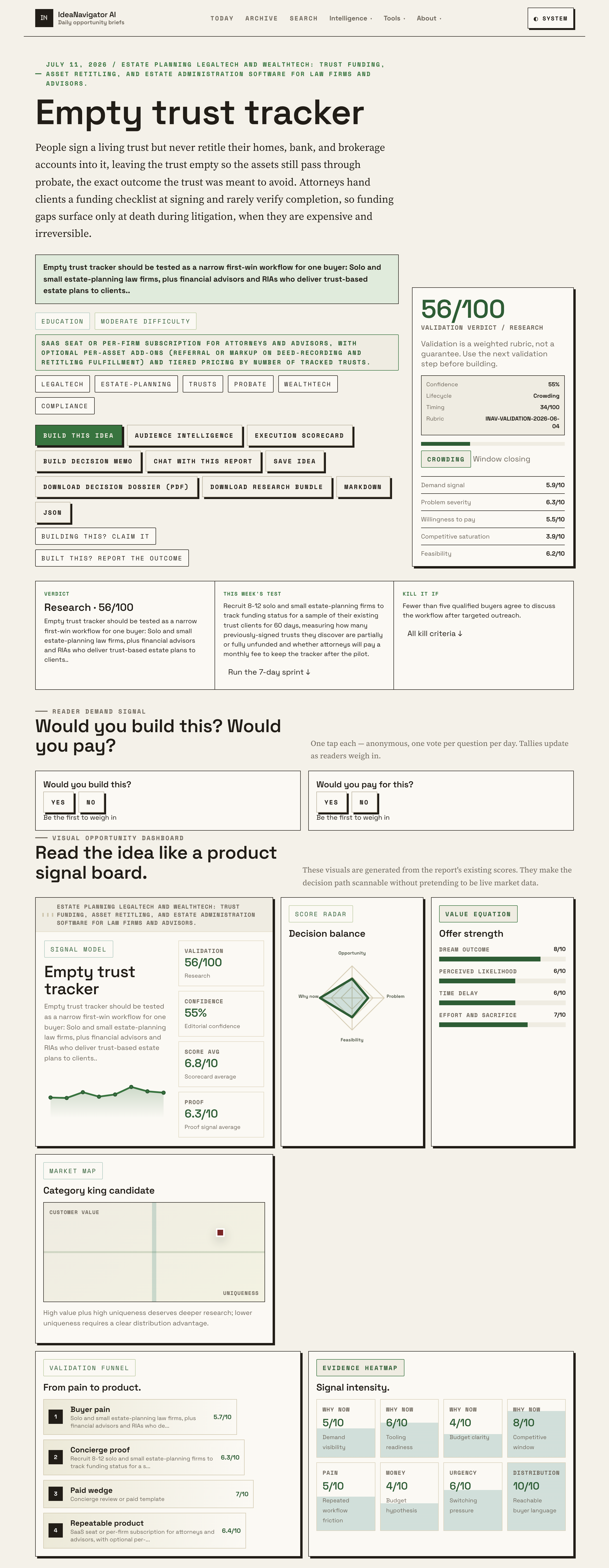
IdeaNavigator AI has outlined a proposed tracker that would help small estate-planning firms and financial advisers monitor whether clients move assets into living trusts. The concept has not been reported as a launched product; its proposed test is a 60-day pilot with 8 to 12 firms.
IdeaNavigator AI has proposed a client-by-client tracker to help small estate-planning law firms and financial advisers follow whether clients transfer assets into living trusts. The concept addresses a potential gap between signing trust documents and retitling assets, but no product launch or completed pilot is reported; the suggested next step is a 60-day test with 8 to 12 firms.
The proposed tool would let a firm create a funding checklist for each trust, covering categories such as real estate, bank and brokerage accounts, business interests, retirement assets and beneficiary designations. Staff or clients would mark each item as pending, in progress or funded, then attach supporting documents such as a recorded deed or an account statement showing a change in ownership.
Automated reminders would prompt clients to complete outstanding tasks. A firm-level dashboard would display the funding status of its trusts, including the percentage of assets marked funded. The proposal suggests this could help attorneys identify incomplete plans earlier, while clients can see which steps remain open.
The proposed commercial model is a subscription for firms or individual seats, with pricing tiers based on the number of trusts tracked. Optional fees or referrals tied to deed recording and retitling services are also suggested. These are possible revenue streams in the concept, not reported sales or an established pricing offer.
The Gap After Trust Signing
A living trust may be signed while assets remain titled in an individual’s name. If property is not transferred or otherwise coordinated with the plan, the trust may not control that property as intended. The proposal argues that the gap can leave assets subject to probate, though the outcome depends on the asset, applicable law and the estate plan.
For firms, a tracker could make follow-up visible across a client roster rather than leaving each funding checklist in a file or relying on memory. Earlier status checks may give clients time to address incomplete transfers. The concept does not establish that tracking alone prevents probate or resolves title, tax, beneficiary or legal issues; those outcomes require appropriate work on each client’s assets.
The idea also points to a potential service opportunity for advisers and law firms that want to follow through after plan delivery. Its practical value will depend on whether clients submit evidence, whether staff can review it efficiently and whether firms consider the workflow worth a recurring fee.
From Documents to Asset Funding
The proposal describes a familiar distinction in trust planning: preparing and signing documents is separate from moving assets into the trust or coordinating them with it. Funding can involve different institutions and procedures, including recording a deed or updating account ownership. The idea frames this work as manual and fragmented, and says document-drafting software does not close that follow-up gap.
IdeaNavigator AI places the concept in a 2026 market setting, citing increased interest in estate planning and digital tools. It says about 11% of Americans hold a trust, but provides no underlying study, date range or definition of “hold a trust” in the supplied description. The figure should therefore be treated as a claim in the proposal, not as independently established here.
The concept also points to deed-funding services priced from $250 as evidence of a paid market. It does not identify providers, explain what services that figure covers or document customer demand for a tracking product. Those details would matter in assessing the market beyond the proposed pilot.
Demand and Verification Remain Open
No launch, firm commitments or pilot results are reported. It is unclear whether any firms have agreed to test the tracker, what the product would cost, or how many trusts would be included. The suggested 8-to-12-firm pilot is a validation plan, not evidence that the service is already in use.
The proposal also leaves operational questions unanswered: who reviews uploaded deeds and statements, what counts as sufficient proof, how sensitive client documents would be stored, and how the tracker would handle assets whose ownership or beneficiary rules are more complex. A status marked funded would need clear criteria and review responsibility to be meaningful.
It is not yet known how often small firms encounter unfunded or partly funded trusts, whether clients would respond to reminders, or whether a dashboard would change completion rates. The proposal gives no measured results to establish that the tool would reduce probate exposure, save staff time or produce a return on subscription costs.
A 60-Day Firm Pilot
The proposed next step is to recruit 8 to 12 solo and small estate-planning firms and have them track funding status for a sample of existing trust clients over 60 days. The test would measure how many signed trusts are found to be partly or fully unfunded and whether participating attorneys would pay a monthly fee to continue using the tracker.
Any reported results would need to state how firms selected clients, how they defined funded status and what evidence they reviewed. Until a pilot is reported, the tracker remains a product concept with an untested business case.
Source: IdeaNavigator AI
Key Questions
Has the empty trust tracker launched?
No launch is reported. IdeaNavigator AI describes a product concept and a proposed pilot, without reporting a live service or completed test.
What would the tracker monitor?
It would track whether assets listed on a client’s trust-funding checklist are pending, in progress or marked funded, with documents attached as supporting evidence.
Who is the proposed product for?
The concept targets solo and small estate-planning law firms, as well as financial advisers and registered investment advisers who provide trust-based estate plans.
How would the idea be tested?
The proposal calls for a 60-day pilot with 8 to 12 firms, measuring how many existing trusts appear partly or fully unfunded and whether attorneys would pay to keep using the tracker.
Source: IdeaNavigator AI
Fall Picks
fall essentials
As an affiliate, we earn on qualifying purchases.