
📊 Full opportunity report: Rehearsing IEP Talks: A Simulator Approach For Parents on IdeaNavigator AI — validation score, market gap, and execution plan.

Get business pricing on office and shipping supplies
- Business-only prices and quantity discounts
- Tax-exempt purchasing
- Multiple users, one account, clear invoices
TL;DR
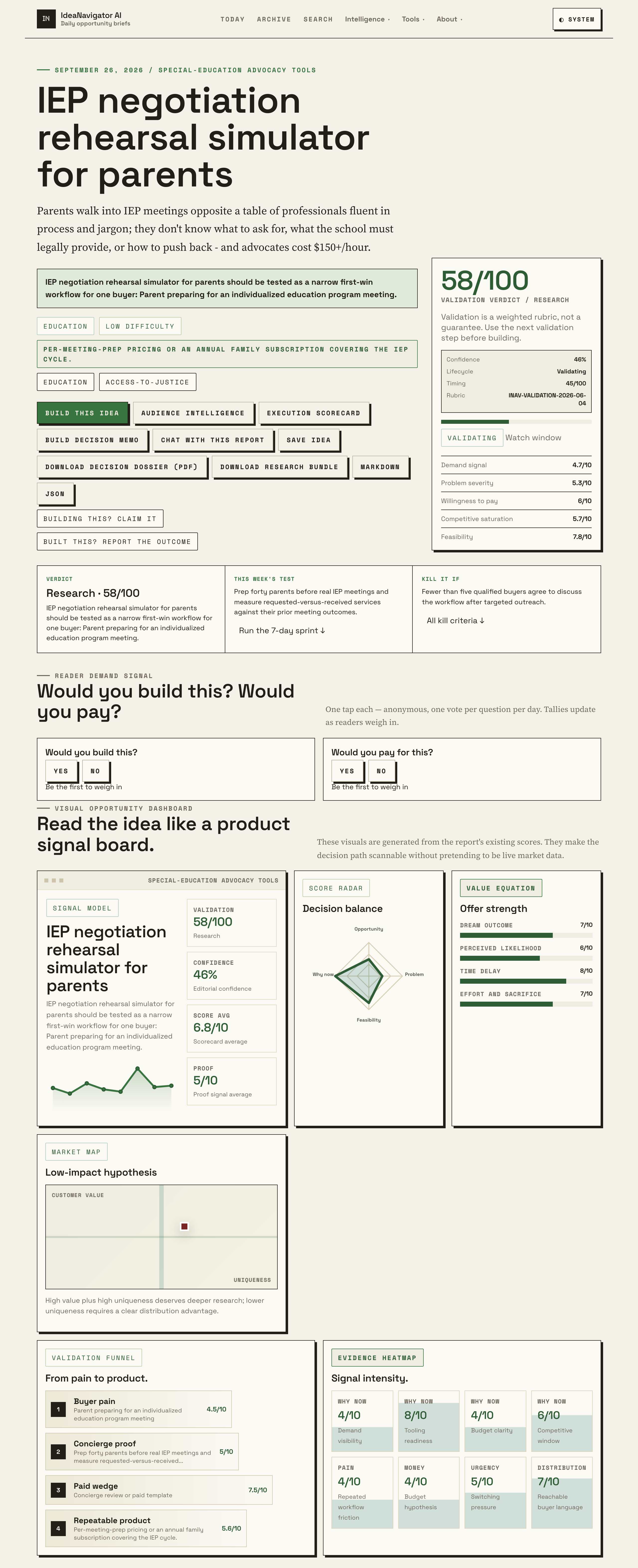
IdeaNavigator AI has outlined a proposed simulator to help parents prepare for individualized education program meetings by reviewing documents and rehearsing conversations. The concept remains at the proposal stage; no product launch, test results or measured effect on services has been reported.
IdeaNavigator AI has proposed testing a simulator that would help parents prepare for individualized education program (IEP) meetings by reviewing education records, outlining possible requests and rehearsing conversations with school staff. The proposal targets one use case—a parent preparing for an upcoming IEP meeting—but no working product, trial results or launch date has been reported.
The proposed minimum version would let a parent upload a current IEP and evaluation reports. It would then explain relevant information in plain language, create a list of possible requests with legal grounding, and simulate a meeting with realistic responses from school representatives. The stated aim is to let parents practice holding their positions before the real discussion.
IdeaNavigator AI describes the problem as a gap between parents and professionals who may be more familiar with meeting procedures and specialized terminology. It also points to the cost of private advocacy, citing rates of $150 or more per hour. That figure is part of the proposal’s rationale; no geographic range, pricing survey or independent cost analysis is provided.
The suggested business models are per-meeting preparation fees or an annual family subscription covering an IEP cycle. To assess demand and potential outcomes, the proposal recommends preparing 40 parents ahead of real meetings and comparing services requested with services received, alongside each family’s prior meeting outcomes. No participants have been reported as enrolled, and no results are available.
Preparing Parents for IEP Meetings
If built and tested, a rehearsal tool could give parents a way to practice raising concerns and responding to disagreement before meeting with school staff. Its proposed document review and role-play would combine preparation steps that families might otherwise handle through personal research or paid support. The practical value would depend on whether the guidance is accurate, understandable and useful in a real meeting.
The proposed 40-parent comparison is a starting validation plan, not evidence that the simulator improves outcomes. Comparing requested and received services could offer an initial view, but those measures alone would not establish that the tool caused any difference. Families’ needs, school decisions and meeting circumstances can vary, and the proposal does not specify how those factors would be accounted for.
A Focused First Use Case
The concept is framed as a narrow first product for parents preparing for an IEP meeting, rather than a general special-education platform. The planned workflow begins with a family’s existing documents, moves to a request list, and ends with simulated practice. IdeaNavigator AI argues that language-model role-play may now be capable of approximating a meeting, but provides no demonstration or evaluation of that capability.
The proposal also cites rising special-education identification rates and tighter district resources as reasons the need may be growing. It does not supply dates, statistics or comparisons for either trend. Those points should be treated as the proposal’s rationale, not as independently documented findings here.
Accuracy and Trial Results
Whether the simulator will be built or tested remains unclear. The proposal gives no development schedule, budget, operating organization or recruitment plan. It also does not identify which laws or jurisdictions the legal grounding would cover, or how the system would handle differences among families’ circumstances and school systems.
No evidence is presented on the accuracy of generated guidance, the quality of simulated pushback, user safety or privacy protections for uploaded education records. The proposed comparison with prior meeting outcomes also lacks details on measurement, participant selection and how changes in requested or received services would be evaluated. Those unanswered questions matter because families could rely on the tool when discussing services for a child.
Testing the Proposed Workflow
The next stated step is to prepare 40 parents for actual IEP meetings and compare the services they request and receive with outcomes from their previous meetings. The proposal does not say when recruitment or testing might begin, who would conduct the comparison, or what safeguards would apply to uploaded records. Until a trial is reported, the simulator’s availability and effect on meeting outcomes remain unknown.
Key Questions
Is the IEP meeting simulator available now?
No availability or launch has been reported. The proposal describes a product concept and a possible test.
What would the proposed simulator do?
It would review an existing IEP and evaluation reports, explain them in plain language, suggest requests with legal grounding and let a parent rehearse a simulated meeting.
Has the tool been shown to improve services?
No results are reported. Comparing requested and received services for 40 parents is a suggested validation plan, not a completed study.
How much would the service cost?
No price has been set. IdeaNavigator AI suggests charging per meeting or offering an annual family subscription.
How would the tool protect uploaded education records?
The proposal does not describe data storage, access or privacy safeguards, so those details remain unknown.
Source: IdeaNavigator AI
Fall Picks
fall essentials
As an affiliate, we earn on qualifying purchases.